
How a Korn Ferry FM Gets Supplier and Contractor Management Right
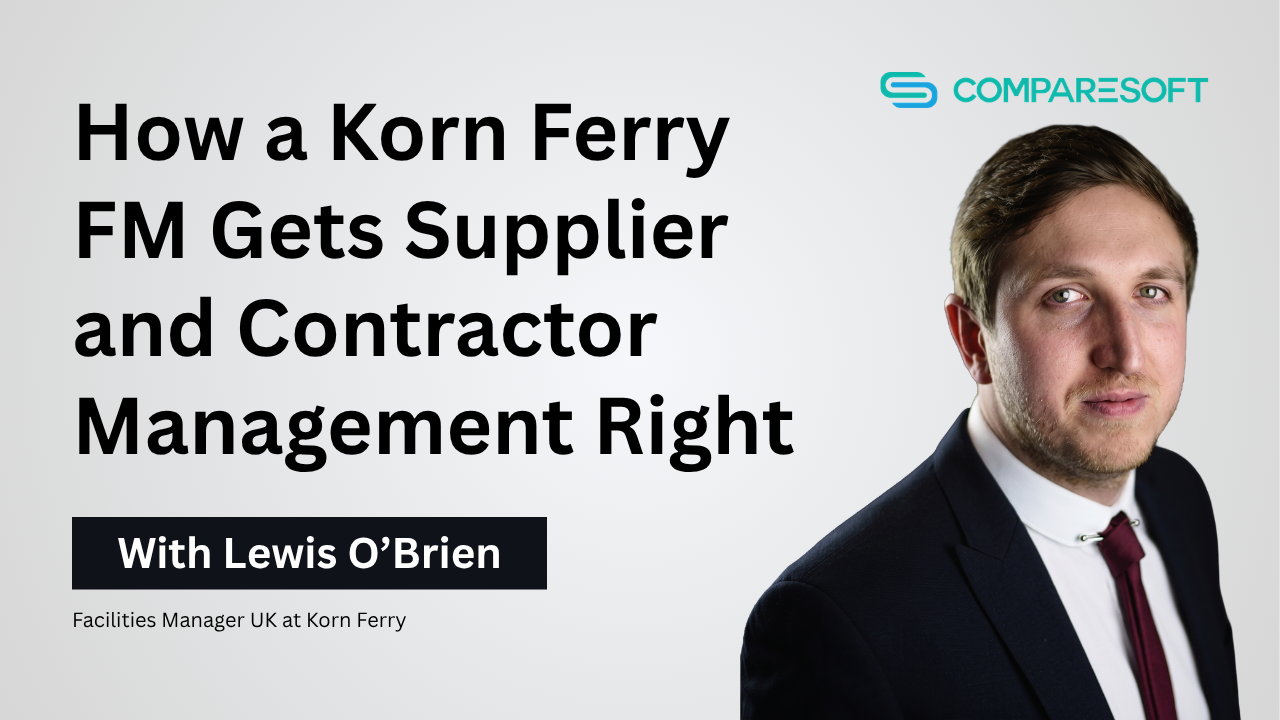
Lewis O’Brien, Facilities Manager UK at Korn Ferry, explains how he manages suppliers and contractors across the firm’s London, Manchester and Dublin offices without a dedicated system, running work orders, maintenance schedules and compliance dates on spreadsheets.
In this episode
- What Supplier and Contractor Management Looks Like Across Three Offices
- Running Work Orders and Compliance Dates on Spreadsheets
- Treating Contractors as an Extension of the Team
- Handling Work That Falls Below Standard
- How to Build a Work Order System by Extending Your IT Ticketing
- Measuring Contractor Performance, and Who Owns the Data
- Where a CAFM System Would Change the Picture
- Three Things Every FM Should Get Right About Contractor Management
Most facilities managers do not run their operation on a single, polished system. They run it on relationships, routines and spreadsheets. Around two-thirds of facility managers still use spreadsheets, and just over half of the buyers who come to Comparesoft are managing hard and soft FM tasks on spreadsheets, paper or digital forms.
Lewis O’Brien is one of them, and he is open about it. As Facilities Manager UK at Korn Ferry, he manages suppliers and contractors across the firm’s London, Manchester and Dublin offices. He started as an Operations Assistant in March 2020 before moving into the facilities manager (FM) role he holds today.
What Supplier and Contractor Management Looks Like Across Three Offices
The three offices are very different sizes, but the job does not shrink with the headcount.
“That is mainly our London office, which is our highest footfall. We have roughly a thousand colleagues coming into London, then roughly two hundred into Manchester and fifty into Dublin. Even though the office locations are smaller, it doesn’t mean the job’s any smaller.”
Underneath that sits a steady flow of requests. “In terms of tickets, I’d say in the region of twenty to thirty a week,” Lewis says, and the figure deliberately includes tickets his own team raises, so recurring problems surface in the data.
The contractor base spans the full range of hard and soft FM services: print, maintenance, cafe and coffee machines, taps, and security. Like most corporate FM teams, Lewis leans heavily on outsourcing. CBRE puts the figure at 58% of organisations fully outsourcing FM services, with a further 25% out-tasking specific functions.
“The majority is outsourced. I think people don’t realise how much we rely on contractors within facilities, and how much it becomes an extension of your team.”
Running Work Orders and Compliance Dates on Spreadsheets
There is no single platform tying contractor records, schedules and assets together. The operation runs on Microsoft Teams and a set of spreadsheets, anchored by a master plan.
“In terms of tech, we are quite old school. We don’t necessarily have a specific system, but what we’ve tried to do is use similar contractors, or the same contractor, across locations where we can.”
Consolidating suppliers across sites is a deliberate tactic. It cuts the number of relationships he manages and keeps service consistent. “So we’re dealing with one contractor for, say, the maintenance, rather than three separate ones in three different locations,” he explains.
Compliance dates live in what he calls an overarching operations plan. It is the backbone of the whole setup.
“We have an overarching operations plan where we have our key testings coming up, so PAT testing, electrical testing and health and safety audits. It’s all scheduled, so we know this month we’ve got a health and safety audit, next month ISO audits.”
PAT (Portable Appliance Testing) checks, electrical testing and ISO (International Organization for Standardization) audits are all tracked this way. Keeping it current is a manual, weekly discipline. “We have a weekly meeting where we review those pieces and go through each of the spreadsheets and just make sure that everything’s up to date,” Lewis says.
It works because the routine is enforced. The exposure is that the schedule is only ever as current as the last person to open the file.
Treating Contractors as an Extension of the Team
The strongest theme in the conversation is relational, not technical. JLL’s 2025 research puts the strength of strategic partnerships at the top of FM provider selection criteria, and Lewis builds that partnership one cup of tea at a time.
“Even though they are a contractor, I’ve had contractors that I’ve worked with for fifteen years. We offer a cup of tea, just to help build that relationship. It also means they like coming in, and they know we’re flexible with the time they come.”
That flexibility doubles as a scheduling tactic. Lewis pushes routine contractor visits to Mondays and Fridays, the quieter days, “so we’re reducing any disruption to our colleagues and to the service itself.”
It also raises the stakes on how contractors behave on site. During one office move, a contractor team waiting to be briefed had settled into the office kitchen, and a senior partner pulled Lewis aside about it.
“It really got me thinking that it’s not just the visibility of me and my team, it’s the visibility of what the contractor is doing.”
A contractor’s conduct reflects directly on the FM who brought them in. That makes the relationship valuable, and fragile.
Handling Work That Falls Below Standard
When something needs correcting, Lewis’s default is a calm conversation rather than a confrontation.
“It’s just a case of speaking to the contractor as a person. You don’t need to scream and shout. If you keep it calm and just say, guys, my senior leaders are over there, I’d really appreciate it if you could tone things down a little bit, 95% of the time they’ll go, I’m so sorry, we’ll make sure we’re quiet.”
Trust is easy to break and hard to repair, he says, especially once a senior leader has had a poor experience with a contractor you are responsible for. The same principle governs substandard work: face to face, fact-based, and free of blame.
“We would still invite the contractor in for a face-to-face meeting and try to have a constructive conversation, not pointing fingers or blame culture. It would be: here are the facts, this is the situation that occurred. I’m flagging this because we want to continue working with you, but I think we need to address these issues ahead of the next project.”
How to Build a Work Order System by Extending Your IT Ticketing
The one genuinely automated part of the operation is work order logging, which Lewis and his team call tickets. Rather than buy a tool, they extended a system colleagues already trusted.
“We piggybacked off our IT ticketing system. We were noticing more and more requests coming into inboxes, so we spoke to our IT team and said, is there any way we can extend what you’re doing to allow for facilities issues, so audiovisual, printer, access control and desk setup?”
Raising a job is deliberately frictionless. Colleagues scan a QR (Quick Response) code around the office, or raise it through the desk-booking system.
“They fill out a few small details, name, floor, what the issue is and a brief description. That sends an email to myself and my colleagues, we log in, assign the ticket, and then go through the process of actioning or assigning the work to the correct contractor.”
Building on the existing IT system solved the adoption problem before it started, which is the most transferable idea in the episode.
Because people were already used to the IT system, we weren’t introducing yet another new system they’ve got to learn. They’re already familiar with the wording, they know what a resolved ticket means. So hopefully it encourages more use of the system.
Lewis framed it as an extra channel, never a replacement for the team. Everything beyond work order logging, though, still sits outside it: “That’s all still a separate system that’s managed via the spreadsheet.”
Measuring Contractor Performance, and Who Owns the Data
Lewis does not run a dashboard, but he is clear about the numbers that matter. Response time leads.
Response time is quite a key one for maintenance and coffee machines. If we’re having to wait five days for a contractor to show up to fix the coffee machine, it’s not really at the level we would expect.
Beyond speed, he uses call-out history to find patterns, reviewed at quarterly catch-ups with the agenda set in advance.
“They provided all of the data of call-outs for the past six months. I think it was eighteen jobs over the period. Four or five of them were office moves, and a couple of the others were related to milk fridges, which lets us dive into the detail of, does that part of the machine need replacing rather than the whole thing?”
There is a detail in that answer worth pausing on. Asked whether he holds the call-out data or the contractor does, Lewis is straightforward: “No, the contractor brought it.”
That is the data ownership question, and it is becoming a live one in FM. More organisations now want to hold contractor data themselves rather than depend on suppliers to share it, on the reasoning that it is their building, their data, and their liability if the building is not compliant. Lewis’s review worked because his contractor is a good one who brought the numbers willingly. A supplier under pressure has less incentive to hand over the record of its own response times.
The upside of the data, when he does get it, is real. It is how the team’s planned preventive maintenance (PPM) schedule was built in the first place, not from a template but from history.
“That’s how we started the PPM schedule with our maintenance contracts. I went through the past six months, this is quite a regular call-out, so let’s include that. How are we for lighting, how are we for electrical repairs, and then just making a sensible schedule for when those things get done.”
Where a CAFM System Would Change the Picture
Asked whether there is a case for a Computer-Aided Facilities Management (CAFM) system, a platform that holds work orders, assets, PPM schedules and contractor records in one place, Lewis is open but non-committal.
“I think there’s always a case for most improvements. It’s just a case of getting a better understanding of what a CAFM system would actually do, and how it would fully function within the three sites that we have.”
That is an honest answer, and a common one. So it is worth setting his own stated frustrations against what a CAFM system is built to do. The gap he feels most is stitching planned maintenance together by hand across separate files.
“It’s when we have the PPMs, knowing that this has come in, ticked off and done. If there was a system where we could just go, yep, that’s been done, rather than having to go into the spreadsheet, having an automated system where someone could go, I’ve attended today, I’ve done this and this, and then it’s all in one place.”
Mapped against the capabilities buyers actually shortlist on, his manual setup lines up like this:
What Lewis does today | The limitation | The matching CAFM capability |
Work orders raised via the extended IT ticketing system | Logs the request, but does not link it to the asset or the contractor record | Job logging, scheduling and assignment against an asset register |
PPM tracked across maintenance spreadsheets and a calendar | Completion is reconciled by hand after each visit | PPM scheduling with completion tick-off on the contractor’s visit |
Contractor performance reviewed quarterly from supplier-supplied data | The contractor owns the record of its own performance | Dashboards and reporting from a single source of truth the FM controls |
PAT, electrical and ISO dates held in the operations plan | Only as current as the last manual update | Compliance checklists with automated expiry alerts and audit trails |
Three sites reviewed in a weekly meeting | No single view across London, Manchester and Dublin | Multi-site dashboard, used by over 80% of CAFM buyers who run more than one site |
Cost is the obvious next question, and one Lewis does not address. For context, CAFM entry pricing on Comparesoft ranges from £8.50 to £999 per month depending on team size and feature depth. Set against that, reactive maintenance runs 3 to 5 times the cost of preventive work, and 49% of maintenance activity globally is still reactive. If a spreadsheet-run PPM schedule slips, that premium is what you pay for it.
Three Things Every FM Should Get Right About Contractor Management
Asked what he would tell a new facilities manager, Lewis offers three principles. The first is to treat contractors as part of the team, because it earns you goodwill you can draw on.
“Looking at them as that extension to your team really helps build a partnership. If you’ve got a little job you didn’t raise before, you can say, sorry, while you’re here, do you mind just looking at that?”
The second is to set expectations at the start of the relationship, not months in, once a problem has taken hold.
“It’s hard, six months down the line, to say this isn’t up to scratch when you haven’t set your expectations. It gives you a lot better standing if you’re having those conversations at the start of the relationship.”
The third is the one FMs forget most often. When a contractor does good work, say so, and tell their employer too.
“Yes, you are paying them to do a job, I get that, but it really does create a good relationship when you let the management team of their company know they’ve done a really good job. We have a fantastic cleaner who is here day in, day out. Being able to tell the company she’s fantastic, and they’ve given her vouchers and certificates, just improves the service, the environment and the culture.”
What Type of Facilities Do You Manage?
Meet the Speakers

Lewis O’Brien
Facilities Manager UK at Korn Ferry
Facilities Manager at Korn Ferry UK covering London, Manchester and Dublin offices.

Ryan Condon
Head of Content
Podcast Host and Head of Content of Comparesoft, joining the team in 2019.

Latest Facilities Management Podcast Episodes
What FMs Need to Get Right First: Team, Tools & Knowledge
Rachael Lawton shares practical advice for new and entry-level facilities managers. Drawing on more than two decades in FM, Rachael explains why you do not need an expensive Computer-Aided Facilities Management (CAFM) system to run an estate well. She leads a team of 24 on SharePoint, spreadsheets and a ticketing tool.
Listen and Watch the Podcast →
Running a PPM Schedule Across 80+ Stations at First Rail London
Marianne Martin, PPM and Statutory Compliance Manager at First Rail London, explains what it takes to build and manage a planned preventive maintenance (PPM) schedule across more than 80 London Overground stations, sidings and depots.
Listen and Watch the Podcast →
Leading Facilities Management at Ocado Retail
Lisa Assiotes, Facilities Manager at Ocado Retail, shares how she built an in-house FM function from scratch, how a small team works with an integrated service provider, and where AI is streamlining FM tasks.
Listen and Watch the Podcast →Find the Right Facilities Management Software for Your Site
Whether you're managing work requests from a loading bay or tracking contractor performance across multiple buildings, the right FM software should work the way you do. Compare tools built for facilities managers in just 40 seconds.