
Making Legacy-to-Cloud Public Sector ERP Transformations Stick
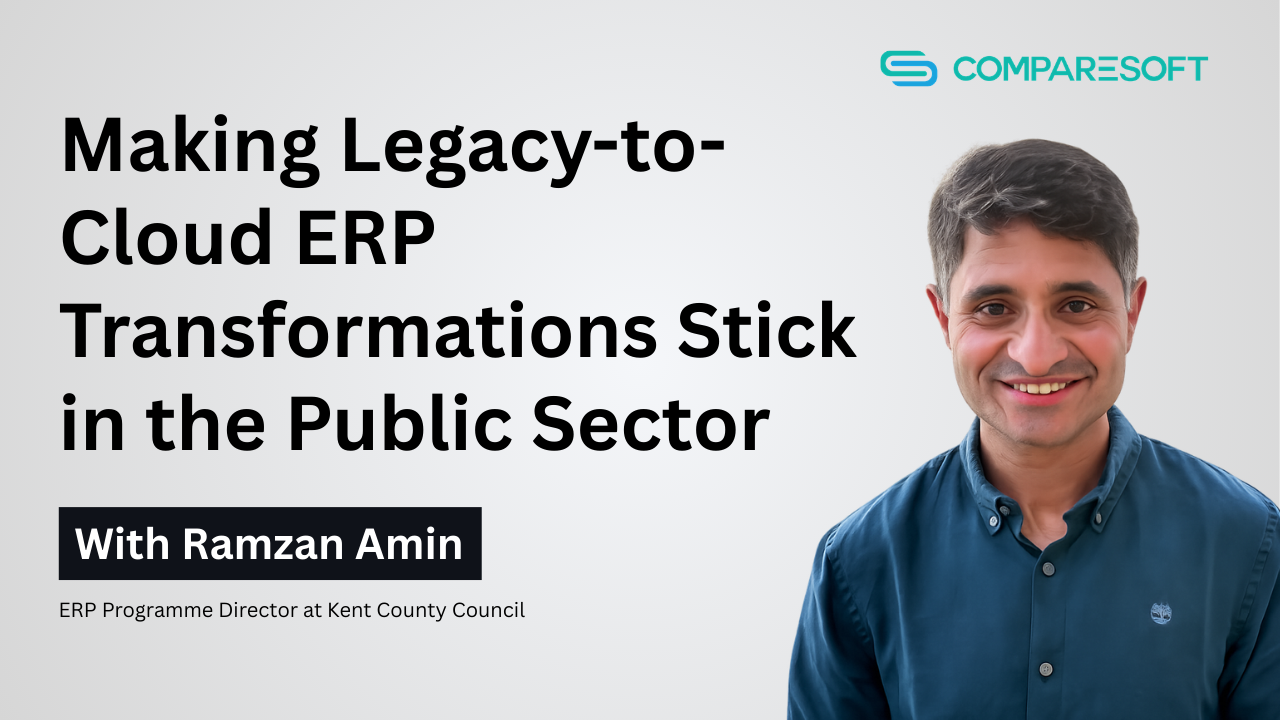
Ramzan Amin, Founder and CEO of SIM Consulting, joins the Comparesoft ERP Podcast to draw on his experience as ERP Programme Director at Kent County Council and explore why public sector organisations are being pushed to replace ageing ERP systems.
In this episode
- Why Councils and Government Organisations Are Moving Their Public Sector ERP from Legacy to Cloud
- How Public Sector ERP Transformation Is More Than a Technology Upgrade
- What Happens When the Wrong Public Sector ERP System Is Selected
- Why Change Management Defines Public Sector ERP Success or Failure
- How Shortlisting the Best Public Sector ERP Software Differs from the Private Sector
- Lessons CEOs and CFOs Can Take from Birmingham City Council’s Public Sector ERP Failure
- Reducing Risk in Public Sector ERP Delivery with Automation and AI
- Why Business Ownership After Go-Live Decides Whether Public Sector ERP Transformation Sticks
Why Councils and Government Organisations Are Moving Their Public Sector ERP from Legacy to Cloud
Councils across the UK are running legacy Enterprise Resource Planning (ERP) systems that are ten to twenty years old. These platforms are expensive to maintain, difficult to secure, and increasingly unsupported by vendors. For most public sector organisations, moving to cloud ERP is not about chasing new features. It’s about removing the constraints that prevent clarity, control, and agility.
In this episode of the Comparesoft ERP Podcast, Ramzan Amin, ERP Programme Director at Kent County Council, explains what is really driving public sector ERP transformation, where programmes lose control, and what leaders must get right to make legacy-to-cloud change stick.
The operational pressures forcing transformation include:
- Rising running costs: Maintaining ageing, bespoke platforms and infrastructure that no longer deliver value
- Security exposure: Systems that are increasingly difficult to patch, monitor, and modernise
- Supplier support: Legacy platforms becoming unsupported, with specialist expertise drying up
- Workarounds and shadow systems: Spreading across spreadsheets and bolt-on tools as teams work around system limitations
- Slow decisions and poor visibility: Fragmented or delayed data undermining confidence in reporting
- Weak control and audit confidence: Processes relying on manual checks and inconsistent practices
- Inability to change processes quickly: Expensive, multi-year upgrade cycles that prevent agility
As Ramzan explains, organisations on legacy platforms often do not know what good looks like anymore. They build shadow systems and manual workarounds, and the technology landscape becomes increasingly complicated.
The real drivers are not about replacing old software. They are about restoring faster decisions, better embedded controls, and the ability to change processes without multi-year implementation cycles.
How Public Sector ERP Transformation Is More Than a Technology Upgrade
Large-scale public sector ERP programmes are often framed as IT projects. In reality, they are business transformations. Modern ERP technology is business-oriented, focused on how the organisation can make better choices, change cultural habits, and streamline decision-making.
When processes are sleek and streamlined, teams get better business intelligence. Leaders can identify problems faster, redirect resources, and stop investing in processes that are no longer effective.
The technology is an enabler. The real transformation happens in how people work, how decisions are governed, and whether the organisation is prepared to adopt standard ways of working rather than rebuild the old world in a new system.
What Happens When the Wrong Public Sector ERP System Is Selected
One of the most difficult challenges Ramzan describes is stepping into programmes after an ERP system has already been selected. At that point, reversing the decision is rarely practical. Money has been spent, timelines committed, and expectations set.
Ramzan has experienced situations where he believed the selected product was not the right fit for the organisation’s size and complexity. In one case, a large global organisation had chosen a product that lacked the maturity and scalability of alternatives better suited to their scale. With significant spend already committed and the programme underway, the only practical course was to continue.
The focus then shifts to governance and decision-making discipline. The real risk is not the technology itself, but blurred ownership and delayed trade-offs. When decisions become consensus-driven or politically sensitive, programmes drift.
Successful public sector ERP programmes require clear authority, fast decisions, and a willingness to enforce standard ways of working. These are the critical success factors that separate programmes that deliver from those that stall. Ideally, independent advisory support is brought in before selection, where a proper open-market tender process will deliver the right answer.
Why Change Management Defines Public Sector ERP Success or Failure
ERP failure is often measured in scope creep, cost overruns, or delays. Ramzan argues this misses the real issue. A programme fails when the organisation reverts to old behaviours after go-live.
If people are not brought along, trained, and supported to change how they work, a modern ERP system simply becomes an expensive version of the old one.
Ramzan describes a resistance scale that exists in every programme:
- Early adopters: Enthusiastic users who are desperate to get their hands on the new system
- The persuadable middle: Sceptical but open to being won over with the right engagement
- Persistent resistors: Those who will not change regardless of what is shown or explained
His approach is to start with explanation and engagement, framing the change as an opportunity rather than a threat. Where resistance persists and risks contaminating other parts of the programme, leaders must be prepared to make hard decisions. That includes removing disruptive individuals to protect adoption across the wider organisation.
Change management is not a phase at the end of the project. In the public sector, it must be continuous, visible, and backed by senior ownership. Resistance ignored early can quietly undermine adoption across entire departments.
How Shortlisting the Best Public Sector ERP Software Differs from the Private Sector
Unlike commercial organisations, councils operate under intense public scrutiny. Decision-making is slower, governance is more complex, and failure has reputational and political consequences.
In the private sector, there is typically a clearer commercial driver and a higher tolerance for rapid change. In local government, ERP transformation must balance commercial drivers alongside statutory duties, public accountability, political governance, and intense financial scrutiny.
Ramzan, who moved into the public sector from a private sector background, acknowledges this was an eye-opener. The consequences of failure become public, and anything in the public domain creates its own cycle of attention that is hard to undo. Councils must go through additional checks and balances that the private sector does not face, but those checks exist for good reason.
This makes public sector ERP procurement fundamentally different. Shortlisting is less about speed or preference and more about fit, scalability, and long-term operating cost.
At Kent County Council, Ramzan led a structured process that included business case development and pre-selection planning, soft market assessment against defined criteria, and a scoring process that weighed pros and cons. Out of four to five products assessed, the field was narrowed to two options: a hybrid multi-vendor approach and a single end-to-end platform.
The single platform was selected. Two factors drove the decision:
- A specific requirement around multiple assignments in the HR module that only one product could deliver out of the box
- The recognition that a hybrid approach would create more integration complexity and a higher total cost of ownership
Lessons CEOs and CFOs Can Take from Birmingham City Council’s Public Sector ERP Failure
The widely reported challenges at Birmingham City Council are often cited as a cautionary tale. Current costs have risen to £144 million over a five-year delay. Ramzan’s view is that no single mistake caused the outcome. Multiple issues accumulated over time.
Based on what Ramzan highlighted in the episode, the failure signals included:
- Weak governance and unclear accountability early in the programme, leaving no single owner with the authority to enforce decisions
- Blurred decision-making, where hard trade-offs were delayed or avoided, allowing problems to drift
- Attempts to replicate the old world in the new system, instead of adopting standard, out-of-the-box ERP processes
- Insufficient ownership of outcomes, meaning business leaders did not consistently step in to stop legacy behaviours being rebuilt
- Too many competing voices, which diluted control and created inconsistency in how the programme was directed
Ramzan is direct about what he would do if stepping into a similar situation: start from scratch. Establishing clear governance, defined ownership, and firm operating principles from the outset is more effective than trying to recover a programme after decisions have already compounded.
The lesson for other councils is clear. Loss of control usually starts early, long before problems become visible. There must be one person accountable. Without ownership, things drift, people make their own decisions, and those decisions are often not the right ones.
Reducing Risk in Public Sector ERP Delivery with Automation and AI
There is a great deal of noise around AI in ERP implementations. Ramzan is clear about where its value lies, and where it does not. The biggest risk is assuming AI replaces discipline. It does not.
SIM Consulting’s no-code, AI-based Testify platform was designed to remove human error and fatigue from the parts of ERP implementations that are repetitive, high-volume, and time-critical. Testing and validation are the primary focus.
Testify allows teams to automate manual testing scenarios using AI prompts rather than technical scripting. A business user describes the scenario they need to test, and the tool designs, executes, and reports on it. No coding skills are required.
It captures key ERP scenarios such as:
- Procure-to-Pay
- Payroll cycles
- Financial postings
These run repeatedly overnight or during off-hours, so teams can focus on improving business operations rather than manual testing.
The benefits extend beyond speed. By lowering the barrier to testing, Testify helps close skills gaps that commonly slow public sector ERP programmes. It integrates with tools like JIRA for reporting, and supports data profiling and cleansing, often one of the most resource-intensive parts of any ERP implementation.
Automation supports discipline. It does not replace it. For public sector leaders, the message is simple: legacy-to-cloud ERP transformation is not about technology alone. It is about ownership, governance, and making change stick long after go-live.
Why Business Ownership After Go-Live Decides Whether Public Sector ERP Transformation Sticks
When asked to identify the single control point that decides whether a legacy ERP replacement sticks long term, Ramzan’s answer is clear: business ownership after go-live.
A transformation succeeds when accountability moves decisively from the programme team to the business. That means the organisation has invested in taking over the system, understanding its processes, and building internal capability (such as a centre of excellence) to maintain and evolve it. Ongoing reliance on system integrators or external consultants is a sign that ownership has not transferred.
The journey does not end at go-live. Ramzan estimates it can take 6 to 12 months for a large-scale change to embed properly. Every quarter brings new updates and features through cloud releases. The change process continues.
Organisations that treat go-live as the finish line, rather than a milestone, risk losing the value they worked to build.
For councils and public bodies evaluating their own public sector ERP transformation, the takeaway is practical: invest in ownership early, govern decisively, and plan for a change journey that extends well beyond launch.
What are You Looking to Improve with ERP?
Meet the Speakers

Ramzan Amin
ERP Programme Director at Kent County Council
Leading the council’s enterprise-wide ERP transformation programme, modernising Finance, HR, Procurement, and Payroll systems to enable digital-first operations and improved citizen services.

Ryan Condon
Head of Content
Content architect and strategist at Comparesoft, helping software buyers make confident decisions through purposeful, well-structured content. Podcast Host and Head of Content since joining the team in 2019.

Shortlist & Compare Public Sector ERP Software
Find ERP systems built for councils, government bodies, and regulated public sector organisations. See verified pricing, real features, implementation timelines, and authentic reviews from public sector buyers. Takes just 40 seconds. Save up to 33% on ERP costs.