
Making Legacy-to-Cloud Public Sector ERP Transformations Stick
Ramzan Amin, Founder and CEO of SIM Consulting, joins the Comparesoft ERP Podcast to draw on his experience as ERP Programme Director at Kent County Council and explore why public sector organisations are being pushed to replace ageing ERP systems.
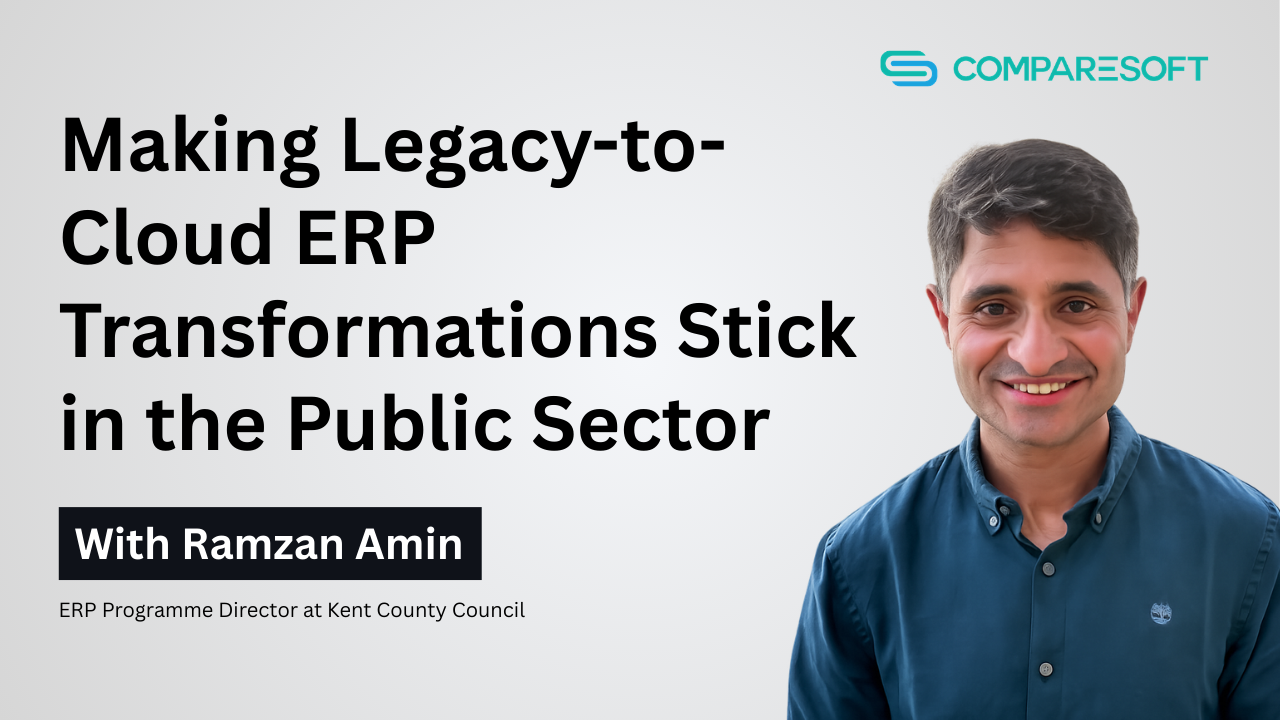
Why Councils & Government Organisations Are Moving Their Public Sector ERP from Legacy to Cloud
Public sector ERP transformation is rarely driven by ambition or innovation agendas. Instead, it’s being forced by urgent operational realities:
- Rising running costs: Maintaining ageing, bespoke platforms and infrastructure
- Security exposure: Systems become harder to patch, monitor, and modernise
- Supplier support: Legacy platforms become unsupported or expertise dries up
- Workarounds and shadow systems: Spread across spreadsheets and bolt-on tools
- Slow decisions and poor visibility: Data is fragmented or delayed
- Weak control and audit confidence: Processes rely on manual checks and inconsistent practices
- Inability to change processes quickly: Expensive, multi-year upgrade cycles
In this episode of the Comparesoft ERP Podcast, Ramzan Amin, ERP Programme Director at Kent County Council, explains that most public sector organisations do not start out looking for cloud ERP. They start out trying to remove constraints.
Legacy systems limit visibility, slow decision-making, and encourage workarounds that fragment data and control. Moving to cloud ERP is often the only viable path to restoring clarity, agility, and resilience.
What Happens When the Wrong Public Sector ERP System Is Selected?
One of the most difficult challenges Ramzan describes is stepping into programmes after an ERP system has already been selected. At that point, reversing the decision is rarely practical as money has been spent, timelines committed, and expectations set.
Instead, the focus shifts to governance and decision-making discipline. The real risk is not the technology itself, but blurred ownership and delayed trade-offs. When decisions become consensus-driven or politically sensitive, programmes drift.
Ramzan stresses that successful public sector ERP programmes require clear authority, fast decisions, and a willingness to enforce standard ways of working rather than recreating legacy processes in a new system.
Shortlist the UK’s Best Public Sector ERP System That Matches Your Legacy-to-Cloud Transformation Requirements
What Do You Need An ERP Software For?
Why Change Management Defines ERP Success or Failure
ERP failure is often measured in scope creep, cost overruns, or delays, but Ramzan argues this misses the real issue. A programme fails when the organisation reverts to old behaviours after go-live. If people are not brought along, trained, and supported to change how they work, a modern ERP system simply becomes an expensive version of the old one.
Change management is not a phase at the end of the project. In the public sector, it must be continuous, visible, and backed by senior ownership. Resistance that is ignored early can quietly undermine adoption across entire departments.
How Shortlisting the Best Public Sector ERP Software Differs from the Private Sector
Unlike commercial organisations, councils operate under intense public scrutiny. This means decision-making is slower, governance is more complex, and failure has reputational and political consequences. Ramzan explains that while this can feel restrictive, it also reflects the need for stronger evidence, audit trails, and accountability.
This context makes public sector ERP procurement fundamentally different. Shortlisting is less about speed or preference and more about fit, scalability, and long-term operating cost.
Lessons CEOs and CFOs Can Take from Birmingham City Council ERP Failure
The widely reported challenges at Birmingham City Council are often cited as a cautionary tale, with current costs rising to £144M over a five-year delay. Ramzan’s view is that no single mistake caused the outcome. Instead, multiple issues accumulated over time.
Based on what Ramzan highlighted in the episode, the failure signals included:
- Weak governance and unclear accountability early in the programme, leaving no single owner with the authority to enforce decisions
- Blurred decision-making, where hard trade-offs were delayed or avoided, allowing problems to drift rather than be resolved
- Attempts to replicate the old world in the new system, instead of adopting standard, out-of-the-box ERP processes
- Insufficient ownership of outcomes, meaning business leaders did not consistently step in to stop legacy behaviours being rebuilt
- Too many competing voices, which diluted control and created inconsistency in how the programme was directed
- The lesson for other councils is clear. Loss of control usually starts early, long before problems become visible.
Reducing Risk with Automation and AI
Finally, Ramzan discusses how SIM’s no-code, AI-based Testify platform is helping reduce risk in ERP delivery. By automating high-volume, repetitive testing and validation tasks, organisations can close skills gaps, reduce human error, and maintain confidence through frequent cloud updates.
Importantly, automation supports discipline; it does not replace it. For public sector leaders, the message is simple: Legacy-to-cloud ERP implementation is not about technology alone; it is about ownership, governance, and making change stick long after go-live.
What are You Looking to Improve with ERP?
Meet the Speakers

Ramzan Amin
ERP Programme Director at Kent County Council
Leading the council’s enterprise-wide ERP transformation programme, modernising Finance, HR, Procurement, and Payroll systems to enable digital-first operations and improved citizen services.

Ryan Condon
Head of Content
Content architect and strategist at Comparesoft, helping software buyers make confident decisions through purposeful, well-structured content. Podcast Host and Head of Content since joining the team in 2019.

Easily Shortlist & Compare ERP Software
Discover ERP systems for your accounting, sales, manufacturing, operations and delivery processes. See verified pricing, real features, realistic implementation plans & authentic erp reviews. Takes just 40 seconds. Save up to 33% on ERP costs.