
SAP & Oracle ERP Implementation In Aerospace
Doug Hanson shares what four decades and more than 25 deployments taught him about ERP selection and implementation, leading SAP and Oracle rollouts at Honeywell Aerospace and B/E Aerospace.

In this episode
- From MRP II to Modern ERP: Four Decades in Aerospace
- Treat ERP Selection as Business Process Change, Not an IT Project
- Lessons From a Large-Scale Aerospace ERP Deployment
- How to Select the Right ERP System
- SAP vs Oracle: Choosing an ERP Platform That Fits
- How to Build an ERP Deployment Team
- Why a Governance Board Holds ERP Implementation Together
- In-House Teams vs External ERP Consultants
- How AI Is Changing ERP Implementation
- Three Pieces of Advice for First-Time ERP Leaders
Doug Hanson started as a Fortran programmer at McDonnell Douglas, spent nearly 17 years at Honeywell Aerospace, and led a multi-site Oracle deployment at B/E Aerospace. Across his career he ran more than 25 Enterprise Resource Planning (ERP) deployments on SAP and Oracle, most of them in aerospace and defence manufacturing.
Now that he is retired, Doug can say what serving executives usually cannot. In this episode of the Comparesoft ERP Podcast, he explains how to select the right ERP system, how to build the team that deploys it, and why the decision that matters most happens before anyone looks at software.
From MRP II to Modern ERP: Four Decades in Aerospace
Doug’s career predates the term ERP. He came up through its ancestor, and learned the software by taking it apart.
“Back when the dinosaurs roamed the earth, there wasn’t ERP,” he says. “MRP is Material Requirements Planning, the predecessor to ERP. I started out as a Fortran programmer, and kind of backed my way into some business software called ASK ManMan, MRP II. I learned how to modify it, and wound up in aerospace.”
Small MRP II systems gave way to modern ERP, and Doug moved from writing code to running the Project Management Office (PMO), the team that governs delivery. If you are new to the field, it helps to understand the shift from MRP II to modern ERP before you weigh up platforms. That vantage point taught him where success comes from, and it is rarely the software. “Most importantly, you’re making sure the C-level staff have got their heads screwed in straight and they’re on the same page,” he says.
Treat ERP Selection as Business Process Change, Not an IT Project
This is the argument Doug returns to more than any other. Before you shortlist a vendor, you have to decide what kind of project you are running.
“It’s not really a software project. It’s not IT jamming a solution down the throat of the business,” he says. “It’s really a process transformation journey. And the C-level staff need to support, and completely honour, that your processes are going to change.”
He points first-timers to an unlikely reference. “One of the books that comes to memory is Who Moved My Cheese,” Doug says. “It’s not a software book. It’s a book about change management.” That instinct is right, and getting ERP change management in place early is what separates adoption from expensive resistance.
His warning to anyone about to start is blunt. “If your C-level staff think this is an IT project, and not a business process transformation, go find a new job,” he says. “You are going to fail.” The mistake shows up in the questions leaders ask. “They’d say, what will it cost to make SAP do this process? That’s the exact wrong question,” he recalls. “The first thing you need to do is decide what your goals are. How are you going to measure success? What differentiates you as a business?”
For Doug, IT has to sit inside that conversation. “The project is owned by the business, not by IT. It’s a true partnership,” he says. “If your culture doesn’t have IT a seat at the table making business decisions, you’re going to have a train wreck.”
Lessons From a Large-Scale Aerospace ERP Deployment
The deployment Doug points to as proof is Honeywell Aerospace, where the early stages were hard and the payoff took years.
“They started a journey in the very early 2000s. SAP was chosen, with great leadership support,” he says. “The first three or four deployments were kind of rough. We were struggling to get the software configured correctly, the data conversion wasn’t mature enough, and change management was a little out of whack. But they did go live.”
What happened next is the part leaders rarely stay long enough to see. “Fast forward 10, 15 years, and it totally transformed the company. It made it profitable,” Doug says. He is honest about the cost. “It wasn’t without pain. The scale was thousands of end users, and tens of millions of dollars.”
How to Select the Right ERP System
Ask Doug how to select an ERP system and he starts with how not to do it. The old blueprinting model spent fortunes before anyone saw working software.
“You’d spend millions of dollars blueprinting before you even had anything,” he explains. “Then you’d hand it to expensive consultants to configure, find problems, and go back and change the blueprint. That’s a really expensive way to do it.”
His alternative is to get working software in front of people fast. “A better way is just go fail fast. Implement a solution with pre-configured standard models, load some software and see what’s broken,” he says. “The earlier you get it in, the faster your internal teams learn the platform.”
That works only if you accept a truth many businesses resist. “You’d be surprised. 80% of what you need comes straight out of the box, probably more if you’re a smaller company,” Doug says. “There’s strong personalities in every business, and they think their process is so unique. Well, there aren’t any unique businesses, hardly ever.”
The lesson is to pick software built for your operating model, then adopt its processes. “If you’re manufacturing or shipping something, somebody’s built a great model for you already,” he says. “Pick software that caters to your business and your flows.” His method is a short, disciplined gap analysis, running the out-of-the-box processes against what you do today and defaulting to standard unless the governance board signs off on a change. That discipline matters most in complex sectors, which is why buyers looking at ERP for manufacturing should map real requirements against standard functionality first.
SAP vs Oracle: Choosing an ERP Platform That Fits
Doug has deployed both dominant platforms, so his view comes from delivery, not a sales deck. His loyalty is clear, and so are its limits.
“SAP runs through my blood. Back in the R/3 days it was infinitely configurable, the most capable platform,” he admits. “The problem was, 25 years ago it wasn’t affordable for the mid-cap and small-cap. SAP has a rightful place with large companies that want to define their industry. Most companies aren’t like that.”
For everyone else, he sees a market full of strong, industry-specific options. “There are so many good pieces of software out there. You don’t have to redefine your processes, they’ll tell you what they need to be,” he says. He adds a warning aimed at first-timers. “SAP will come at you hard with sales. They’ll sell over people who don’t understand what they’re getting into. So bring somebody in to read the tea leaves.”
How to Build an ERP Deployment Team
Once the platform is chosen, the deployment team decides everything, and its size has to match the business. A mid-size company cannot free up the people a large one can.
“A 50 million dollar business can’t take six or eight people out for a year,” Doug says. “So you’ll share. Maybe somebody is dedicated 20 hours a week, mornings for project work, afternoons for the day job, and a bonus when it goes live.” Large deployments are different. “On bigger companies, absolutely 100% dedicated staff. And that’s probably their job for the next three years, through deployment, hyper care and cleanup fixes.”
He structures the team around functional areas, then sizes each to the business, starting with finance, order management, manufacturing, supply chain and engineering on the org chart and adding people where the volume sits. Mapping roles to modules like this is one of the least glamorous but most important parts of ERP implementation.
His advice on who to pick is counterintuitive. The obvious expert is often the wrong choice. “It’s often not the supervisor or manager of that area. They might be the biggest nightmare you ever had,” Doug says. “They’re great at running their legacy process, but hell bent against changing anything, because they built it. Look at who the shooting star is, maybe someone who graduated three years ago but is eager to make this new platform work.” The stakes justify the effort: “if you get one dissenter in a group of 10, it’ll train wreck the whole project.”
Why a Governance Board Holds ERP Implementation Together
The thread connecting selection, implementation and adoption is a governance board that owns the hard decisions. Doug treats forming it as the first real move.
“As a PMO lead, I’d insist a governance board sits over the top of the project team,” he says. “It needs the right level of people who can make decisions, and it needs to meet periodically.” That board owns any change to the software. “Nobody approves enhancements or customisations, and it’s not the integration partner you met last week. It’s the business. If it blows up, it’s their fault, so you’d better learn what’s going on.”
He is practical about recording those decisions. “Any decision made by the governance board, track it. It’s as simple as a spreadsheet, so it’s referred to if it comes up again.” When something is going wrong, he handles it privately first, taking the issue to the functional leader before it surfaces in a meeting. And when a board stalls, he sets a clock. “Up until you go live, you can change just about anything. So give time limits, then the designated project leader makes the decision and moves on.”
In-House Teams vs External ERP Consultants
Doug sees a clear role for external consultants, along with a clear trap. Their independence is what makes them useful. “They’re experts. They can look you in the eye and say, that’s a stupid process, we’re going to fix that. There’s no pride of ownership,” he says. He also ties their fee to delivery with milestone incentives, holding back a share until the first site is live.
The risk is dependency, so he prefers to keep expertise in the business. “I’d prefer internal functional analysts, not techie programmers, but experts in their area who can do first-line support,” Doug says. His rule when consultants are in the building is simple: “make them teach you what they’re doing. When something breaks, you’re more qualified to fix it.”
How AI Is Changing ERP Implementation
Doug is enthusiastic about where artificial intelligence (AI) is already helping, and specific about it. The wins are in the heavy, repetitive parts of a deployment. “Data migration is often a heavy lift, and AI is great at that. Data mapping, sensing anomalies, restructuring things,” he says. “There are wonderful ways to have AI generate test scripts and load testing.” Reporting is another, with a connected model producing a customer report in seconds.
His forward-looking point is about data access. He favours a replication database, a near real-time copy of production, so analysis never threatens the live system. “Turn your AI tools loose on that, not your production data,” he says. “If your business strategy is to do AI, and if it’s not, you’re probably not going to survive. But make sure you’re not violating any software licence you signed.” Comparesoft’s guide to AI in ERP covers where the technology is ready today.
Three Pieces of Advice for First-Time ERP Leaders
Asked what he would tell an IT leader running their first implementation, Doug gives three answers that map onto everything above.
The first is relationships. “Have great relationships with the senior people who run those functions. You ought to be able to pick up the phone anytime and talk to leadership,” he says.
The second is people, held to a high bar. “Insist on the best people for the team,” Doug says. “When someone nominated a team member, I wanted to know their performance rating and how long they’d been there. I’d interview them like a job, and ask what they thought about everything changing.”
The third is proximity. “There’ll be long hours, but it’s rewarding,” he says. “You’ll go down on the factory floor and watch them ship a product. Stay that close to the team and the processes.”
What are You Looking to Improve with ERP?
Meet the Speakers

Doug Hanson
IT & ERP Director
Former ERP Director at Honeywell Aerospace, B/E Aerospace & Polyconcept NA.

Ryan Condon
Head of Content
Podcast Host and Head of Content at Comparesoft.

Prasanna Kulkarni
Founder, Product Architect & CEO
Product Architect and Founder of Comparesoft.

Latest ERP Podcast Episodes

Running Microsoft Dynamics ERP at Alpine F1 Team
Jaco Schutte discusses selecting, implementing and running the technical and functional design of Microsoft Dynamics 365 Finance and Operations inside Alpine Formula One Team for a team of 900 people.
Listen and Watch the Podcast →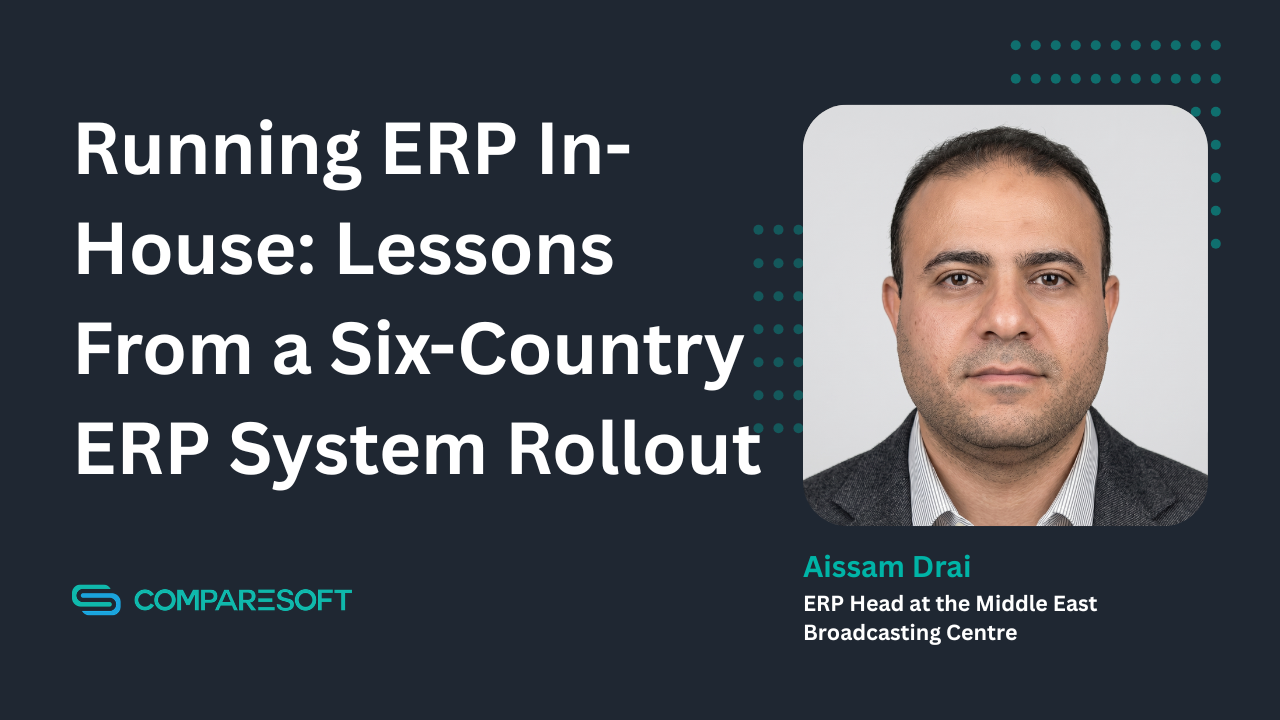
Running ERP In-House: Lessons From a Six-Country ERP System Rollout
Aissam Drai, ERP Head at the Middle East Broadcasting Centre (MBC), talks through his journey of selecting, implementing, and adopting an ERP system. He explains how he runs Oracle Fusion across six countries and 38 legal entities at the largest broadcaster in the Middle East, and why he chose to implement it in-house.
Listen and Watch the Podcast →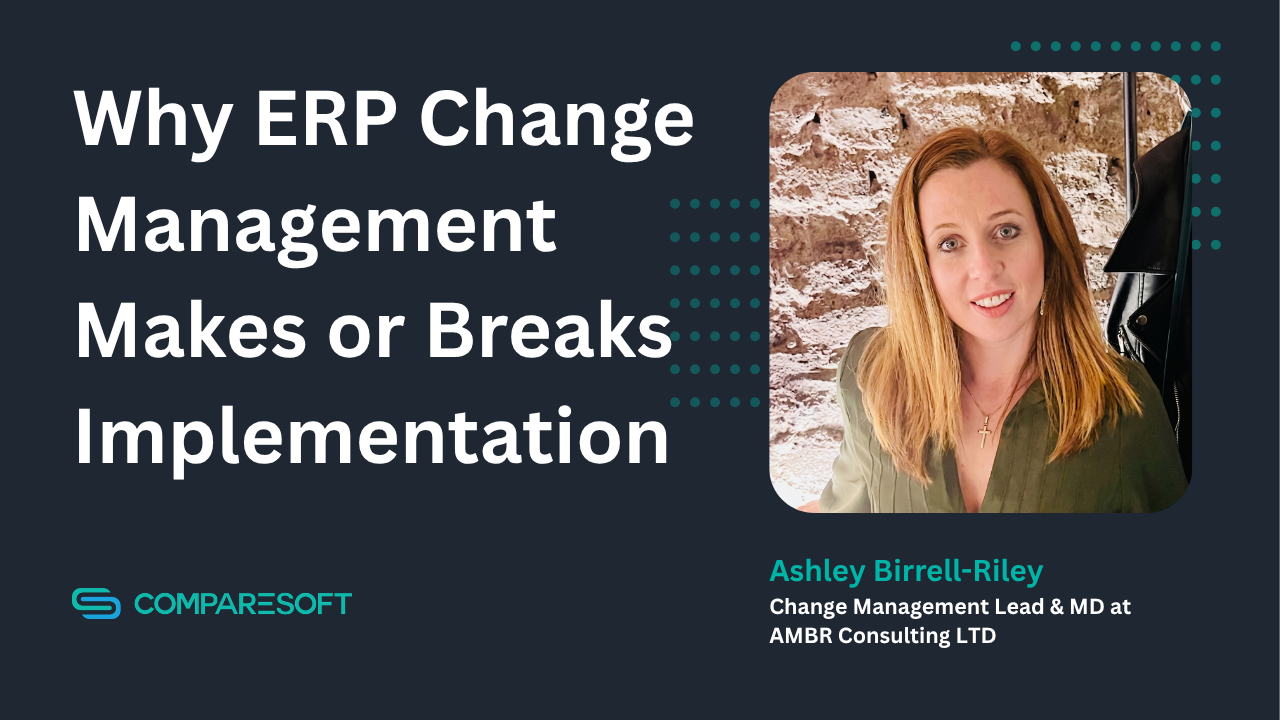
88% vs 13%: Why ERP Change Management Makes or Breaks Implementation
Ashley Birrell-Riley, a change management lead, explains why change management decides whether an ERP implementation succeeds or fails.
Listen and Watch the Podcast →Easily Shortlist & Compare ERP Software
Discover ERP systems for your accounting, sales, manufacturing, operations and delivery processes. See verified pricing, real features, realistic implementation plans & authentic erp reviews. Takes just 40 seconds. Save up to 33% on ERP costs.