
The Critical Success Factors (CSF) Behind Successful ERP Implementations
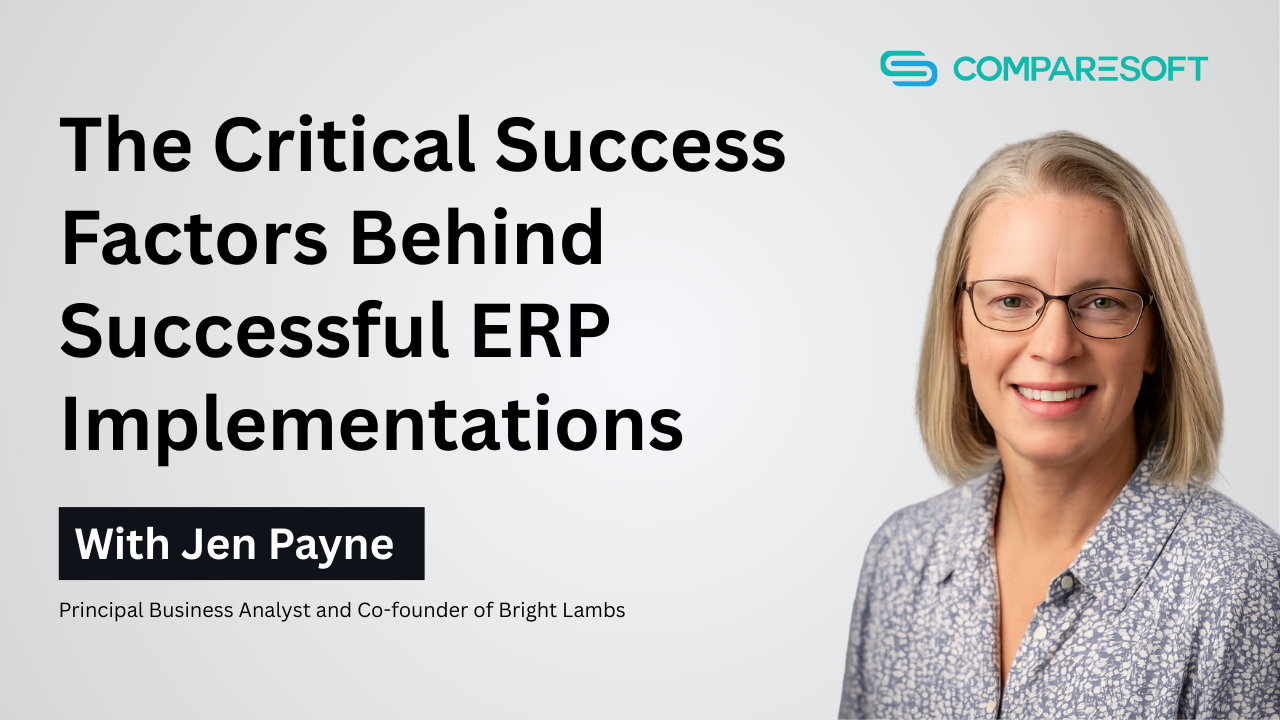
Jen Payne, Co-founder of Bright Lambs, joins us to break down the critical success factors behind successful ERP implementations and why so many projects fail before they even reach go-live.
In this episode
- Why ERP Critical Success Factors Matter More Than the Technology You Choose
- The First ERP Critical Success Factor: Understanding Why You Need Change
- Why Listening Is a Critical Success Factor in Its Own Right
- Data Readiness: An ERP Critical Success Factor Most Businesses Underestimate
- Why Realistic Expectations from Senior Leaders Are a Critical Success Factor
- The CARES Framework: Five Capabilities That Underpin ERP Critical Success Factors
- When ERP Critical Success Factors Start to Break Down
- What Research Across 30 NATO Nations Reveals About ERP Critical Success Factors
- Have ERP Critical Success Factors Changed with AI and Cloud?
- One Step to Reduce the Risk of ERP Implementation Failure
- Full Transcript
Why ERP Critical Success Factors Matter More Than the Technology You Choose
ERP implementation failure rates sit between 70 and 90%. For businesses investing six or seven figures in a new system, those odds should be a serious concern. Yet most organisations still treat ERP as a technology decision, not a business transformation.
Left unaddressed, this misunderstanding leads to misaligned expectations, weak governance, and programmes that drift long before go-live. The technology works. The failures are almost always human.
In this episode of the Comparesoft ERP Podcast, Jen Payne, Co-Founder of Bright Lambs, draws on her Master’s research into ERP critical success factors and her experience across Caterpillar, Siemens, and NATO military environments to explain what actually determines whether an ERP implementation succeeds or fails. From leadership and governance to data readiness and people, the fundamentals of success have little to do with the software itself.
The First ERP Critical Success Factor: Understanding Why You Need Change
Before any system is selected, you need clarity on why your organisation is pursuing ERP Software in the first place. Jen explains that businesses arrive at the decision for a range of reasons. Some have outgrown smaller finance and logistics packages. Others face regulatory compliance demands (such as SOX readiness ahead of an IPO), or a vendor has announced end-of-life for a legacy platform.
In many cases, frustration with fragmented data and spreadsheet-driven workarounds pushes leadership to seek a single integrated system. The risk is that ERP is often seen as the next shiny thing, a tool that will solve every operational problem overnight.
When the motivation for change is unclear, or driven by a single executive’s enthusiasm rather than a genuine operational need, the programme lacks the foundation it needs. This is where many ERP critical success factors begin to erode before the project has even started.
Why Listening Is a Critical Success Factor in Its Own Right
When asked what a manufacturing MD running on spreadsheets should do first, Jen’s answer is clear: listen. Every spreadsheet in an organisation exists for a reason. Those manual tools represent real requirements, gaps that a formal system has not yet filled.
Jen’s approach at Bright Lambs is to understand what each spreadsheet does, how it integrates (even manually) with other systems, and what unique business logic it supports. Jumping straight to an ERP platform without mapping this detail risks overlooking something fundamental to the operation.
This is an ERP critical success factor that rarely appears in formal frameworks, but Jen considers it foundational. The assumption that a standard ERP offering will replace everything a spreadsheet currently does is one of the most common, and most costly, mistakes in the early stages of ERP implementation.
Data Readiness: An ERP Critical Success Factor Most Businesses Underestimate
Messy data is one of the biggest risks in any ERP programme. Jen stresses that fixing data before migrating it to a new system is essential, but the process is not as simple as running a clean-up script. Every data point exists to inform a decision somewhere downstream. Without understanding what that data is there for and who uses it, cleaning it up can cause more problems than it solves.
Jen highlights a planning gap that appears in nearly every programme: businesses consistently underestimate the time and resource required for deep data clean-up. The people best placed to do this work are the staff who use that data daily. Bringing in external help without domain knowledge often leads to changes the organisation no longer understands.
In some cases, data is so corrupt that the best decision is to leave it behind entirely. Data readiness may not be the most visible ERP critical success factor, but neglecting it introduces risk that compounds throughout the implementation.
Why Realistic Expectations from Senior Leaders Are a Critical Success Factor
Senior leaders often make a critical error during ERP evaluation: they watch a demo and assume implementation will be straightforward. Jen points out that many CEOs and CFOs have not been at the operational coal face for years. They see a polished interface and underestimate the complexity of what their teams do day-to-day.
This gap in understanding leads to overhyped expectations. When the implementation begins and workarounds start stacking up (a manual process here, a configuration compromise there), the resulting technical debt accumulates quickly. The new system ends up carrying the same friction as the old one, just with a higher price tag.
Jen’s recommendation: if you are a senior leader considering an ERP programme, spend a day back at the operational level. Sit with the people who enter data, run reports, and manage exceptions. That first-hand understanding is far more valuable than any vendor demonstration, and it directly supports one of the most important ERP critical success factors: informed executive sponsorship.
The CARES Framework: Five Capabilities That Underpin ERP Critical Success Factors
At Bright Lambs, Jen and her co-founders apply a framework called CARES to develop the people delivering ERP programmes. It stands for:
- Critical Thinking
- Adaptability
- Resilience
- Emotional Intelligence
- Systems Thinking
Each element addresses a capability that Jen considers essential for turning ERP critical success factors into practice, and increasingly important as AI changes the way projects are delivered.
Critical thinking means looking beyond individual opinions to find root causes. In any workshop, five people will offer five different views of the same process, and none of them are wrong. The skill lies in pulling those perspectives apart, analysing them logically, and reaching a shared understanding.
Adaptability acknowledges that requirements will change throughout an implementation, no matter how thorough the initial mapping. New information surfaces, priorities shift, and teams must be prepared to adjust course rather than rigidly following an outdated plan.
Resilience supports adaptability. When a work stream proves unviable and weeks of effort need to be revisited, the team must be able to conduct a clear post-mortem, understand what went wrong, and start again without losing momentum.
Emotional intelligence is central to Bright Lambs’ people-first ethos. Jen describes a project where one team member was visibly disengaged, arms crossed in the corner. Rather than ignoring the resistance, Jen spent time understanding their frustration. The person had never been consulted about the system they used every day.
Over time, that individual became one of the most valuable contributors to the project, identifying requirements the team would otherwise have missed. It took months, but the investment in listening transformed a blocker into a champion.
Systems thinking requires an understanding of how changes in one area affect the entire operation. Changing a single data point may take 30 seconds in the system, but without understanding the downstream effects (on cost calculations, reporting, integrations), that small change can create weeks of rework.
When ERP Critical Success Factors Start to Break Down
When ERP projects start to struggle, Jen identifies adaptability as the element of the CARES framework that typically fails first. Teams build contingency into their plans (time and budget for the unexpected), but that contingency is often consumed quickly. Once it is gone, decision-making becomes rigid.
A project that started with an agile approach can find itself forced into a waterfall process without the underlying structure to support it. By the time a programme is weeks from go-live, there is almost no room to adapt if something fundamental is wrong.
The lesson is clear: adaptability must be protected and planned for throughout the programme, not treated as an early-stage luxury. Without it, every other ERP critical success factor is harder to sustain.
What Research Across 30 NATO Nations Reveals About ERP Critical Success Factors
Jen’s Master’s thesis, completed in 2019 during her time in the military, examined whether ERP critical success factors differed between civilian and military organisations. Working from a NATO headquarters with access to 30 nations (each of which had implemented ERP systems to manage logistics, asset tracking, and accountability), Jen found that the factors were remarkably consistent.
The top ERP critical success factors identified were:
- Top management support, sustained executive commitment throughout the programme, not just at launch
- A project champion and high-level steering committee, clear ownership with authority to enforce decisions
- The right vendor relationship, selecting a partner and tool that genuinely fits the organisation’s requirements
The most significant factors had little to do with the technology itself. They centred on leadership, governance, and the ability to drive and sustain organisational change.
Success depended on convincing people of the need for change and maintaining high-level support all the way through, not just at the beginning until things started to go wrong.
Have ERP Critical Success Factors Changed with AI and Cloud?
Despite major shifts in the ERP landscape (including cloud deployment, AI-powered analytics, and faster market evaluation tools), Jen’s view is that the fundamental ERP critical success factors remain the same. Technology has accelerated parts of the process. You can analyse options, model scenarios, and compare platforms faster than ever before.
However, speed introduces its own risk. Faster analysis also means faster mistakes. Your organisation can commit to the wrong path more quickly if governance and adaptability are not in place.
Jen argues that this makes ERP critical success factors more important, not less. Top management support must include an understanding that decisions may need to be reversed, and that the cost of undoing a bad decision must be built into the programme from the start.
One Step to Reduce the Risk of ERP Implementation Failure
When asked for a single action a business could take tomorrow to reduce implementation risk, Jen returns to the principle that underpins every ERP critical success factor she has discussed: listen.
Before selecting a system, before engaging a vendor, before writing a requirements document, take the time to listen to the people across your organisation who experience operational pain every day. Understand what causes frustration, where data breaks down, and what workarounds have become embedded in daily work.
Jen cautions against the instinct for quick fixes. The pace of modern business encourages rapid decisions. But rushing into an ERP programme without deeply understanding the problem is precisely what drives failure rates so high.
The message for any business considering ERP is straightforward: slow down, listen first, and treat the implementation as a people challenge, not a technology one. The ERP critical success factors that matter most are not technical. They are human.
Full Transcript
Ryan (00:00): Hi, Jen. Welcome to the show. It’s an absolute pleasure to have you with us. The topic of conversation today, Jen, is ERP implementation. Implementation failure rates sit between 70 to 90%, which is incredibly high for such a huge investment. For the best chance of success, businesses need to know what an ERP system can and cannot actually deliver before the implementation process begins.
Ryan (00:30): I’d say to get the best understanding there, we should be looking at critical success factors. And that’s a subject close to your heart. You wrote your thesis on it in 2019. So I feel like we’re in good hands to understand that today. Before we get into analysing critical success factors, let’s first understand the beginnings of the ERP implementation process. You’ve recently co-founded Bright Lambs. What did you see happening in the industry that made you feel a people-first business analysis practice was needed?
Jen Payne (00:57): Well firstly, Ryan, thanks very much for inviting me onto the podcast. It’s an absolute pleasure to be asked to be on this. In terms of why we set up Bright Lambs, and as you say a people-focused consultancy, is that the three of us worked together previously in a company called Volta Trucks, which was an electric truck startup. There were a huge amount of challenges there in terms of building a company from scratch, implementing ERP systems and all the other systems that we needed, CAD and PLM systems, and integrating them all together.
Jen Payne (01:30): But what we found was we had such a great bunch of people. We were able to recruit some really good talent who wanted to be part of making a difference. But everybody still needs development, support, nurturing, whether you’re straight out of uni or school or you’re very experienced. And through our backgrounds, especially Bex and I, we spent a lot of time trying to develop our people and get a good team together.
Jen Payne (02:05): We felt that that was the real differentiator, especially when things are going wrong. You can lean on those people because they’ve got the support network around them, and not just the boss or the manager, but also their peers as well. We did a lot of peer review of each other’s work and supporting each other.
Jen Payne (02:30): And we found that that’s the best way to get a team together that can implement these systems, because it is really difficult. It takes a lot of effort. A lot of things go wrong. And without that support network within the teams, it becomes really disheartening. And that’s why we’re very much people focused, because if we get the best people performing to their best ability, then we’ll hopefully overcome some of those massive challenges that we have with ERP implementations.
Ryan (03:10): Yeah, and so you often hear that an ERP journey starts long before choosing any sort of system. In your view, where does that journey actually begin?
Jen Payne (03:18): Yeah, well, lots and lots of different reasons and this is very unique to every organisation. You get internal factors and external factors. The external factors can be things like your current systems, for whatever reason, aren’t up to the job of what you need them to do.
Jen Payne (03:40): For example, if you’ve scaled up, so you started off as a smaller business, you’ve got maybe smaller software, so you might have a finance package and you might have a logistics package and you might have some other package, and you think, actually, we’ve scaled beyond this. And now we’re seeing shadow IT and Excel spreadsheets creeping in to fill all the gaps that really an ERP can provide, that backbone to your whole business. So that’s one reason why people go through it.
Jen Payne (04:15): There’s also regulatory compliance as well. If you are really scaling and you want to ultimately IPO, you need to have a system that is fully SOX compliant, or similar. So that’s another reason. These external pressures that come from a growing company, but also where it’s been the vendor that turns around and says, actually, we’re not supporting this particular software any further beyond 2028. And you go, okay, great, well, our hand is forced. So people are forced into it one way or another.
Jen Payne (05:00): And some of the other reasons are just a general displeasure at the current system. And that’s what a lot of companies go, well, that’s broken and that’s broken. We’re just going to rip it all out and we’re going to replace it with one system, which on the surface sounds like a great idea because integrations between systems are really complicated, difficult to do, and they take a lot of effort and can break as well.
Jen Payne (05:30): So you think, great, we’ll just put everything in one system and we get rid of all of those integrations and it all moves seamlessly around. So all of the data problems, people see that those will be solved overnight. You just put in this bigger ERP system and happy days, all your data problems and double entry and things all go away.
Jen Payne (06:00): So yeah, there’s lots of different reasons why people want to do it. And as we see a lot, sometimes it’s seen as the next shiny thing. It’ll solve all our problems. Let’s do this. But it comes at huge cost. And you also get it as somebody’s pet project sometimes. They go, actually, this is a focus I can really get my teeth into and I can be seen as the person that has done this amazing implementation. And they are sometimes sold the shiny tool by some very slick salespeople that say, life will be better if you implement this.
Ryan (06:53): If only it was that simple. If we take a hypothetical, say for example a manufacturing MD who was considering an ERP system, if they came to you and confessed their entire operation is currently being held together by spreadsheets, what’s the very first thing you would recommend they do to regain control of their data and processes?
Jen Payne (07:10): Well, the first thing I would recommend is, I wouldn’t recommend anything, is to listen. To listen to what they are using those Excel spreadsheets for. We have a process that we go through and it starts off with listening. Because all of those spreadsheets are doing something for a reason. People don’t just create these fillers for no reason.
Jen Payne (07:40): So listen to what their business is, what their current processes are. Have a look at those spreadsheets, how those spreadsheets are integrating in whatever way, even as a manual integration, it’s still an integration with another system. And treat those spreadsheets as real requirements for the business, because you can’t just implement an ERP system and go, well, it does everything.
Jen Payne (08:05): If you just stick to the standard process and their standard offering within the ERP system, you don’t need those spreadsheets anymore. But you might have missed something absolutely fundamental and unique to that business that they really need. So the recommendation would then fall out of the process of really listening to what the problem is and what their unique situation is.
Ryan (08:36): And if you take a look at those spreadsheets and you see missing fields, duplicate data, we often hear the phrase garbage in, garbage out. Is it a case of saying, right, fix your data first before doing anything?
Jen Payne (08:48): It is necessary to fix the data first, yes, but I find it really important to understand what that piece of data is, what the purpose is of it, what it’s there to achieve. So it might be duplicated, never good, but what’s that piece of data there for? And it’s normally to inform a decision somewhere down the line. So you have to understand each of those data points and what they’re there for and who is using them ultimately.
Jen Payne (09:20): If it’s very messy data and incorrect, it’s never a nice task, but you have to go through it and make sure that it’s in some kind of format that is structured so that people can understand it. And it may be a case that actually some of that data is so corrupt that you’re best off just leaving it behind.
Jen Payne (09:50): That’s something that people very often forget to budget both time and resource for. That deep data clean-up, because it can be a huge piece of work and unfortunately the best people to do it are the people that use that data on a day-to-day basis. If you get somebody in from external that doesn’t understand that data and what it’s there for, inevitably they don’t make the situation much better because they may change that data to something that the organisation doesn’t understand anymore.
Ryan (10:29): It’s very high risk. They could be even getting rid of data that is essentially needed for a process.
Jen Payne (10:32): Yeah.
Ryan (10:35): And so you’ve mentioned it already, misunderstanding the role of an ERP can lead to overhyped expectations if a company is sold by this glossy package, this is going to fix everything. What are the most common misconceptions you see among CFOs and CEOs when they come to implement ERP?
Jen Payne (10:54): I think unfortunately quite often it’s been a long time since they were at the coal face, putting data into a system, sitting next to the financial controller or the bookkeepers and understanding the data input and the decisions that are being made on that data. They see a demo and they go, that looks really easy, because they haven’t done that job for so long.
Jen Payne (11:25): They misunderstand that there’s a lot of complexity to putting information into a system and using it on a day-to-day basis, especially when you go through an ERP implementation and you see the system implementers say, well, it doesn’t quite do that, we’ll put in a workaround.
Jen Payne (11:50): And then there’s workaround onto workaround and a manual system and a bit here and it doesn’t quite flow. That friction for the individuals working on it can mount up. You hear the phrase technical debt. So the system ends up, this new shiny system, having a lot of technical debt that then the C-suite don’t fully understand how much effort that then takes.
Jen Payne (12:20): And I would really advise them to spend a day in the life of, back again, before they even start an implementation. Just spend a day back at the coal face, looking at what people do and understanding how complex it really is.
Ryan (12:41): Yeah. So at Bright Lambs you use a framework called CARES, C-A-R-E-S. Can you talk us through that framework and how you apply it in practice when you’re working with a client?
Jen Payne (12:49): Yeah, so it stands for critical thinking, adaptability, resilience, emotional intelligence and systems thinking. What we decided on that framework is because those are the skills and the fundamentals that we think every business analyst will need and every system implementer will need. It gives you that kind of rounded skill set and way of thinking that you need for work going forward, especially with AI coming in. What’s the added value of us?
Jen Payne (13:30): So starting off with critical thinking. Being able to look at a problem and understand that if you walk into a workshop, for example, and you say, we’ll map this process and we’ll see where the pain points are, where the issues are. Naturally people will say, well, I think the answer is this. If you speak to one person, they’ll be absolutely adamant with their view of the way things are going wrong or the way the process works.
Jen Payne (14:05): You speak to the next person and they’ll be absolutely adamant the way they see it is correct and not the other person. Speak to the third, fourth person. None of them are wrong. They’re all absolutely right, they have their own opinions and they have their own view of that part of the process. But the critical thinking part comes in to say, okay, well we take all of those opinions and we drill down into the absolute nub of the problem, the root cause.
Jen Payne (14:40): In a way we’re not criticising, but we’re looking at the critical elements of it without criticising, to say, okay, this is the way you see it. But actually, could it be this? Could that person’s bit of it also be correct? And understanding that we can pull that apart and analyse it in a logical way and come to a joint understanding. So that’s the critical thinking part of it.
Jen Payne (15:15): And also then being able to be adaptable. So from that critical thinking, we can adapt to different ways, different opinions and also new information coming to light. That happens all the way through an implementation. Things will change, new things come to light, new requirements drop in. It doesn’t matter how well you do requirements mapping at the start of that exercise, things will pop up.
Jen Payne (15:54): People have forgotten things. People come up with great ideas halfway through and they go, yeah, let’s put that in. Being adaptable all the time for when things change, because they always will.
Jen Payne (16:10): Resilient, I think that ties in very much with adaptability because it can be quite disheartening when you spend so long working on one piece and then you go, actually, that doesn’t work. Fundamentally, we’ve gone down the wrong path, and that can happen. We need to backtrack and understand and go through the process of that post-mortem in terms of analysing why things didn’t work out, why we went down the wrong path potentially.
Jen Payne (16:45): And you might do that with an entire system. If ultimately you haven’t implemented what you intended to, you have to be adaptable to come back and start again and have that resilience to be able to deal with it.
Jen Payne (17:05): Emotional intelligence, I think that comes back very much to our ethos of listening first. So not diving straight in with a solution. We spend a lot of time just listening to what the needs of the business are so that we can actually uncover the true requirements. And emotional intelligence, I found, I mean it’s a key skill, but one case that I always come back to is I was doing a small system implementation.
Jen Payne (17:35): I went into a workshop and you’ve got five or six people there and there’s one person in the corner, crossed arms, with the look on their face that said, I’m not interested. And it’s like, okay. And having that emotional intelligence to kind of spot that person early on, and I spent some time understanding that person’s point of view.
Ryan (17:51): I know best.
Jen Payne (18:03): And it does take time, but I spent some time understanding that person’s point of view. And the biggest problem that they had, and why they had that attitude, is that nobody had asked their opinion. They were one of three people that were using the original older system that we were looking at replacing. And the first thing that they said to me was, nobody’s asked me, I don’t even know what this meeting’s about.
Jen Payne (18:30): The emotional intelligence to not get your back up but to go, right, okay, and be more inquisitive about why do you feel that way? Why do you feel that you’re not being listened to? Initially they were very much a hold on the whole project. And it did take months to bring them round.
Jen Payne (18:55): By the end of the project, when we rolled out the system, as I left they gave me a big hug and said thanks very much, thanks for listening to me. And they were absolutely pivotal to implementing that system. They came up with loads of requirements that we would have otherwise missed.
Ryan (19:14): Excellent.
Jen Payne (19:22): They were absolutely great in holding us to account, doing that critical thinking of, it won’t work like that because of this. But because I spent the time with them to bring them round, they were doing the critical thinking for us as well and saying, you haven’t thought about this, and holding us to account for the quality of the system we were implementing.
Jen Payne (19:50): So yeah, that’s a reason why emotional intelligence is very important, to understand those factors, because it is all about the people. It’s not actually about the software. The software, if we didn’t have people problems, would probably be implemented a lot easier. But we’re humans and we have feelings and motivations. And that’s why we’re pretty keen on that element.
Jen Payne (20:20): And then the last one is systems thinking. So as people generally in business go through their careers, they’ll be in finance or they’ll be in logistics or they’ll be in operations or in engineering. Some people are lucky to have worked in lots of different areas, but most people don’t and they stay in that kind of stovepipe.
Jen Payne (20:50): The systems thinking part is where we come in. And I don’t know if it’s luck or judgement, but I’ve ended up working in lots of different fields, as have a lot of our people, so that we can look at the end-to-end process, that global process of the whole system.
Jen Payne (21:10): Finances, good case in point. Understanding how the money moves through the ERP system is absolutely vital, and all of the different things that can affect the money all the way through. From the moment you design a part and that part is going to have a cost, and how you ensure that that cost follows all the way through, and the different types of cost elements to that item, be it standard cost, actual cost, shipping costs and all the rest. You have to have that understanding of the total system.
Jen Payne (21:50): Because if you don’t, and somebody says, can we just change this thing here, this little bit, this one little data point over here, can we change that? You as the analyst or the implementer need to understand the second, third, fourth, fifth effects of that one little change all the way through the system.
Jen Payne (22:27): Because if you don’t, that one thing might cost you a week’s work to unpick it all, or a huge data problem down the line. So that’s why we ensure that our people are systems thinkers as well and try to always get them to think about the wider implications, not just when somebody says, can we add this field in or can we change that?
Jen Payne (22:56): It’s like literally 30 seconds potentially in a system to change a field or a data point or something. But what are the knock-on effects of those?
Ryan (23:06): Yeah, what’s the impact? It could be huge further down the line.
Jen Payne (23:09): Yeah.
Ryan (23:10): Obviously, all five points of that CARES framework are incredibly important. Just from hearing what you’ve been saying, I would say possibly adaptability is the most important part of that. It has to be a dynamic process. It has to be forever changing. It has to be adaptable. When an ERP project starts to struggle, which part of the CARES framework tends to break down first based on what you’ve seen? Would it be that adaptability side, if someone isn’t adaptable to change or system management?
Jen Payne (23:41): Yeah, I think that adaptability, I mean people build contingency into their implementations but nobody really wants to use it, and very often it gets used up very quickly. And then people shut down the being adaptable because they go, well, we can’t deviate out of the plan because the contingency is gone, be that time or money.
Jen Payne (24:10): So people then get stuck into delivering what they planned to. Maybe they started off in a very agile way with the implementation, but then you realise that you’re almost forced down a waterfall process. And if you haven’t designed a waterfall process or implementation from the start, you don’t have the bedrock of stability to turn into that later on.
Jen Payne (24:40): So I think you’re right that adaptability quite often ebbs away as you get further down the implementation. And even to the point, at the end of the project, you’re a couple of weeks from go-live. There’s really no adaptability in there if you’ve got something fundamentally wrong, because the ship has sailed.
Ryan (25:10): Yeah. So we mentioned at the beginning of this episode that you wrote a Master’s thesis on ERP critical success factors, and that was during your time in the military. What was the inspiration behind that research and what were the key critical success factors that you identified at the time? I think it was back in 2019.
Jen Payne (25:29): Yeah, that’s right. So the inspiration behind it was before I joined the army, I worked for Siemens and Caterpillar and sort of dabbled on the edges of their ERP implementations that they were doing at the time. I was very junior at that point. And as I was doing my Master’s degree, we discussed critical success factors, but it was all around civilian ERP systems.
Jen Payne (26:00): I thought, well, militaries have ERP systems. The British military had just gone through a massive upheaval to replace their very logistics-focused ERP system. So I thought, well, are there parallels between the two, between civilian and military systems and the critical success factors? I thought that would be a really interesting thing to go and research.
Jen Payne (26:30): And at the time I was quite lucky that I was working in a NATO headquarters with 30 NATO nations who at one point or another have all done the same thing, implemented an ERP system, because militaries still have to account for things and they have to move stuff around. Whether that’s beans, bullets, or multi-thousand-pound communication systems, it all needs tracking and monitoring.
Jen Payne (27:00): So I started with researching very well-documented information about civilian critical success factors and then I interviewed as many of the NATO nations as I could at the time to analyse and get their qualitative opinions about their implementations through those militaries. So I had quite a good cross-section of information to go off of.
Jen Payne (27:30): And what I found was that they’re actually very similar. Few of the critical success factors are actually to do with the system that was implemented. It’s all to do with the leadership and governance around implementing ERP systems.
Jen Payne (27:50): Probably unsurprisingly, the top critical success factor that I found amongst these NATO nations was top management support, having a project champion and high-level steering committee, and then having the right vendor relationship and choosing the right tool. So those were the top three. I had the top nine.
Jen Payne (28:15): And yeah, I’m sure if I went through the entire list, they would be very familiar to a lot of the listeners as well. And it was a really interesting thing to understand that, going back to the earlier point, it’s about the people. It’s about convincing the need for the change, having that support, having those high-level drivers throughout the project, not just at the beginning until things start to go wrong and then people distance themselves. It’s all the way through.
Ryan (29:01): And as we touched on, that was seven years ago where you identified this. Have any of those factors changed meaningfully? We’ve had quite a bit of technological shift. We’ve seen AI applications come in. Would you say any success factors have changed or are the fundamentals still the same?
Jen Payne (29:15): I think the fundamentals are still the same. I think with AI and machine learning and advancing technology, things can be speeded up a lot. You can do faster analysis, you can analyse the market and software across the board a lot quicker, which is great because that saves time and money.
Jen Payne (29:45): But it means that you can also make mistakes faster. You can go down the wrong path faster. So you need that adaptability to actually come back from those mistaken paths sometimes. And I think that’s where the critical success factors become all the more important. Because if you have top management support that understands that you need the adaptability to change decisions, and that can cost companies a huge amount of money to undo a bad decision.
Jen Payne (30:20): Building it into the process and actually discussing what would happen if, understanding that if we go down the wrong path, how quickly can we pull it back and then adapt and go down the right path.
Ryan (30:52): Yeah, so even though it might have accelerated the speed of figuring out those processes, it still requires a lot of critical thinking and adaptability in there, which brings you back to your CARES framework.
Jen Payne (31:03): Yeah, absolutely.
Ryan (31:05): Excellent. So we like to save the last few questions here, Jen. Just sharing your insight and advice for the listeners. Looking back across your career, we’ve touched on it already, what is the single best piece of advice you’ve got that you still rely on today? And that has helped you co-found Bright Lambs as well.
Jen Payne (31:23): I think it’s one I sort of realise you kind of do later on in life, but people always said keep learning, keep learning. And that’s the one bit of advice I would give to anybody. It’s very easy to get stuck into the day job and just going through the same problems and the same issues again and again.
Jen Payne (31:50): I’ve taken every learning opportunity that I can. I’m still learning a lot, especially today with AI. I spend a huge amount of time just learning and getting into the different tools and the different ways of working now. And I’m one of those people, I really enjoy learning and I enjoy new challenges.
Jen Payne (32:15): And I think because now I’m a bit later in my career, I want to take that learning and do more teaching. So the people that we bring on into Bright Lambs, a lot of my focus is also on helping them to discover learning for themselves. The resources available to us today are mind-blowing.
Jen Payne (32:40): I remember growing up, my dad was really proud when he bought the Encyclopaedia Britannica. I don’t know if people remember that. It was like a stack of 30 books that had everything you could ever imagine. Anyway, I think it was about 18 months later the internet happened and it sort of rapidly declined in its relevance. But that was all you had to go off of. For a lot of people it was quite an investment. A lot of people couldn’t afford that. Libraries.
Jen Payne (33:15): And now, a click of a button and you find an answer. It’s amazing, but it can be like drinking from a fire hose. The absolutely overwhelming amount of knowledge that you can be exposed to now. And I would say, I was about to say absorbed, but people aren’t absorbing it.
Jen Payne (33:40): And this is, I think, the problem, that there’s so much out there. It is this fire hose effect. People need to slow down the learning and really get into subjects very deeply to properly learn, and not just expose themselves to everything. It comes back down to the shiny thing. I’ll look over there and I’ll look over there. And I’ve been guilty of it as well. I see the shiny thing and go, I’ll just go and research that. But yeah, it’s a really interesting time to be alive, I think, and especially for people that like learning.
Ryan (34:17): Yeah, excellent. And again, it comes back to adaptability. I think we’ve touched on that a few times today. And just to round up our chat today here, Jen, if a company could take just one small step tomorrow to reduce the risk of any ERP implementation failure, what would you recommend that small step be?
Jen Payne (34:35): Yeah, that’s a really difficult one to answer because there is no one thing that I can recommend that would do justice to every situation and every company. So I think certainly the first thing I would do is listen to their pain and anguish that they have at the time. Really understand what is it that is causing them sleepless nights, causing them frustration. And across the organisation it can manifest in lots of different places. So before I could recommend something, the first thing is listen.
Jen Payne (35:15): And if you’re in an organisation, take a step back and just listen to lots of people’s opinions and pain points before you leap in and try and fix the next thing. Because as I said before, you have to understand the whole system before you can do that, because you change one thing and it’ll have a knock-on effect somewhere else.
Jen Payne (35:45): So you have to listen first, understand the problem before you can really solve it. So that would probably be my advice. Listen and take the time to research what the problems are. But it’s not a quick fix. And I think that’s also a little bit of a symptom of today, that everybody wants a quick fix.
Jen Payne (36:10): Because that’s the way we’re fed data and we’re fed information through social media, through outlets. Everything’s shock and clickbait and immediate and in your face. And people want, I think our pace as human beings has increased so much, like pace of thought, everything’s got to be quick and fast.
Jen Payne (36:35): But unfortunately that’s probably what’s leading to the most problems, these quick fixes and these quick changes and people not taking the time to really understand the problem first.
Ryan (37:02): Slow down, take it in and understand what the issue is. Excellent. Jen, thank you so much for joining us today and sharing your experience. We set out to understand why implementation failure rates are so high and what companies can do to reduce that risk. And you’ve given a really practical view there of the fundamentals that matter most, looking at the CARES framework and your critical success factors as well. So Jen, thanks again for joining us, and thank you all for listening. We’ll see you on the next episode. Thank you, Jen.
Jen Payne (37:31): Thank you.
What are You Looking to Improve with ERP?
Meet the Speakers

Jen Payne
Principal Business Analyst & Co-Founder of Bright Lambs
Helping organisations understand what is really going on inside their processes and systems.

Ryan Condon
Head of Content
Content architect and strategist at Comparesoft, helping software buyers make confident decisions through purposeful, well-structured content. Podcast Host and Head of Content since joining the team in 2019.

Latest ERP Podcast Episodes
Making Legacy-to-Cloud Public Sector ERP Transformations Stick
Ramzan Amin, Founder and CEO of SIM Consulting, joins the Comparesoft ERP Podcast to draw on his experience as ERP Programme Director at Kent County Council and explore why public sector organisations are being pushed to replace ageing ERP systems.
Listen and Watch the Podcast →
What ERP Failure Really Looks Like and How to Prevent It
James Robertson, ERP Troubleshooter & Published Author, explains what ERP failure really looks like today and why it is far more common than most organisations realise, arguing that up to 95% of ERP programmes fail at the executive decision-making level.
Listen and Watch the Podcast →
How ERP Phase 0 Prevents Scope Creep, Governance Drift & Data Chaos
Bryan Oak unpacks ERP Phase 0 and why it is the decision work that protects scope, governance and data from chaos later. Drawing on decades of experience advising leadership teams, Bryan explains what Phase 0 actually covers, what “good enough” looks like, and why organisations default to vendor selection before they have aligned on outcomes.
Listen and Watch the Podcast →Easily Shortlist & Compare ERP Software
Discover ERP systems for your accounting, sales, manufacturing, operations and delivery processes. See verified pricing, real features, realistic implementation plans & authentic erp reviews. Takes just 40 seconds. Save up to 33% on ERP costs.