
88% vs 13%: Why ERP Change Management Makes or Breaks Implementation
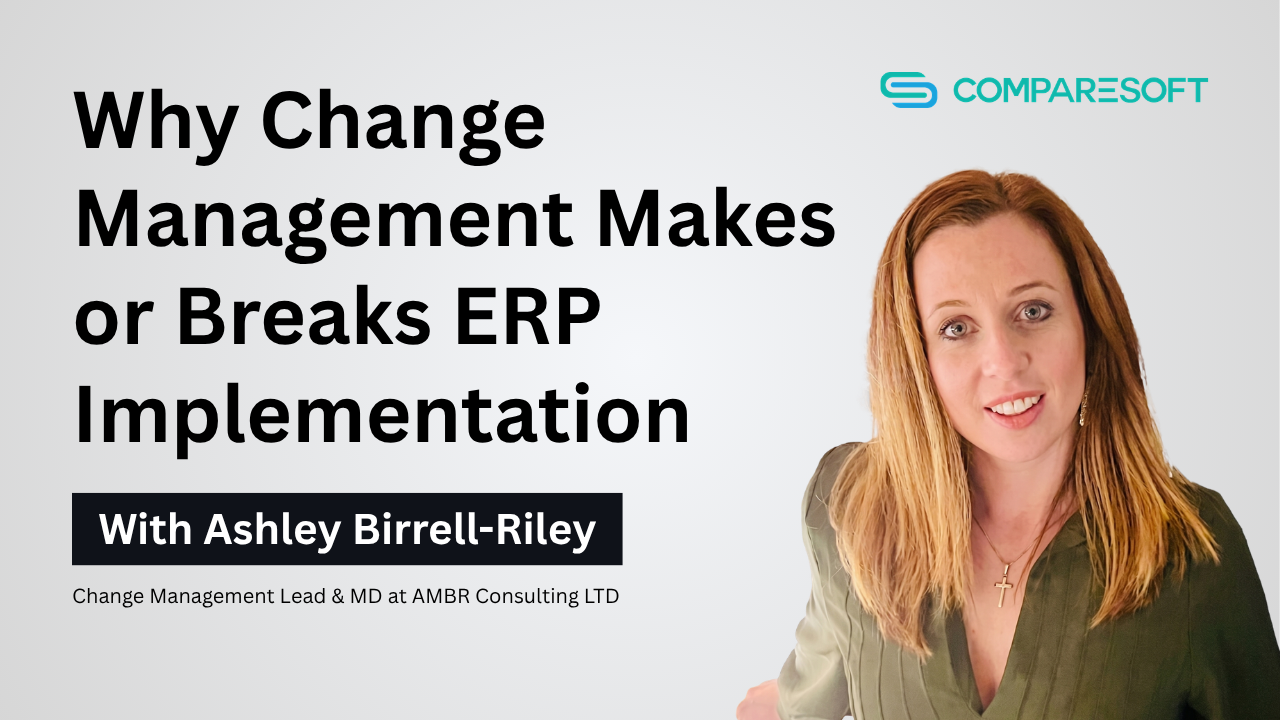
Ashley Birrell-Riley, a change management lead with over a decade guiding large-scale ERP transformations across local government, construction, and transport, explains why change management decides whether an ERP implementation succeeds or fails.
In this episode
- What ERP Change Management Really Means
- Why Tacking ERP Change Management On at the End Costs You
- Is ERP Change Management Really the Cause of ERP Failure?
- How to Measure Whether ERP Change Management Is Working
- Spotting Early Warning Signs and Handling ERP Workarounds
- Building an ERP Change Management Strategy From Scratch
- Why Change Champions Carry an ERP Rollout
- Making the ERP Change Management Business Case to a CFO
Research from Prosci shows that 88% of programmes with excellent ERP change management meet or exceed their objectives, against just 13% of those with poor change management.
For any organisation weighing up an ERP implementation, that gap is the difference between a system that pays for itself and one that becomes an expensive version of the old one.
Ashley Birrell-Riley has spent over a decade on the people side of that gap. As a change management lead, she has guided large-scale ERP transformations through local government, construction, and transport, including an award-winning Oracle programme at the Royal Borough of Kensington and Chelsea.
In this episode of the Comparesoft ERP Podcast, she explains what ERP change management actually involves, why people resist new systems, and what leaders must get right to make transformation stick beyond go-live.
What ERP Change Management Really Means
ERP change management is the work of moving an organisation from how it operates today to how it needs to operate on the new system, and managing every person affected along the way. Most people reduce it to communications and training. Ashley starts somewhere more fundamental.
“Change management looks at where we are today in the organisation and then where we need them to be,” she says. “It looks at the strategies for how we bridge the gap between those two things, which in essence sounds so simple. But when we’re dealing with one complex change and lots of different people with different requirements, we start to introduce lots and lots of complexities.”
The discipline only earns its keep when it moves off the page. “A change strategy is fantastic,” Ashley explains. “But if it’s only ever a document that lives on a SharePoint site, it doesn’t serve any benefit to anybody. The beauty and the nuance of the change that we deliver is in the actions that we take to interact with the wider organisation.”
That is also why the change lead role is so often misread. The job is far larger than the tools people associate with it.
“Change is often misunderstood, because it’s grown this badge of honour of being, well, it’s just a bit of communications and a bit of training that we tag on at the end,” she says. “But one of the biggest aspects of the change lead role is to help organisations understand that there is more to change than just those little component elements. There’s more understanding, awareness, leadership and coaching that needs to come into play.”
Why Tacking ERP Change Management On at the End Costs You
Failed programmes share a common pattern: they treat ERP change management as the final item on the plan. Ashley sees the irony because the work is judged at exactly the point it has had the least time to land.
“It’s a very old-fashioned approach to just tag it on and hope for the best,” she says. “The crazy thing is that programmes, in terms of their success at the point we hit that go-live date, are often judged on the value that change management has brought. So the perception is often, well, we just need to do this little bit at the end.”
In reality, the value is built long before launch, and it does not stop at launch day.
“A lot of programmes gear up for go-live day, and they think, right, if we can get to that date, we’ve hit our marker,” Ashley continues. “But the change management remit goes beyond that, because what we’re interested in is seeing people through that intense transition period, which is often called hyper care. And then, how do we make sure that at the point we step away from the project, they’re able to carry on, and that all of these new ways of working are fully embedded?”
Is ERP Change Management Really the Cause of ERP Failure?
ERP change management is frequently named as a leading cause of ERP implementation failure. Ashley pushes back on the premise itself.
“I would actually challenge the whole premise of change management being the root cause of any failed programme,” she says. “In my view, programmes succeed together and they fail together. It’s never really one component element, particularly when you’re doing such large programmes where you’ve got so many interdependencies.”
That does not let change management off the hook. Preparation is decisive. As Ashley puts it, an organisation that understands what it is about to go through, that is properly resourced, and that has its leadership lined up “so that it’s not the programme doing something to the business, but the business working in partnership with the programme, is always going to achieve a far more successful output.”
She also recognises why change makes such an easy target:
“We often judge it on that one point in time at go-live, and people will say, we didn’t have enough training, or we didn’t have enough communications. But often there are reasons behind why that was the case. Was the time period condensed because something ran over? Was the solution not ready enough for the team to do the training delivery?”
Her instinct is to refuse the blame game entirely. “When you get into a culture of where do we place blame, we’ve kind of lost the point of it,” she says. “No implementation is smooth. But it’s more along the lines of, how do we work together to overcome the bumps, and what’s the best route forward that we can all align to?”
How to Measure Whether ERP Change Management Is Working
If you only start measuring adoption once the system is live, you have left it far too late. Ashley measures from early in the programme and treats it as continuous.
“If we get to the point where we’ve gone live and we only start measuring then, for me it’s too late; the horse has bolted,” she says. “So throughout the programme, I look at the programme life cycle, and we have natural stage gates.”
Those gates sit alongside a structured readiness journey. “We have readiness surveys that go out, and we start that fairly early on,” Ashley explains. “We’ll take a baseline and we’ll say, what do you know about the programme, its objectives, what it’s trying to achieve? How are you finding the engagement? We collect that data and use it to inform what we do going forward, so that we’re constantly learning.”
Once the system is live, the metrics become more familiar, but the emphasis is telling. “We’re looking at how many people have logged in, how many tickets have been raised, and how many of those tickets are ‘how do I’ questions rather than the system actually not working,” she says. “We look at how much reliance we’ve got on our change champion groups, and what types of queries are coming back through them.”
Spotting Early Warning Signs and Handling ERP Workarounds
Workarounds are where adoption quietly slips. Ashley takes a more nuanced view of them than simply stamping them out, because not every workaround is a problem.
“By the time we go live, people are learning themselves, and they likely have quite a lot of pressure because there could be backlogs they’re trying to get through,” she says. “We find bad habits often form around those periods, which is natural, because people have a natural tendency to want to find the quickest way to get from point A to point B.”
The test she applies is about impact, not preference. “Is the workaround impacting the system or the output? Are we compromising the quality of the data?” she asks. “If they’re following all of the process steps but doing some things outside of the system that aren’t ideal, then that’s a judgment call for the leadership and the line manager. They’ve found a quicker, more efficient way to do it; that’s brilliant.”
The problem cases are different. Ashley draws a sharp line between a skill gap and what she calls a will gap. “If it’s not a skill gap but a will gap, where someone is saying, I’m doing it because I don’t want to do it your way, and I don’t care about the downstream impact, then that’s the point where we look at managing the performance.”
Even then, her default is explanation over enforcement. “We’re all adults in a workplace, and we all, in theory, want to do the best job we can,” she says. “We’re not there to rap knuckles and police things. But people always tend to respond to, okay, I understand why you’re doing what you’re doing, but the impact of that is that this doesn’t work.” In an ERP, she adds, “your systems and your processes are connected in a way they probably weren’t before, so sometimes it’s just a lack of understanding about how that follows on.”
Building an ERP Change Management Strategy From Scratch
When Ashley joins a programme after ERP system selection, her first move is not a survey or a comms plan. It is alignment.
“When I very first join any organisation, the key thing for me is to understand what we’re trying to deliver,” she says. “I’ll speak to the programme director, but I’ll also speak to the programme sponsor and some of the leadership team outside of the project. What I’m trying to do is gauge how aligned everybody is, and how clear they are on what we’re actually trying to achieve.”
She has a neat way of testing whether that alignment is real or rehearsed. “People get really good at parroting back key phrases. You’ll hear buzz phrases like ‘adopt, not adapt’, because we’re talking about Oracle,” Ashley explains. “Part of what I do is say, okay, what does that mean to you? If we flash forward to the end point, what would that look like? It’s getting them to articulate that.”
Only once she understands the parameters and the organisational structure does the formal strategy take shape, anchored to the programme itself. “We use the strategy as an anchor to help the leadership team and the wider organisation understand what change does and the value it’s going to bring,” she says. “I try to map it alongside the programme life cycle, so that they can see, in design, this is what I should expect from the change team.”
Much of the role, she adds, is acting as a translator between a technical programme and the people it affects. “Part of our job is to be that conduit between the programme, which is often dealing with really complex elements, and the wider organisation,” Ashley says. “It’s being that person who explains things in plain English, and helps them understand what we’re asking of them, why we’re asking it, and why it’s important.”
Why Change Champions Carry an ERP Rollout
On one current programme, Ashley supports 30,000 employees with a team of four. At that ratio, a network of advocates is not a nice-to-have; it is the delivery model.
The approach works in both directions. Senior buy-in sets the tone from the top. “If the senior leaders don’t buy into what we’re trying to deliver, we’ve kind of lost the dressing room already, because they set the tone for what’s important,” Ashley explains. But the swell has to come from the bottom too. “We build out networks, which you’ll have heard called change champions or advocates. That’s about creating the swell from the bottom up, and getting input from the people doing the tasks on a daily basis. They are honest and they’re brutal, and that’s what we need.”
The reason champions matter so much comes down to presence. “I could go out and talk to people, and I could be really passionate about it. But ultimately I’ll only be there for the time slot they’ve given me, and then I’ll go away,” she says. “The line managers and the people who are there are there constantly. They have the most face time, and the ability to correct, steer, and move things in the right direction.”
So what actually makes a good change champion? For Ashley, it is not the job title. “The big thing in terms of a change champion, for me, is, are they credible?” she says. “Are they the type of person somebody would ask, how do you do this? Are they easy to approach? And, to a certain extent, are they trustworthy? Because if people don’t trust them, they won’t tap into that network.”
There is a long-term payoff too, because an ERP is never finished. “What we know about ERPs in particular is that they’re not static,” Ashley notes. “You’ve got this constant evolution, new releases, all of these updates. So establishing these networks is not only helpful before go-live but definitely beyond. You really are helping the organisation set up for the future.”
Making the ERP Change Management Business Case to a CFO
For a CFO building an ERP business case, Ashley frames ERP change management as risk reduction with a hard financial edge. The cost of skipping it does not disappear; it moves downstream and grows.
“Change management is integral, and it really is going to pave the way to minimise disruption and help prepare that go-live window,” she says. “If we compromise on that, the implication is that your hyper care and your post go-live impact is more significant. And it might not be the system; it might be that people just don’t know how to do it.”
Then there is the burn rate. “Getting it wrong, and not doing the change management bit upfront, just means you carry that risk forward,” Ashley explains. “You’re either extending your programme team for a longer period, or you’ve got the costs associated with reworking bits of process. That’s never palatable, particularly after you’ve just spent a significant amount of money. So for me it’s, do it right, do it once.”
She is reluctant to attach a budget percentage to it, preferring to talk about resourcing the right roles at the right time and phasing teams in. On one point, though, she will not bend.
“Where they tend to scrimp in terms of budget is often the training elements,” Ashley says. “My stance is, no, invest in your training. If you’re going to invest in anything, make sure people have a real fighting chance to build the skills they need, because that is where that skill set is invaluable. It really will set the tone for how successful you are at the point you go live.”
That is the through-line of the whole conversation. A modern ERP only delivers when the people using it are ready, supported, and brought along. That readiness is built deliberately, from the start.
What are You Looking to Improve with ERP?
Meet the Speakers

Ashley Birrell-Riley
Change Management Lead & MD at AMBR Consulting LTD
Director/Change Lead/Change Architect at AMBR Consulting LTD

Ryan Condon
Head of Content
Podcast Host and Head of Content at Comparesoft.

Latest ERP Podcast Episodes
How to Ensure a Successful ERP Implementation Go-Live
Laura Pointer explains the methodology behind her 100% ERP go-live success rate.
Listen and Watch the Podcast →
What Your ERP Delivery Partner Does Between Purchase and Go-Live
Yuriy Zaletskyy draws on 13 years of hands-on implementation experience to explain what really happens once a business has chosen its ERP and an ERP delivery partner takes over.
Listen and Watch the Podcast →
ERP Recovery Roadmap: How to Rescue a Failing ERP Programme
Drawing on 15 years in construction and EPC operations and her experience leading ERP transformation and recovery work at Deloitte, Adileh Mountain unpacks what causes ERP programmes to go off the rails and what a practical recovery plan looks like.
Listen and Watch the Podcast →Easily Shortlist & Compare ERP Software
Discover ERP systems for your accounting, sales, manufacturing, operations and delivery processes. See verified pricing, real features, realistic implementation plans & authentic erp reviews. Takes just 40 seconds. Save up to 33% on ERP costs.