
How an ERP Project Manager Keeps Large-Scale Programs on Track
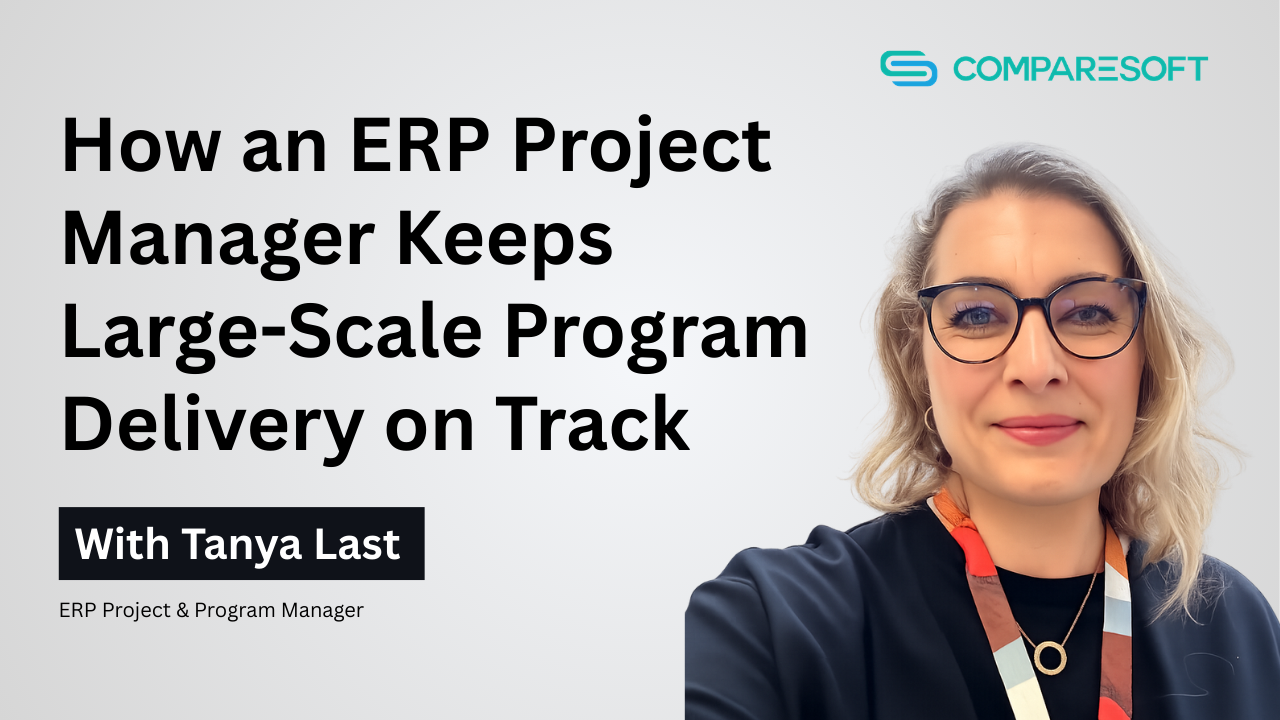
Tanya Last explains the role of an ERP project manager and how large-scale ERP programs are kept on track from early delivery through to post-go-live stabilisation. Tanya covers delivery control, early warning signs, change management & what successful stabilisation looks like after implementation.
In this episode
- What Does an ERP Project Manager Actually Do?
- How an ERP Project Manager Defines Implementation Failure
- Early Warning Signs That an ERP Programme Is Starting to Drift
- Why People, Not Technology, Determine Whether an ERP Programme Succeeds
- When Change Management Should Start in an ERP Programme
- What an ERP Project Manager Tightens First When a Programme Loses Control
- Lessons from a Complex Public Sector ERP Transformation
- Key Advice for New ERP Project Managers
What Does an ERP Project Manager Actually Do?
An ERP project manager is the single person responsible for holding a complex, multi-workstream ERP Software programme together from start to finish. Tanya Last, an experienced ERP programme manager with around 15 years of delivery experience across large-scale transformations, compares the role to an orchestra conductor.
The conductor does not need to play every instrument, but they know exactly who needs to do what, at what time, and what good performance sounds like.
In this episode of the Comparesoft ERP Podcast, Tanya Last explains why the ERP project manager role should begin long before design or build phases start. Tanya argues that the right person needs to be involved from the moment an organisation decides to replace an existing system, whether that is a finance, HR, or procurement platform. Too often, she sees programmes where the project plan is already too tight and the team lacks the right skills before an ERP project manager is even brought in.
The role extends well beyond go-live. Tanya stresses that walking away immediately after launch is one of the most common mistakes in ERP implementation. The ERP project manager carries critical knowledge about the programme’s history, decisions, and risks. Staying through stabilisation until the target operating model is running, managed services are operating correctly, and business-as-usual teams are confident is essential to protecting what has been built.
How an ERP Project Manager Defines Implementation Failure
Failure rates in ERP are widely debated, with some experts placing them between 70% and 90%. Tanya offers a more nuanced perspective. She argues that what counts as failure depends entirely on the organisation’s objectives and expectations.
Tanya describes two nearly identical programmes she managed, moving from one platform to another:
One organisation considered the project a complete success because it went live on time, on budget, and safely. The other considered it a failure because stakeholders felt they had not been consulted or engaged enough, despite strong delivery outcomes. The criteria for success, she explains, are different for every customer.
On the question of timelines and cost overruns, Tanya pushes back against the assumption that adding time automatically equals failure. If an ERP project manager was not involved in the original planning and the critical path does not support the agreed timescale, extending the timeline can improve quality and ensure a safe ERP go-live. The key is making pragmatic decisions early rather than sacrificing quality to meet an unrealistic deadline.
Early Warning Signs That an ERP Programme Is Starting to Drift
From Tanya’s experience, the first signs of drift typically appear during the design phase. This is when teams begin discovering complexities that were not anticipated during planning, such as data structures that do not align, integrations that are more involved than expected, or processes that do not map neatly to the new system.
The danger, she explains, is going down the rabbit hole of trying to make the solution fit every convoluted scenario. Organisations that try to replicate every legacy process in the new ERP system are the ones most likely to see timelines slip.
Tanya’s advice is direct: “every organisation runs accounts payable and accounts receivable, and there are hundreds of thousands of implementations to learn from. Adopting standard processes rather than building bespoke configurations keeps the programme on pace”.
Data migration is the second major area where programmes lose control. Organisations often want to migrate everything they have accumulated over years or even decades, including the full history of HR records, finance transactions, and purchase orders.
Each migration cycle involves transformation, testing, loading, and reconciliation, and Tanya notes that programmes typically require three to five cycles to reach the accuracy needed for go-live. Organisations that make pragmatic decisions, such as migrating only open items or starting balances and investing in thorough data cleansing, significantly reduce this complexity.
Why People, Not Technology, Determine Whether an ERP Programme Succeeds
Tanya is clear that implementing the technology itself is the straightforward part. A system can be stood up in a couple of months. The hard work is translating an off-the-shelf product into something that works for a specific organisation with its own complexities, deviations, and ways of working.
Success depends on the organisation’s appetite for change. If teams are open to doing things differently and willing to adopt standard processes, the ERP project manager has a strong foundation to work with. If there is resistance, or if people insist on recreating legacy behaviours in the new platform, the programme is at risk before it reaches testing.
Tanya highlights the importance of having calm, experienced workstream leads who have delivered ERP implementations before. These individuals can consult stakeholders effectively, manage tension, and keep decision-making moving. ERP programmes are inherently stressful, and experienced people in key positions make a measurable difference to outcomes.
When Change Management Should Start in an ERP Programme
On the question of timing, Tanya’s position is unequivocal: as early as possible. She has seen too many programmes where change managers are parachuted in late, tasked with sorting out training and go-live communications with little understanding of the stakeholder landscape, the key messages, or the organisational culture.
The best programmes Tanya has worked on are those where the change manager started before the ERP project manager. In those cases, the change team was already embedded in the organisation, understood the wider landscape, and had built networks of business change champions before the programme formally began.
These change champions, drawn from within the business, play a critical role during and after implementation. They alleviate anxieties across departments, attend post-go-live support sessions, and continue to carry the knowledge and messaging forward after the programme team has moved on. Tanya confirms that programmes with early change management consistently deliver stronger post-go-live outcomes than those where it is treated as a late-stage activity.
What an ERP Project Manager Tightens First When a Programme Loses Control
When a programme starts to feel loose, Tanya’s first priority is removing ambiguity. That means getting the plan sorted, governance mobilised, and roles and responsibilities clearly defined across the team. She looks at who is responsible for what, who owns specific documents and meetings, who is capturing actions, and what the turnaround time is for each one.
This operational clarity acts as the foundation for everything else. Without it, issues surface as vague conversations that escalate into larger problems because there is no structured way to scope them, package them, and assign them to the right person. With it, the ERP project manager can jump on emerging issues quickly, lock the right stakeholders in a room, work through options, and make decisions fast.
Tanya emphasises that strong governance is not optional and should never be skipped under time pressure. Gateways exist for a reason, and bypassing them, even when the programme is busy, introduces risk that compounds over time.
Lessons from a Complex Public Sector ERP Transformation
Tanya led the ERP transformation for the Royal Borough of Kensington and Chelsea, a programme she describes as one of the most complex and rewarding of her career. The programme involved moving off a shared service platform under tight deadlines, with multiple stakeholders and multiple boroughs involved.
What made the difference, Tanya explains, was the governance and the senior support around the programme. The council had a single sponsor, a wider group of senior sponsors, and an engaged Chief Executive. When the programme team escalated an issue, the support was there to resolve it quickly. As Tanya puts it, ERP project managers are not magicians. They can highlight the pathway to green, but they cannot make it happen alone. The right support from the right people is what makes delivery possible.
The programme used robust go-live readiness criteria, including multiple exit gates and weekly or fortnightly checkpoint reviews. Every deviation from where the programme needed to be was acted on immediately. The cut-over plan ran to thousands of lines, with a minute-by-minute sequence covering who would do what and when.
Post-go-live, Tanya and the change team stayed on for several months to ensure the transition to business-as-usual was smooth. There were no major surprises, she reports, because the preparation had been thorough and the right managed service and target operating model were in place to take the system forward.
Key Advice for New ERP Project Managers
For anyone stepping into the ERP project manager role for the first time, Tanya’s advice centres on learning from people who have done it before. Working alongside an experienced programme manager, asking questions, observing how they handle challenges from different directions, and adopting their proven templates and frameworks is far more valuable than building everything from scratch.
She encourages new ERP project managers to get involved in every phase, including technical discussions and data migration planning, even when it feels daunting. Understanding the detail across workstreams builds confidence and strengthens decision-making.
Above all, Tanya stresses the importance of not bypassing governance, not keeping slippage to yourself, and not being afraid to escalate. If the programme is slipping, senior stakeholders need to know so that resources can be mobilised and decisions made before quality and timelines are compromised. Governance and those gateways exist for a reason. An ERP project manager who maintains them, communicates openly, and keeps the programme aligned to the plan gives the organisation the best chance of a successful outcome.
What are You Looking to Improve with ERP?
Meet the Speakers
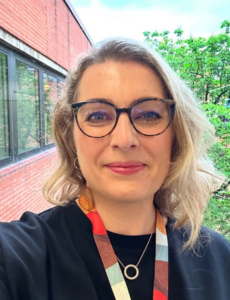
Tanya Last
ERP Project & Program Manager
ERP Programme Manager responsible for a successful delivery of the ERP programmes and projects through the implementation lifecycle.

Ryan Condon
Head of Content
Content architect and strategist at Comparesoft, helping software buyers make confident decisions through purposeful, well-structured content. Podcast Host and Head of Content since joining the team in 2019.

Latest ERP Podcast Episodes
Making Legacy-to-Cloud Public Sector ERP Transformations Stick
Ramzan Amin, Founder and CEO of SIM Consulting, joins the Comparesoft ERP Podcast to draw on his experience as ERP Programme Director at Kent County Council and explore why public sector organisations are being pushed to replace ageing ERP systems.
Listen and Watch the Podcast →
What ERP Failure Really Looks Like and How to Prevent It
James Robertson, ERP Troubleshooter & Published Author, explains what ERP failure really looks like today and why it is far more common than most organisations realise, arguing that up to 95% of ERP programmes fail at the executive decision-making level.
Listen and Watch the Podcast →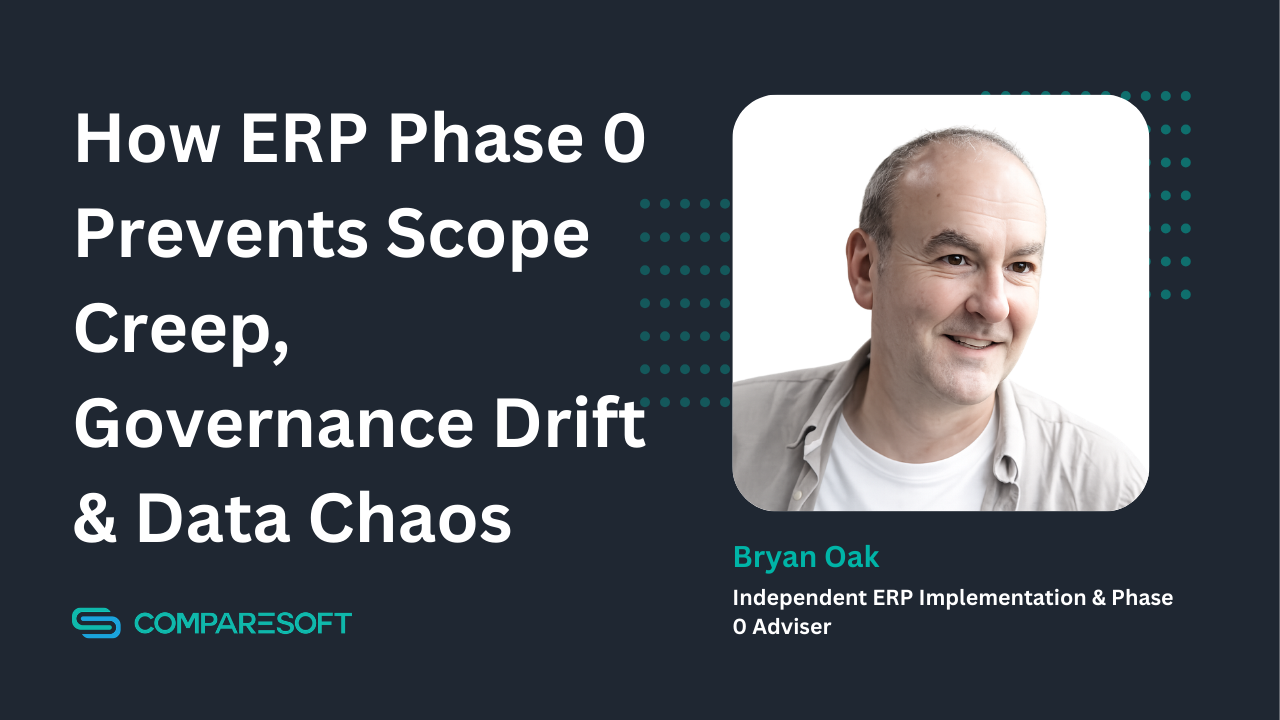
How ERP Phase 0 Prevents Scope Creep, Governance Drift & Data Chaos
Bryan Oak unpacks ERP Phase 0 and why it is the decision work that protects scope, governance and data from chaos later. Drawing on decades of experience advising leadership teams, Bryan explains what Phase 0 actually covers, what “good enough” looks like, and why organisations default to vendor selection before they have aligned on outcomes.
Listen and Watch the Podcast →Easily Shortlist & Compare ERP Software
Discover ERP systems for your accounting, sales, manufacturing, operations and delivery processes. See verified pricing, real features, realistic implementation plans & authentic ERP reviews. Takes just 40 seconds. Save up to 33% on ERP costs.