
AI-Native ERP: What Buyers Should Know Before Selecting a System
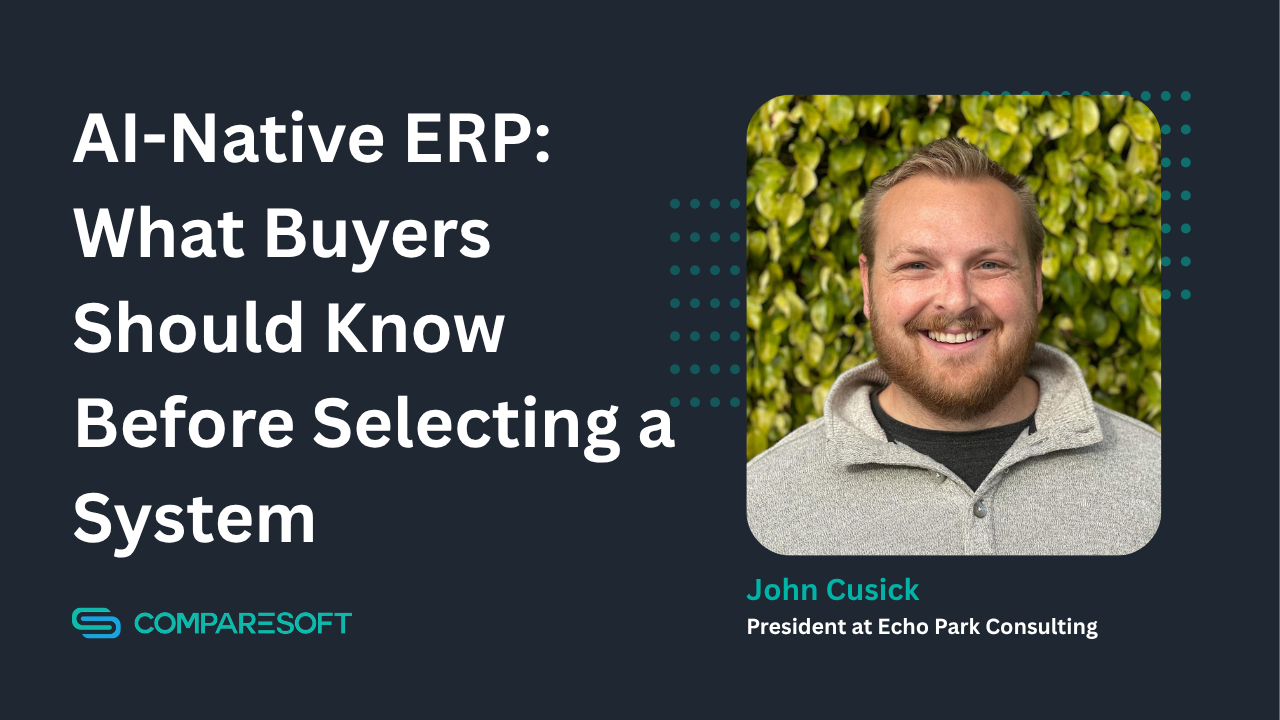
John Cusick joins the Comparesoft ERP Podcast to explain what AI-native ERP actually means for software buyers. He breaks down the practical differences between AI-native and traditional ERP systems, from implementation and evolution to integrations, training, and post-go-live governance.
In this episode
- What Causes Pain in Traditional ERP Implementations
- AI-Native vs AI-Enabled: What the Difference Actually Looks Like
- Where AI-Native ERP Sits in the Market
- Why Companies Are Moving from QuickBooks and Legacy ERP
- What an AI-Native ERP Implementation Actually Looks Like
- The “ERP Plus” Mindset
- Governance, Hallucinations, and Staying Safe After Go-Live
- How to Test Data Trust Before Going Live
- What to Look for When Shortlisting an AI-Native ERP
AI-native ERP is one of the most loaded phrases in finance software right now. Most legacy vendors are bolting AI on top of existing platforms. A smaller group is rebuilding ERP from the ground up around it. For finance leaders weighing up a move from QuickBooks, spreadsheets, or a heavily customised legacy system, the distinction matters more than the marketing suggests.
In this episode of the Comparesoft ERP Podcast, John Cusick, President of Echo Park Consulting, unpacks what AI-native ERP looks like in practice. He started his ERP career at NetSuite leading customer implementations and specialising in subscription billing. He now helps growing finance teams implement AI-native finance stacks, and he is direct about where these systems shine, where they fall short, and what buyers should actually test for.
What Causes Pain in Traditional ERP Implementations
Cusick spent years inside large, legacy ERP implementations before moving into the AI-native space. When asked what consistently caused the most pain, his answer was specific.
“Usually data migration,” he says. “Dealing with data that is billing data or revenue data has a big impact. Eventually, if you go public, say in the US, you’re going to have to provide very clean books. So a big part of these implementations that caused a lot of pain is making sure your data is in the right spot. A lot of dirty data had to be cleaned up, hard decisions to be made as to what you need to keep versus what you had before.”
Data is only the first layer. The second is people.
“From there, it’s just change management. You have to move people into a different day-to-day. And for them, they have to commit to that learning. So that sometimes becomes really, really difficult, especially for traditional ERPs because of the fact that it’s such a long implementation timeline.”
The third layer is decision paralysis. Cusick describes a pattern where the sheer weight of choices, combined with the rarity of the project, creates the conditions for costly customisation in ERP implementations.
“A lot of times these types of companies that are going through this change, it’s one that they’re going to do every 20 to 30 years,” he says. “There’s just so many nuances to deal with. Exceptions to the rule. And that creates a lot of tech debt as a result.”
AI-Native vs AI-Enabled: What the Difference Actually Looks Like
The phrase “AI-enabled” gets attached to almost every ERP brochure on the market. Cusick draws a sharper line.
“AI-enabled really means that those solutions are built with that AI functionality a lot of times, and it’s built on top of it. Usually the biggest way for you to tell is the AI being used in the system is just a chatbot,” he explains. “There are systems out there that just throw a thing on top and say, hey, you got all your data. Here’s a chatbot you can talk to. It’s not a bad thing. But the difference with AI-native solutions is that they can do things like trigger workflows or fundamentally change maybe the objects within ERP so that it works better for your business.”
The behaviour of the system, in other words, is the tell. An AI-native ERP can notice, prompt, and act on the data, not just describe it.
“They give you a lot of opportunity to do things like notify someone when two bills are the same on the same day from the same vendor. It creates a lot more opportunity for users to utilise the functionality in a way that’s not just, hey, what’s my data that I need to adjust? It actually helps you do the adjusting.”
When pressed on whether AI-native is closer to agentic and AI-enabled is closer to generative, Cusick agreed.
“As time goes on, these companies will get to be a little bit more aggressive in how they utilise AI within current systems that are out there, legacy systems. And I think they will get smarter. But if you look at it today, the ones that are built on AI natively are pretty far ahead in the sense that they can do a lot of things that maybe is a little bit more of a lift for some of the legacy ERPs today.”
Where AI-Native ERP Sits in the Market
AI-native ERP is not yet a fit for every business. Cusick is honest about who these systems serve well today, and who should keep looking.
“State of the art, all these things, brand new shiny toys. These companies are building ERP. That’s enterprise-level applications. Currently, the challenge they have is that they’re an inch deep and a mile wide because they’re being built from scratch. They’re being built a lot faster than our legacy ERPs are, but they’re still being built right now.”
The sweet spot, in his experience, is small to lower-mid market services businesses.
“If you look at SMB, the S of SMB, the small companies, are probably the best served to utilise this tool. A lot of the leading AI-native or AI-enabled ERPs are servicing companies between $2 million and $300 million ARR roughly. And they’re more towards services or SaaS-based high-tech companies, because they don’t have things like products, inventory, manufacturing, Warehouse Distribution (WD).”
For businesses with heavy inventory or manufacturing needs, that depth has to come from somewhere else, which is why fit matters more than novelty when shortlisting ERP options.
Why Companies Are Moving from QuickBooks and Legacy ERP
The companies coming to Cusick are not, as a rule, chasing AI. They are escaping something.
“You have more options in that stage between $2 to $300 million. A lot of companies made the decision to jump to a legacy ERP from QuickBooks or from spreadsheets. And now they’re stuck with one, a high cost in general, a subscription-based model for some of the legacy ERPs. And maybe they have failed implementations that have heavy tech debt.”
For those buyers, the appeal of AI in ERP is not the AI itself. It is the chance to start over.
“It makes a pretty good case for me going to an AI-native ERP. It’s going to be cheaper. I’m going to be able to clean up again, and I get to use some of the AI functionality. And I have a system that’s maybe not as much overkill as maybe going to a legacy ERP, which is built for more of a north of $300 million company.”
What an AI-Native ERP Implementation Actually Looks Like
Echo Park Consulting structures every implementation around five stages: plan, migrate and reconcile, integrate, train, and go live. The shape will be familiar to anyone who has run a cloud ERP project, but the emphasis is different.
“AI-native ERPs are more configurable and less customisable, so the highlight is really on that data,” Cusick says. “We use a kind of white-glove approach where we’re pulling some of that data out of your legacy system, entering it into the AI-native ERP, and then reconciling it, having you reconcile it. So it’s a lot of pulling of data, making sure that it’s in the right spot.”
Integration looks different too.
“The native integrations being built into these AI-native ERPs today are a lot better, smarter than they ever have been for any of the legacy ERPs. So for us, integrating is really helping you make sure things are connected in the right way, in the right fashion.”
Training shifts with the technology.
“Training is very different in the modern age because you have AI sitting there as a chat functionality, at a minimum, to answer those functional questions. So you can teach a man to fish, or teach a woman to fish, basically giving them the tools to say, hey, these are the questions you can ask. These are the prompts you can use to help learn and train.”
Average timeline, Cusick says, sits at three to four months. With one caveat.
“It comes back to what we talked about with legacy ERPs. There’s still a commitment from the client or the customer to be able to support the nuances that come out of the data. Because data cleanliness drives a lot of this. So if you have dirtier data, it’s going to take a little bit more time to go through it, because you need to make those decisions with our help.”
The “ERP Plus” Mindset
AI-native ERPs are finance-first by design today. Cusick is candid that buyers should not expect a single system to cover every business process, and should plan for what he calls “ERP plus”.
“Companies are looking at a solution that’s going to cover all of their business processes. And because we have that inch-deep, mile-wide kind of experience now with the ERP itself, you have to utilise these other best-of-breed solutions around it. So having that as something you expect going into the buying process will help you determine what systems are actually important to you, what business processes are most important to you. AR automation, AP automation, taxation, FP&A tooling, CRMs, all of these solutions. Going with the best-of-breed and connecting it might be the right answer.”
The takeaway: don’t expect your ERP to be everything.
“Don’t think of your ERP as everything, because you don’t have to. And that’s really the answer.”
Governance, Hallucinations, and Staying Safe After Go-Live
The other concern raised by the finance community is governance drift, which is the slow leak of unsanctioned automations, shadow logic, and workarounds that quietly undermine control. Cusick says AI-native systems are built with this risk specifically in mind.
“The cool thing about these AI-native solutions today is that they’re built with context in mind. They’re in more of a vacuum with bounds. And that’s a big part of their role in the market, to be able to build those bounds for you. So being able to create the governance, I think, is a lot easier than you would think.”
Hallucinations, the non-starter in finance, are addressed by the same architectural approach.
“That’s one of the largest roles of these AI-native ERP software companies in the marketplace. They have to be there to help create those bounds. That’s another reason why I don’t subscribe to the idea that AI will make SaaS obsolete, because it still needs to be controlled and put into context. These companies are building AI agents and building specific endpoints so that the actual user can feel more confident in the data, and not see it as something that might not make sense because it’s not in the right context. So it really trims down that possibility of hallucinations.”
How to Test Data Trust Before Going Live
Cusick’s advice for testing AI-native ERP before commit is the inverse of how most ERP demos are run today. Hands on, real data, real questions.
“Play with it. There are a lot of companies that don’t see the benefit in actually trying it. It’s becoming more palatable today than it ever has been. You’re not making a purchase of a legacy ERP that’s going to be in the millions of dollars to then not have it work for you. In this case, the stakes are a lot lower.”
“Get in there, try it, play with it, do your day-to-day in that environment, feel it out, ask those questions you maybe have wanted to ask your ERP through AI. That will make you feel more like it understands what you’re trying to do. Finance and accounting folks, yes, they have a structure, but they are challenged by a lot of the things they don’t know. And being able to make that easy for them to do by utilising AI in these tools can help open their eyes so that they can trust that what they’re putting in place is something that is going to work.”
What to Look for When Shortlisting an AI-Native ERP
For finance teams running an AI-native ERP selection today, Cusick says the criteria should look different from a traditional ERP shortlisting process.
“AI-native ERPs are really changing how companies work. So you have to flip it on its head. You need to look at them as something that’s going to evolve as you go. They’re not actually releasing functionality once or twice a year. They’re doing it once or twice a day in some cases. So there’s a lot of functionality and evolution that’s going to happen over time. You have to expect that what you’re buying today is not what you’re going to see in the next couple of months.”
He also recommends evaluating the system through the lens of use, not customisation.
“You have to think about that ERP from the lens of how it’ll be used and not how it’s going to be built out. A lot of legacy ERPs are evaluated from the effect that they are going to build it the way they want it. It’s more customisable versus configurable. With AI-native ERPs, you’re going to expect things are going to change and change quickly, and you’re going to evolve and get the best of what they have, but in a much quicker fashion.”
Three specific requirements should sit at the top of any shortlist, he says.
“One, does that AI functionality answer your most nuanced finance or business questions? The questions that maybe would take 15 to 30 minutes of creating a report, poking around in a legacy ERP. Could that be answered by AI in a couple of minutes? That saves tons of time as time goes on.”
“Then, how does that AI functionality allow you to analyse your data more effectively or more efficiently to close your books? Accounting software, at the end of the day, comes down to how quick you can close your books and how accurate it can be. So closing your books is the North Star. AI-native systems should be giving you that. You should be closing books much faster. If they’re not, it’s not moving the needle enough for you.”
“Thirdly, does that AI-native ERP show an aggressive product roadmap utilising AI? That’s a big part of the advantage, that it’s evolving. If you’re buying a system that is AI-native and they’re not growing at a pace that actually makes sense for the fact that they’re using AI-assisted functionality, then it’s probably not the right system for you. They need to make that promise that it’s going to evolve, that it’s going to grow, and that it’s going to be able to support your challenges of tomorrow, not just the challenges of today.”
It is the line that ties the whole conversation together. AI in ERP, Cusick reminds finance teams, is at the dumbest point it will ever be. The systems that will matter are the ones built to get smarter, not the ones built once and held still.
Listen to the full episode of the Comparesoft ERP Podcast featuring John Cusick for more on what AI-native ERP means for finance teams, implementation timelines, and how to evaluate the next generation of ERP systems.
What are You Looking to Improve with ERP?
Meet the Speakers

John Cusick
President at Echo Park Consulting
Helping Companies utilise AI-first ERPs to Revolutionise their Order to Cash Processes.

Ryan Condon
Head of Content
Content architect and strategist at Comparesoft, helping software buyers make confident decisions through purposeful, well-structured content. Podcast Host and Head of Content since joining the team in 2019.

Latest ERP Podcast Episodes
How Manufacturers Can Optimise Supply Chains By Fixing ERPs & Layering AI
Lee Wachter explains how mid-market manufacturers and CPG companies can regain control of failing ERP supply chain operations, drawing on senior leadership experience at Olympus, Diageo, and three years inside an ERP vendor.
Listen and Watch the Podcast →
How an ERP Project Manager Keeps Large-Scale Programs on Track
Tanya Last explains the role of an ERP project manager and how large-scale ERP programs are kept on track from early delivery through to post-go-live stabilisation.
Listen and Watch the Podcast →
How ERP Phase 0 Prevents Scope Creep, Governance Drift & Data Chaos
Bryan Oak unpacks ERP Phase 0 and why it is the decision work that protects scope, governance and data from chaos later.
Listen and Watch the Podcast →Find the Right AI-Native ERP System for Your Business
From book closes to billing automation, every finance team runs differently. Quickly find the AI-native ERP that matches your processes, scale, and integration needs — in just 40 seconds.