
Leading Water Utility Maintenance With a CMMS at United Utilities & Binnies
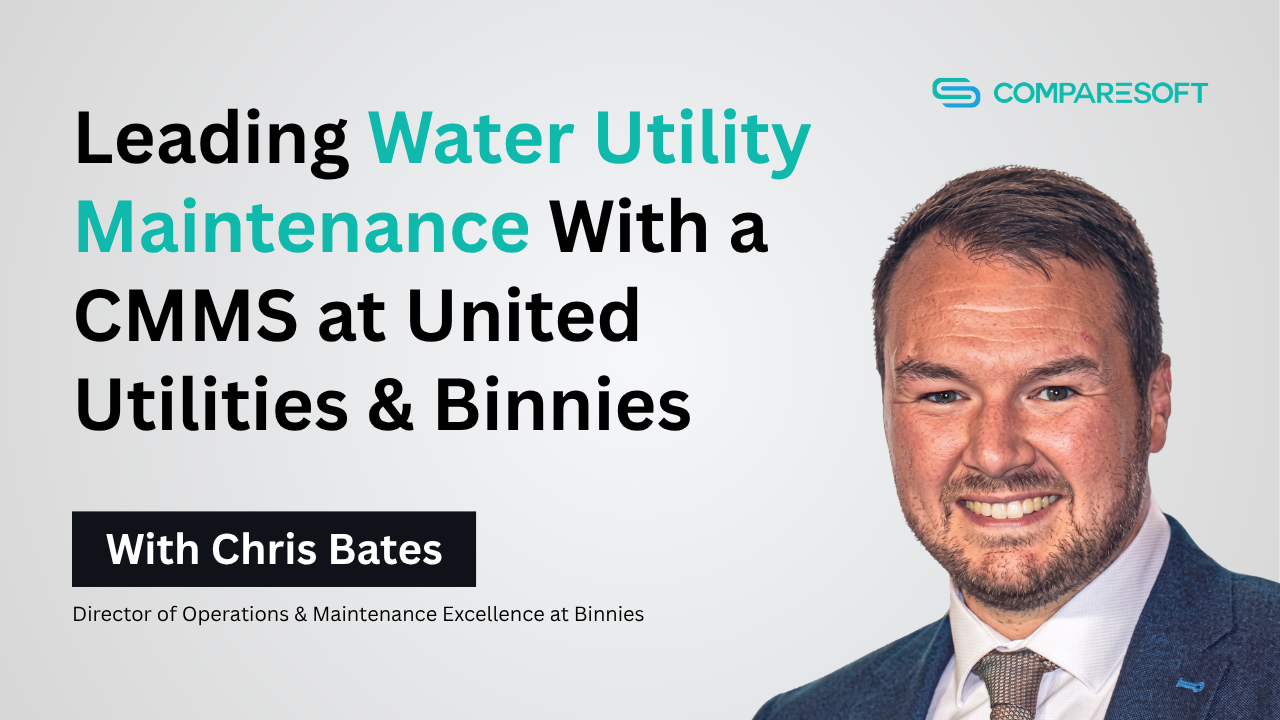
Chris Bates, Director of Operations and Maintenance Excellence at Binnies, explains what water utility maintenance management really takes, discussing the CMMS requirements matter more than the system, how to select and implement a CMMS in a regulated environment, how to win technicians over & where AI fits in the water sector.
In this episode
- When Selecting CMMS For Water Utility Maintenance, Start With the Requirements
- How to Select a CMMS for a Water Utility
- Why the System Alone Won’t Fix Your Maintenance
- The KPIs That Prove Your Maintenance System Is Working
- Building the Culture and Team Behind the System
- Winning Technicians Over to a New Maintenance System
- Where AI Fits in Water Utility Maintenance Management
- Making the Case for Maintenance to the C-Suite
Water utility maintenance management sits on top of a vast, aging and heavily regulated asset base, where a single software decision can shape a decade of reliability. Buy the wrong system, or the right system for the wrong reasons, and you inherit years of poor adoption and dirty data.
Chris Bates is a chartered mechanical engineer and Director of Operations and Maintenance Excellence at Binnies, the water and environmental consultancy, where he leads a team of consultants advising water companies on asset health. Before that he spent eight years at United Utilities, the UK’s largest listed water company, rising from graduate engineer to Reliability Maintenance Manager and helping shape its predictive maintenance strategy.
By the end of his time at United Utilities, Chris was running specialist maintenance across the full water cycle, “everything from abstraction from a reservoir or a borehole all the way through to delivery, through to tap,” he explains, “and similarly treatment, from flushing your toilet all the way out to river.” His teams covered planned instrumentation, condition monitoring and lubrication.
At Binnies, his consultancy team either drops into a tactical fix, such as improving planning and scheduling, or leads a much broader reliability transformation covering “new processes, people, systems, capability.”
In this episode of the Comparesoft Maintenance Management Podcast, Chris explains how to select, implement and adopt a maintenance system in an asset-intensive water environment, and why the requirements matter more than the software.
When Selecting CMMS For Water Utility Maintenance, Start With the Requirements
Ask Chris which Computerised Maintenance Management System (CMMS), the software a maintenance team uses to record assets, plan work and store history, he recommends, and he refuses to name one.
“It’s really important to us that we’re agnostic,” he says. “We forever guide on implementation of CMMS, or conversely recovery from poor implementation, which we see quite a lot. What we forever guide towards is you’ve got to nail the requirements upfront. This is the process I want to enable, therefore these are the requirements, and this is the level of training I need to give people. If you really nail that stuff, you set yourself up for a much smoother journey.”
In a water utility, that discipline is not optional. Spending is funded by bill payers and bound by procurement rules. “It can’t be as simple as just picking a multi-million pound CMMS investment off the shelf,” Chris explains. “There’s a whole procurement process that needs to be held to.”
The work he sees skipped most often is the change analysis underneath the requirements: identifying the benefits you expect and designing out the change across “people, processes and the tools that are available, and not all of those are the CMMS themselves.” When teams choosing CMMS Software do that first, the market conversation gets far easier.
How to Select a CMMS for a Water Utility
Requirements only work when a strategy sits behind them. Chris is honest that you will never have every answer at the start, as long as you know where you are heading.
“What isn’t OK is a really immature set of requirements that isn’t future-proof, aligned or guided by a strategy,” he says. “If you know where you’re trying to get to in 10 years’ time, if you can at least set out a vision you’re trying to achieve, then you’re going to be a whole lot closer than if you just think, well, we need a new CMMS because this one’s obsolete.”
Reputation is not the same as fit. “There are a number of big players in the CMMS game who have a really good reputation,” he says, “that doesn’t mean they’re the right ones for you, because every organisation is unique in the culture it has within it.”
What decides the shortlist is ambition. Chris has worked with SAP and IBM Maximo across both tactical and enterprise-wide projects, and the two look very different. “We either see a tactical CMMS implementation to just smooth out planning and scheduling, then we see much more ambitious implementations that are truly organisation-wide, where an SAP would lend itself well as an Enterprise Asset Management (EAM) platform.”
His point for buyers is to decide which of those you are. “You’ve got to set your level of ambition early, and that ambition tends to play out in the amount you’re prepared to spend implementing it and the timeframe.”
Why the System Alone Won’t Fix Your Maintenance
A recurring theme in water utility maintenance management is the first-time buyer who believes new software will fix everything. Chris does not.
“If you’ve worked in maintenance for a little bit, then throwing in a CMMS when your team ignores their existing one isn’t a silver bullet,” he says. “I’ve yet to find an instance where it’s just a tech-led solution and everything gets better.” When a client opens with that expectation, sometimes the honest move is to walk away. “We have walked away from engagements where we’ve said, actually, I don’t think this is quite going to do what you need it to do.”
His day-one recommendation is not a system at all. It is a reliability maturity assessment, benchmarking your operation end to end against what a leading reliability organisation looks like. Those assessments expose an uncomfortable truth about data. Chris asks for the maintenance strategy, the ISO 55000 documentation, the work orders and the asset register, and rarely gets them. “We might get an asset register, but with a caveat that it’s only 80% accurate, or 60% accurate,” he says. The point is blunt: “If you’ve not got an idea of what your designed organisation looks like, then how can you possibly kick on, because you don’t know the base you’re starting from?”
He has lived the consequences. On one project a measuring point built into SAP was meant to trigger a spares order automatically when a screen press hit a wear threshold. The system fired correctly, but the foundations failed around it. The site team binned the delivered spares, the asset register was wrong so the parts were incorrect, and the readings were unreliable because the SAP field had no units. It is the clearest argument for cleaning your data before you lean on the system.
The KPIs That Prove Your Maintenance System Is Working
Once a CMMS is live, Chris measures success with two distinct suites of Key Performance Indicators (KPIs).
The first assures the processes you have designed: compliance, people using the system, work flowing through without deviation. He leans on Robert Merton’s strain theory to read weak compliance. “If a valued goal can’t be achieved by legitimate means, then deviance results. So if you’re not seeing good compliance, it effectively means your process isn’t allowing your teams to do what they need to do.”
The second suite tracks the shift you are actually trying to make. “If you’re trying to move to a more planned state, you’d start to see the state of the organisation change,” he explains. “A drop in reactive work orders, a greater preventative maintenance compliance, a better schedule compliance.” Those changes compound into a decrease in mean time to repair and, in turn, an uptick in reliability.
The two suites answer different questions:
Process assurance KPIs (is the system being used?) | Outcome KPIs (is the operation changing?) |
Process compliance | Fewer high-priority reactive work orders |
System usage and uptake | Higher preventative maintenance compliance |
Work flowing through without deviation | Better schedule compliance |
No workarounds outside the system | Lower mean time to repair, higher reliability |
For anyone setting KPIs for the first time, his advice is practical. Make them SMART, which means:
- Specific
- Measurable
- Achievable
- Relevant
- Time-bound
“You’ve got to know what data you’ve got available, you’ve got to know you can trust it, and then it’s got to drive an action,” he says. Expect them to change too, retiring a metric once it has done its job. “The KPI would evolve as your maturity evolves.”
Behind it all is coherence. Chris credits his old chief maintenance officer at United Utilities with the model he still uses: top-level objectives, with each manager owning a scorecard that shows how they play into them, reviewed every month. Mapping those measures against your Asset Management Software early makes the data far easier to trust later.
Building the Culture and Team Behind the System
Numbers only move when people are aligned behind a shared idea of what good looks like. Chris frames this as identity.
“It’s about being really clear on what your vision is, what end state you’re trying to achieve as a maintenance function,” he says. “If everyone’s aligned behind that vision, then those conversations tend to be pretty straightforward.”
The hard part is unlearning old rewards. “If you’re in a reactive world, the chances are you get a pat on your back when you bring something back in at two in the morning,” he says, “despite the fact that’s less safe, less cost-effective and not aligned to your organisation’s outcomes. Moving to celebrating when we’re 100% compliant with our schedule that week is a huge shift.”
Sustaining a big team takes relentless repetition, paired with a culture that can admit when things go wrong. “The biggest blocker we’ve seen is a lack of ability for those trying to implement the change to play back when it’s going badly,” Chris says. “If you can’t put your hand up and say this isn’t quite going the way we intended, that can be really counterproductive.” He calls it “that zero-blame piece,” and treats it as central to any transformation.
Winning Technicians Over to a New Maintenance System
Adoption is where water utility maintenance management is won or lost, and Chris is candid that the leap into condition monitoring can feel like a loss of purpose for an engineer.
“If you’re used to dealing with motors where the paint’s burnt off the outside, and contractors descending at no notice at great cost,” he says, “and then you’re being asked to stick something magnetic on the outside of a motor and told it’s a six, and you don’t need to do anything, the lived experience of that engineer is huge. There’s every chance people walk away from that first task saying, I don’t really feel like I’ve done anything today.”
His answer at United Utilities was to make the data mean something. A route-based condition monitoring team focused on the most critical assets, while mechanical engineers were tooled up with handheld vibration analysers for less critical equipment. A red screen was not the end of the job, it was the start of a conversation with a specialist who could show the engineer why it mattered. “All of a sudden your red screen means something to you,” Chris says. “Now there’s a defect you have a chance of being bought into.” Adoption, in other words, is a human problem before it is a technical one.
Where AI Fits in Water Utility Maintenance Management
Artificial Intelligence (AI) is not new to condition monitoring, and Chris is measured about it. His concern is not capability but distance.
“My worry is that it removes that human-led piece,” he says. “It takes the engineer a step further away from understanding the data and making it real. Now you’re asking that person to trust yet another piece of technology, with even less insight and even less opportunity to be hands-on with that data.”
He sees a real prize, but only on the right foundations. “That opportunity probably exists within more mature organisations where there’s a strong data-driven culture,” Chris explains. “What it probably does is realise efficiencies and allow you to process more signals without such a specialist resource. It probably allows for an early triage.” Asked whether he has seen it deployed well, he is honest: “Have I seen it implemented successfully anywhere? No, not right now.”
His advice to engineers and leaders is simpler than the technology. Try it. “I see some really successful people who won’t go near AI, and that’s absolutely fine, but you can’t do that having not given it a go. Because if you’re not prepared to give it a go, then what else aren’t you prepared to give a go?” The same openness, he notes, is what separates people who adopt a new CMMS or Predictive Maintenance Software from those a new system quietly designs out.
Making the Case for Maintenance to the C-Suite
Much of the role is translating maintenance into a language the board understands, and Chris opens with a challenge he puts to executives.
“Who’s responsible for health and safety? That person. Who’s responsible for your IT security? That person. Who’s responsible for reliability? And you’re met with silence, typically,” he says. “For me, that’s unforgivable. You’re an asset management company, but you’ve got no one accountable for the health of those assets.”
He reframes the cost argument entirely. “Maintenance is not a profit centre. Maintenance is there to cost you money, because the money you spend here is worth more than it is if you let those assets get to where they would without that maintenance team.” Where top-down sponsorship is missing, he coaches a bottom-up route: fit a small amount of low-cost kit to a known problem asset, prove the benefit, and build a case study that is “real to your organisation,” not a textbook.
Chris is about to test his own advice, moving from consultancy back to an owner-operator. “I’ll be needing to practise what I preach,” he says. It is a fitting note from someone who has spent a career arguing that water utility maintenance management is never really about the system. It is about the requirements, the data and the people you build around it.
What Type of Maintenance Do You Perform?
Meet the Speakers

Chris Bates
Director of Operations & Maintenance Excellence
Leading a team of consultants delivering operational excellence and maintenance excellence products and services while managing the performance and sustainable growth of the business unit overall.

Ryan Condon
Head of Content
Podcast Host and Head of Content of Comparesoft.

Prasanna Kulkarni
Founder, Product Architect & CEO
Product Architect and Founder of Comparesoft.

Latest Maintenance Podcast Episodes

From Jet Engines to Runways: Airport Maintenance Management at MAG
James Ayre, Asset Management Director at Manchester Airports Group (MAG), explains what airport maintenance management takes at the UK’s largest dedicated cargo hub. After 20 years at Rolls-Royce, James oversees more than 220,000 assets across Manchester, London Stansted and East Midlands.
Listen and Watch the Podcast →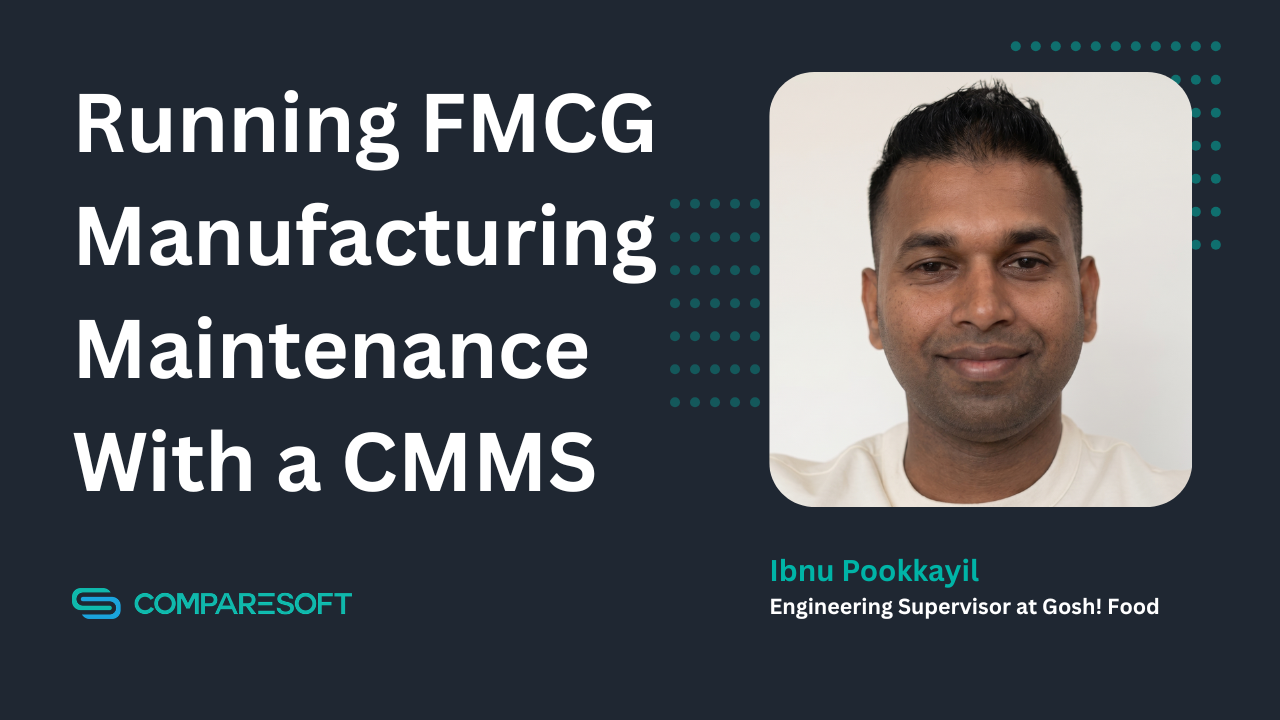
Running Maintenance in FMCG Manufacturing With a CMMS
Ibnu Pookkayil, Engineering Supervisor at Gosh! Food shows what running maintenance in FMCG manufacturing actually involves, explaining how his team cut reactive work below 20 per cent, why perishable products raise the cost of downtime, and how a CMMS underpins planned maintenance.
Listen and Watch the Podcast →
Maintenance in Food and Beverage Manufacturing at Arla Foods
Josh Clarke, Senior Maintenance and Engineering Manager at Arla Foods' Aylesbury site, details the ins and outs of food and beverage manufacturing of a 24/7 dairy that produces 1.5 million bottles of milk a day and handles 500 to 700 work orders a week.
Listen and Watch the Podcast →Find the Right CMMS Software for Water Utility Maintenance Management
From abstraction and pumping stations to treatment works, buried networks and flow instrumentation, every water utility maintains a vast, regulated asset base spread across hundreds of sites. Quickly find the CMMS software that matches your asset mix, your risk-based maintenance strategy, and the compliance and uptime standards you are held to.