
Leading Waste & Recycling Maintenance at Biffa
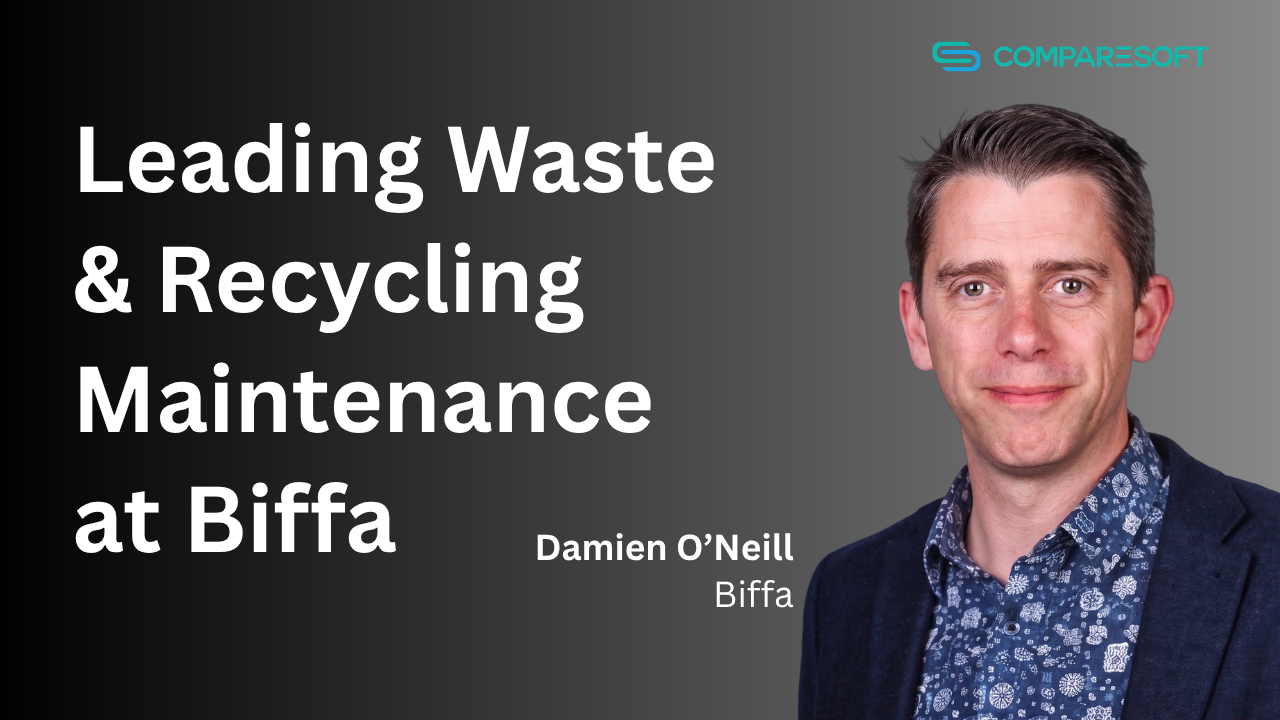
Damien O'Neill of Biffa explains what CMMS selection really takes in waste and recycling when leading maintenance across more than 100 UK sites and roughly £1bn of assets.
In this episode
- From the Royal Navy to Waste and Recycling Maintenance
- Scaling Maintenance Across 100+ Recycling and Waste Sites
- Why the Right People Decide Your Maintenance Operation
- The Communication and KPI Framework Behind a Multi-Site Team
- Why Proactive CMMS Selection Beats Waiting for a System to Break
- What to Look for in a CMMS: Start With the Technician Interface
- Get Your Data Right Before You Move to a New CMMS
- Winning Technician Adoption With One System and One Linear Workflow
- Where AI Fits in Waste and Recycling Maintenance
- Making the Case for a CMMS Investment
Damien O’Neill is Group Head of Engineering (Maintenance) at Biffa, the UK waste management and circular-economy business, where he leads maintenance across more than 100 sites and roughly £1 billion of assets. Before Biffa he spent 12 years as a marine engineer in the Royal Navy, then worked in facilities management at EMCOR, precision manufacturing at Doncasters and outsourced production maintenance at ATS.
In this episode of the Comparesoft Maintenance Management Podcast, Damien explains how he approaches CMMS selection in an asset-intensive waste and recycling environment. A CMMS, or Computerised Maintenance Management System, is the software a maintenance team uses to record assets, plan work and store history. His argument is that the data you feed that system, and the technician who uses it, matter far more than the software you buy.
From the Royal Navy to Waste and Recycling Maintenance
The Royal Navy gave Damien structure and discipline, but the skill he leans on most is adaptability. “That skill of being parachuted in anywhere and, on the fly, problem solve, maybe not the perfect solution but something that works for now, I’ve used throughout my career,” he says. One instructor framed it memorably: “We give them these skills so they know how to bodge in a fight, because you may not have the resources you’ve got when training.”
Industry tested that adaptability. At Doncasters, the precision manufacturer, he inherited a function with no system at all. “They had no CMMS when I started, and I was tasked with getting one in place,” he recalls. “I was winging it a bit. Then all of a sudden, there’s nothing, where do you even start?” It was a sharp contrast with the military, where every record, document and system was already in place.
Scaling Maintenance Across 100+ Recycling and Waste Sites
Biffa has changed shape underneath him. “Since I joined in 2020, and here we are in mid 2026, the business has effectively doubled in size, primarily through acquisition,” he says. That forced a build-as-you-go approach, assessing the maturity of each site while writing the playbook just in time. “We’ve always been racing to stay ahead of the sites catching us up.”
The central team scaled too, from Damien and one CMMS manager to three regional engineering managers, a CMMS lead now covering stores, reporting, data and onboarding, and a team of controls technicians used as “deployable surge resource.”
Managing at that distance changed the job, and one test keeps it grounded. “If what we’re doing at our level does not make the life of the person next to the asset at three o’clock in the morning easier, then we need to question what we’re doing,” he says. The risk with any new process is “causing friction or added burden that they don’t need.”
Why the Right People Decide Your Maintenance Operation
Ask Damien what makes a good maintenance operation and he does not start with systems. “Fundamentally, it’s all about the people,” he says. “Getting the right people in the right seats is absolutely critical. If you’ve not got the right person, you can have all of the data and processes in the world, and it just falls apart.”
The site maintenance manager decides it, and the role has widened. “We effectively need our maintenance managers to be P&L managers now,” he explains, referring to profit and loss accountability, alongside forecasting, parts, suppliers and the client relationship. That exposes a common trap. “Because someone’s been there a long time and is technically very great, that does not make them a good maintenance manager. It might, but it’s not a given.” Promote a brilliant technician by default, he warns, and “six months in, it all falls apart.”
Biffa’s answer is a dual career track. Its controls technicians hold management-graded roles. “They’re a hundred per cent technical, they don’t line manage anybody, but they’re the same grade, the same perks, the same package as a maintenance manager,” he says. “That would traditionally be a stop, that you’ve hit the career ceiling. With us, that isn’t the case.” Recruitment reaches beyond the sector too, drawing on manufacturing and the military.
The Communication and KPI Framework Behind a Multi-Site Team
A national team needs a rhythm, and Damien runs his on EOS, the Entrepreneurial Operating System from Gino Wickman’s book Traction, adapted for a large business. The spine is a 90-minute meeting every Monday for issue solving, a lighter Friday catch-up, and a 90-day cycle with quarterly and annual reviews. Issues are logged in Microsoft Lists so nothing is lost while people travel. “It’s a high-trust environment where we can openly challenge each other,” he says, and he welcomes his team challenging him when he misses a commitment.
KPIs, or Key Performance Indicators, get a short slot in that meeting. “All of our KPIs have a target, and it’s either on track or off track,” he explains. “If something is off track for two consecutive weeks, or somebody feels there’s an underlying issue, it becomes an issue we discuss.” The suite is practical: compliance and safety work orders, leading safety and work-quality observations, backlog, completion rates, technician utilisation, weekly spend and forecast accuracy.
The data journey has a twist. Biffa moved from Excel reports stitched with macros to a Business Intelligence connector feeding an internal data lake and Power BI. The problem now is abundance. “It sometimes feels like we’re almost drowning in data,” he says. “At the beginning we didn’t have enough, and now we’ve almost got too much. Turning that data into meaningful insight is where we are at the moment.”
Why Proactive CMMS Selection Beats Waiting for a System to Break
Biffa has run its current CMMS (Eleco ShireSystem) for nine or 10 years, across roughly 130 locations, 15,000 assets and 200 users. It is not failing, which is exactly why Damien is looking at the market. “Often people wait for a system to reach breaking point, then start looking when there’s an emergency,” he says. “You’re not going to make the right decision.” His principle is to review deliberately. “If something’s not working, almost push it over the edge yourself, rather than waiting to be reactive.”
The bar for change is high. Because Biffa has “grown up alongside” its CMMS and onboarded acquisitions onto it, the disruption of switching only grows. “We need to be super clear about what we need from a new system, and what is going to be worth the pain of transition.” Applying that proactive mindset to CMMS software rather than a reactive one is, for Damien, simply how good maintenance teams think.
What to Look for in a CMMS: Start With the Technician Interface
Most systems clear the functional bar, Damien argues. “The core is pretty much the same. They’re effectively databases,” he says. “Most systems can build your location tree, asset tree, user hierarchy, contacts, parts inventory. There’s not much difference between one and another.”
The differentiator sits in the place buyers most often overlook. “The game changer for us is the user interface for the technician,” he says. “Too often, the user experience for the technician on the frontline is a bit of an afterthought.” He is unsparing about the result. “That technician interface feels 20 years old. It doesn’t render well on a mobile device, it’s difficult to use with gloves, and yet we ask people to wear gloves on our plants. It’s not easy to find the right asset in the asset tree.” The knock-on is real: technicians log work against the wrong asset, then get pulled up for it, when the interface was the problem.
Get Your Data Right Before You Move to a New CMMS
A new system will not rescue poor data. Biffa has launched a project at one site to build what Damien calls a “golden data set” for a single asset, covering task instructions, images, diagrams, parts and barcoding. His benchmark is demanding. “Can I take a competent engineer from another location, or outside our business, and give them enough information through that interface to execute the task? So they don’t need site knowledge.” He reaches for an analogy. “It’s the old Haynes manuals for cars. You could take someone who knew about cars, but not that car, and they could do the task.”
He puts the responsibility on his own team, not the vendor. “That’s all on us. That isn’t the CMMS. That underlying data set is all on us to deliver.” Skip it, and migration is pointless. “If we just take what we’ve got and dump it into a new system, it isn’t worth it.” That discipline turns a system change into a real step forward in preventive maintenance rather than an expensive copy of the old world.
Winning Technician Adoption With One System and One Linear Workflow
Adoption is won by removing friction, and Damien describes the friction his technicians live with. A preventive maintenance task too often ends in one unhelpful word. “All we give them is a page of things to check, and then how do they articulate the results without just going, done. What does done mean?” Adding a photo is worse. “I’ve got to take a photo, save it to the device, go back into the CMMS, click upload, then find it in my files. No one’s going to do that, it’s too much friction,” he says. “All of that data, that human experience of being next to the asset, is lost in the word done.”
The selling point writes itself. “Right now I need you to log into three systems and transfer a number from one into another, and take a photo and upload it,” he says. “Now I’m going to give you a system where an entire work order, risk assessment, permits, photos, meter readings and parts, is in one linear workflow, and time tracking is automatic. We just need you to be a technician, not an administrator.” That, he says, “is the greatest seller for any technician.”
The implementation partner matters too. “The best integrators come from a maintenance background and understand real-world system usage on the shop floor,” he says. Without that, “you end up with a data dump and run, and that’s a recipe for a failed implementation.”
Where AI Fits in Waste and Recycling Maintenance
On Artificial Intelligence (AI), Damien is candid that Biffa is “dabbling at the moment,” and sees two areas of value. The first is analysis no human could do by hand. “We’ve used it to analyse an asset class at one location, nine years of asset history, maybe 14,000 work orders,” he says. “A human can’t do that, not meaningfully.” The catch is trust, so he applies a risk-based test: “What’s the risk if the AI gets it wrong?”
The second is frontline fault finding. Rather than a technician trawling history they will never have time to read, the system does it for them. “The technician can input the symptoms they’re seeing, and it can look at the manual, the asset history, even go on the internet,” he says, rating one source in particular. “YouTube is a great resource that’s woefully underutilised by frontline technicians.” Used well, AI augments collective knowledge. “If you can collectively pull on the knowledge of your entire technician workforce, then that technician’s skill and knowledge can be used.”
Making the Case for a CMMS Investment
Maintenance is often treated as a cost centre, so Damien tailors the case to the audience. For a smaller business without a system, he leads with exposure. “You’ve got to start by focusing on risk, whether that’s compliance risk or risk of asset failure,” he says. “Most business owners want to know where the risk lies, and the extent of it,” alongside asset cost tracking that shows which assets drain money.
At enterprise scale the argument turns strategic, toward long-term asset management and lifecycle planning, and it centres on people. “The pool of skilled engineering technicians is certainly not getting any bigger,” he says. “So what’s the force multiplier to get those people as efficient as possible? How do you stop them jumping between systems doing admin tasks? Because you can’t just go out and get another one, they’re not there.”
That is the thread through Damien’s whole approach. The system is close to a commodity; the value lies in the data behind it and the technician in front of it. “We just need you to be a technician, not an administrator,” he says, and every part of his selection process is built to make that true.
What Type of Maintenance Do You Perform?
Meet the Speakers

Damien O'Neill
Group Head of Engineering (Maintenance) at Biffa
Spearheaded the strategic direction and leadership at Biffa of a dynamic team comprising over 250 personnel, more than 100 locations, and £1bn worth of assets.

Ryan Condon
Head of Content
Podcast Host and Head of Content of Comparesoft.

Prasanna Kulkarni
Founder, Product Architect & CEO
Product Architect and Founder of Comparesoft.

Latest Maintenance Podcast Episodes
Maintenance in MTO Manufacturing: 300 Machines & 1000 Custom Doors a Day
Israel Arrieta unpacks maintenance in made-to-order (MTO) manufacturing at TruStile Doors and how he runs a 24/7 operation across 900 maintainable assets and 1000 custom doors a day with CMMS Software.
Listen and Watch the Podcast →
Leading Water Utility Maintenance With a CMMS at United Utilities & Binnies
Chris Bates, Director of Operations and Maintenance Excellence at Binnies, explains what water utility maintenance management really takes, discussing the CMMS requirements matter more than the system, how to select and implement a CMMS in a regulated environment, how to win technicians over & where AI fits in the water sector.
Listen and Watch the Podcast →
From Jet Engines to Runways: Airport Maintenance Management at MAG
James Ayre, Asset Management Director at Manchester Airports Group (MAG), explains what airport maintenance management takes at the UK’s largest dedicated cargo hub. After 20 years at Rolls-Royce, James oversees more than 220,000 assets across Manchester, London Stansted and East Midlands.
Listen and Watch the Podcast →Easily Shortlist & Compare CMMS Software
Every maintenance team is run differently. Easily identify the best maintenance management software options that suit your way of maintenance. Takes just 40 secs, saving you 11 hours of research.