
Maintenance in MTO Manufacturing: 300 Machines & 1000 Custom Doors a Day
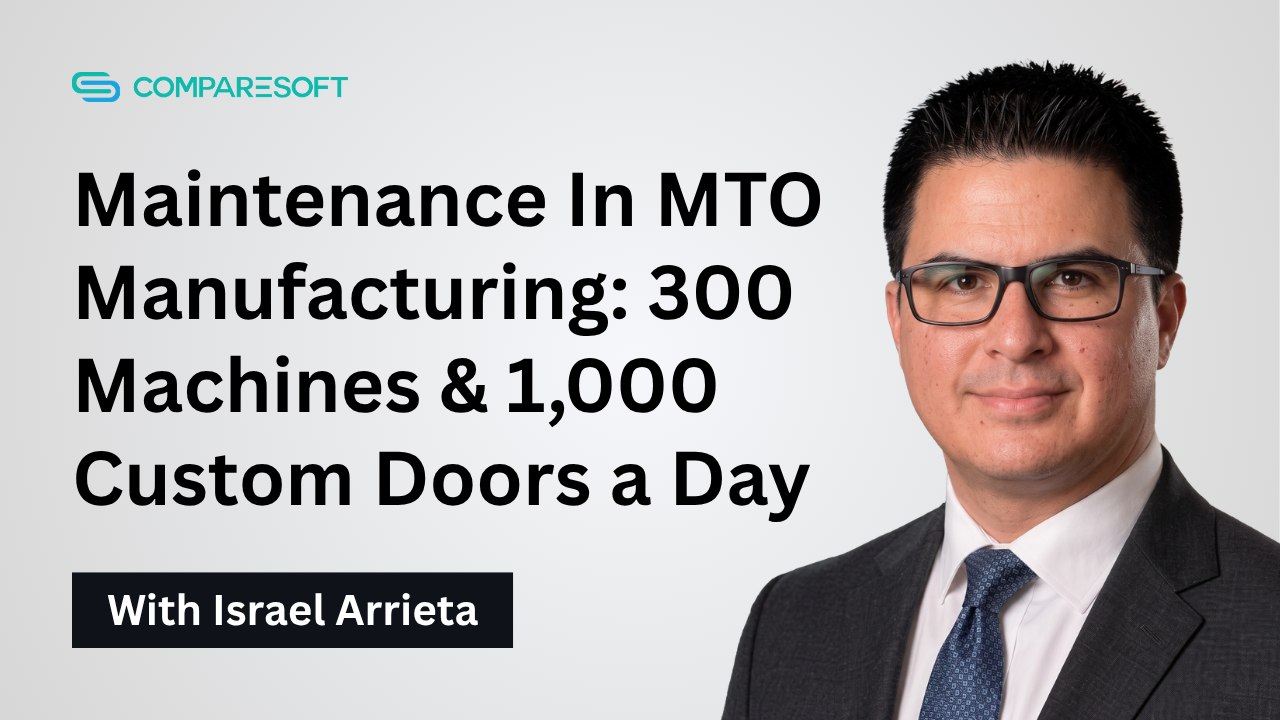
Israel Arrieta unpacks maintenance in made-to-order (MTO) manufacturing at TruStile Doors and how he runs a 24/7 operation across 900 maintainable assets and 1000 custom doors a day with CMMS Software.
In this episode
- Inside the MTO Maintenance Set-Up at TruStile Doors
- Why the CMMS Is the Backbone of MTO Maintenance Management at TruStile
- Replacing a Legacy CMMS: From eMaint and UpKeep to Fiix
- Three Things to Get Right Before You Select a CMMS
- What CMMS Implementation Really Involves
- What Fiix Does Well, and Where It Falls Short
- Spreadsheets, Calendar PMs and Ranking Critical Assets
- Where AI Fits Into MTO Maintenance Management
- Making the Business Case for Maintenance Spend
- Troubleshoot the Environment, Not Just the Machine
From Naval Aviation to the Factory Floor: MTO Maintenance Management at TruStile Doors
Made-to-order (MTO) manufacturing breaks the usual rules of maintenance. On a mass-production line, one machine makes the same part every few seconds. In an MTO plant, the product changes with almost every unit, so the equipment, the utilities and the people behind them have to stay reliable through constant variation.
Israel Arrieta is Senior Maintenance Manager at TruStile Doors, a made-to-order manufacturer producing more than 900 custom doors a day across a 24/7 operation. Before industry, he spent 10 years in the US Navy as an aviation structural mechanic, then led maintenance in medical devices and pharmaceuticals.
In this episode of the Comparesoft Maintenance Management Podcast, Israel explains what MTO maintenance management takes at scale: why the CMMS is an operating model rather than a piece of software, how he selected and implemented Fiix, and why the goal of a strong maintenance team is to become invisible.
Inside the MTO Maintenance Set-Up at TruStile Doors
Israel’s remit covers maintenance and facilities across multiple manufacturing sites. “Across that broader footprint, we’re approaching about nine hundred maintainable assets,” he says. “At our largest operation we’re running essentially twenty-four seven and producing roughly a thousand custom products per day.”
The word custom defines the challenge. “This isn’t one machine producing the same item every 30 seconds. It’s essentially a SKU change between one product and the next,” he explains. In practice, the stock-keeping unit (SKU) changes almost every time the line moves. The equipment runs from CNC (computer numerical control) machining to automated material handling, saws, sanders and finishing lines.
Underneath all of it sits what Israel calls the second factory. “That’s the infrastructure: compressed air, dust collection, boilers, chilled water, cooling towers, HVAC, fire protection,” he says. “These don’t directly touch the product, but they can shut down the entire operation when they stop working.”
Scale is the other constraint. The sites process 7,000 maintenance work orders a year, and on a given shift as few as four or five technicians cover a very large equipment population. “Scale changes the way you lead maintenance. You can’t rely on tribal knowledge and you can’t rely on heroics,” he says. That is why systems matter more than any individual. “I don’t want our maintenance strategy to be ‘call Bob because Bob knows that machine,'” he adds. “Eventually Bob goes on vacation or retires. The organisation has to know what Bob knows.”
Why the CMMS Is the Backbone of MTO Maintenance Management at TruStile
Ask Israel where the culture starts and he points to the computerised maintenance management system (CMMS), the software a maintenance team uses to log assets, plan work and store history. “The backbone is our CMMS, but the important part isn’t the brand of the software,” he says.
Buying one is not an IT project. “A CMMS implementation is really an operating model project disguised as a software project,” he explains. “You’re deciding what your asset hierarchy looks like, how work enters the organisation, who prioritises it, how technicians document their work. Those aren’t IT questions. They’re maintenance management questions.”
That thinking shapes how work reaches his team. A simple digital request portal lets employees outside maintenance ask for support without understanding the CMMS, and visual dashboards keep priorities and backlog in the open. He also refuses to force everything into one tool. Technical maintenance lives in the CMMS, while operator-led total productive maintenance (TPM) runs in lighter tools such as Microsoft Office and Power BI. “The tool should fit the process,” he says.
What has to stay consistent is the information itself, and that matters more as his scope grows across sites. He wants common asset structures, work order expectations, failure information and KPI (key performance indicator) definitions. “If one site defines a failure one way and another defines it differently, you don’t have enterprise analytics anymore,” he explains. “You just have several databases sitting next to each other.”
Replacing a Legacy CMMS: From eMaint and UpKeep to Fiix
TruStile had tested several platforms before Israel arrived, without ever getting full value from them. “The challenge was getting the full use of those platforms and getting reliable information,” he says. “There were too many people involved to really have a fundamental understanding.” A fresh start was a chance to reset. “We used eMaint, we used UpKeep, and the system we transitioned to was Fiix, by Rockwell Automation.”
Selection was driven by where he wanted maintenance to go, not just where it was. “I wanted a system that could ultimately speak to the machines, so the moment a machine breaks down it automatically triggers a work order,” he explains.
It also meant moving away from fixed calendars towards condition-based maintenance. “Instead of doing preventive maintenance every week or every month, you do it as it’s needed, based on hours or cycle counts,” he explains. “You’re doing the PM at the right interval, not just because the calendar says so.”
Three Things to Get Right Before You Select a CMMS
For any manager weighing up a system, Israel offers three priorities, then a bonus he cares about most.
First is focus. “You need to know your critical assets. Not everything deserves the same urgency,” he says. “If you don’t know which equipment carries the greatest safety, quality or operational risk, priorities get determined by whoever is yelling the loudest.”
Second is process. “Build a repeatable work management process. How does work enter? Who prioritises it? Who plans it? What information comes back?” he explains. “You can do that with sophisticated software or a whiteboard. The technology helps, but the discipline comes first.”
Third is memory. “You have to create a source of truth and capture what you learn,” he says. “Every failure costs the organisation something. If you solve that failure and don’t document what you learned, you paid for knowledge and then threw it away.”
The bonus is people. “Develop your people,” he adds. “A strong team should become more capable every year, not more dependent on the manager.”
What CMMS Implementation Really Involves
Selecting the system was only the start. The rollout took months and pulled in far more than the maintenance team. “We involved multiple maintenance departments and stakeholders, and we included leadership,” Israel says. “Even our finance department was part of it, because they look at our spare parts and expenses.” He widened the group as the shortlist narrowed.
The hardest lessons only appeared in daily use. “It’s difficult to know all the intricacies of a platform until you make it your daily driver,” he explains. “You do all your research, but you still discover it doesn’t do this or that.”
One example still stings. The team had been sold on custom workflows, the rules that route a request to the right team or set its priority automatically. “Once we adopted the system, we learned that only a couple of custom workflows could be created at any given moment. You could only do two,” he says. “That’s one of those details you don’t think to ask.” His fix for next time is simple. “I would ask more specific questions. The representatives give you all the highlights. You have to dig and find the details that get overlooked, and understand the limits of the system.”
What Fiix Does Well, and Where It Falls Short
After living with Fiix, Israel is clear about its strengths. Search tops the list. “You can type in one word and it will search all the fields for that word,” he says. “When you’re trying to understand the history behind something, it helps you narrow that scope.” He also values raising one work order against multiple assets, because data entry is never free. “Every field in a CMMS costs money. When you multiply that across thousands of work orders, it adds up.” The third strength is analytics, with tools flexible enough to build almost any dashboard he needs.
The gaps are just as practical.
What Works Well With Fiix | Where Fiix Falls Short |
Powerful search across every field | Reporting module is not user-friendly |
One work order against multiple assets | Steep learning curve to shape analytics |
Flexible analytics and dashboards | Machine integration needs paid, back-end work |
The integration gap hit closest to his ambitions. “It’s very technical to integrate a piece of equipment to Fiix the way we wanted,” he says. “It requires you to hire them to do it on the back end. I thought it would be something we could do ourselves.”
Spreadsheets, Calendar PMs and Ranking Critical Assets
Not every maintenance job needs the CMMS, and not every asset needs the same care. Israel is relaxed about spreadsheets, up to a point. “I’m not anti-spreadsheet. They’re excellent analytical tools,” he says. “The problem is when a spreadsheet becomes your enterprise maintenance management system. If you have 20 assets and one technician, a spreadsheet works fine. But give it multiple sites, nearly 900 assets and thousands of work orders, and complexity outruns the tool.”
He applies the same logic to calendar-based PMs. “If operating hours drive the failure, use hours. If cycles drive it, use cycles,” he explains. “One of the worst maintenance habits is doing something every 90 days because somebody 20 years ago decided 90 days sounded reasonable. Every PM should answer one question: what failure are we trying to prevent?”
To decide where effort goes, he ranks assets with ABC categorisation, then adds a numeric layer:
- A: if it goes down, production stops. At a wood plant, that includes the dust collection system.
- B: production slows, for example throughput cut by half.
- C: so plentiful that failure barely matters, so you run to failure and replace.
“Your A1 is critical and most likely to fail, so you start there,” he says. “The goal is to move it from an A1 to an A3 by building such a robust preventive maintenance programme that failures are no longer frequent. You re-evaluate every year.”
Where AI Fits Into MTO Maintenance Management
Israel is enthusiastic about artificial intelligence (AI) and wary of hype in equal measure. “I don’t want AI in maintenance because AI is fashionable,” he says. “I want it where it removes friction or helps people make better decisions.” The opportunity that interests him most is knowledge. “A mature maintenance organisation creates thousands of work orders, technician notes, manuals, alarm history and parts records,” he says. “Most companies already have more maintenance information than their people can realistically consume.”
He describes the payoff with a familiar scene. “Imagine a technician standing in front of a machine at two in the morning, asking, have we ever seen this alarm before?” he says. “Instead of searching through 10 manuals and five years of work orders, the system could say: yes, we’ve seen this six times, and here are the relevant work orders.”
At enterprise scale, the value compounds. “If we’re standardising maintenance information across sites, you could identify failure patterns that no individual site sees often enough to recognise,” he explains. “One plant’s experience can help another plant before they repeat the same failure.”
Making the Business Case for Maintenance Spend
Maintenance is often treated as a cost centre, and Israel’s answer to the budget conversation starts, again, with criticality. “Understanding your parts consumption helps you stock the right items for the right time,” he says. “Using your data to anticipate breakdowns helps you be smarter about how you spend. You can’t stock every spare part, so you have to be strategic.”
This is where predictive maintenance turns the argument into time and money saved. “If you leverage predictive maintenance technology like vibration, temperature and ultrasonic sensors, you know you’re starting to have a failure, so you can schedule it,” he explains. “You can say, we’ll replace that in two weeks. You don’t spend expedite fees, and the operations team is prepared. That frees up your budget for the things you simply can’t prevent.”
Troubleshoot the Environment, Not Just the Machine
That systems view runs through Israel’s favourite recent problem. A CNC process stopped clearing dust and chips, and everyone reached for the obvious causes in the machine. The real fault was airflow. “We were seeing roughly 4,000 feet per minute at one point, closer to 1,600 downstream, and only a few hundred near the tooling,” he recalls. A dust system extended piece by piece over years had starved the machine. “The biggest problems aren’t always caused by one terrible decision. Sometimes they’re caused by 20 reasonable decisions made over years,” he says. “Don’t just troubleshoot the machine. Troubleshoot the environment the machine lives in.”
Get all of that right, and the reward is a plant nobody notices. “The best maintenance day is unbelievably boring. The boilers run, the compressors run, nobody calls you,” he reflects. “When maintenance is performing extremely well, we’re almost invisible. A lot of what we do is making sure everybody else never has to think about the systems we think about constantly. And that’s okay. Uptime is the product we deliver.”
What Type of Maintenance Do You Perform?
Meet the Speakers
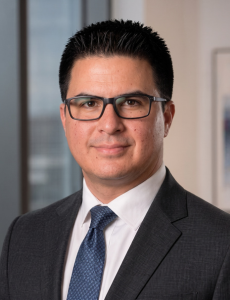
Israel Arrieta
Senior Maintenance Manager at TruStile Doors
Senior Maintenance Manager at TruStile Doors and Maintenance & Reliability Leader

Ryan Condon
Head of Content
Podcast Host and Head of Content of Comparesoft.

Prasanna Kulkarni
Founder, Product Architect & CEO
Product Architect and Founder of Comparesoft.

Latest Maintenance Podcast Episodes
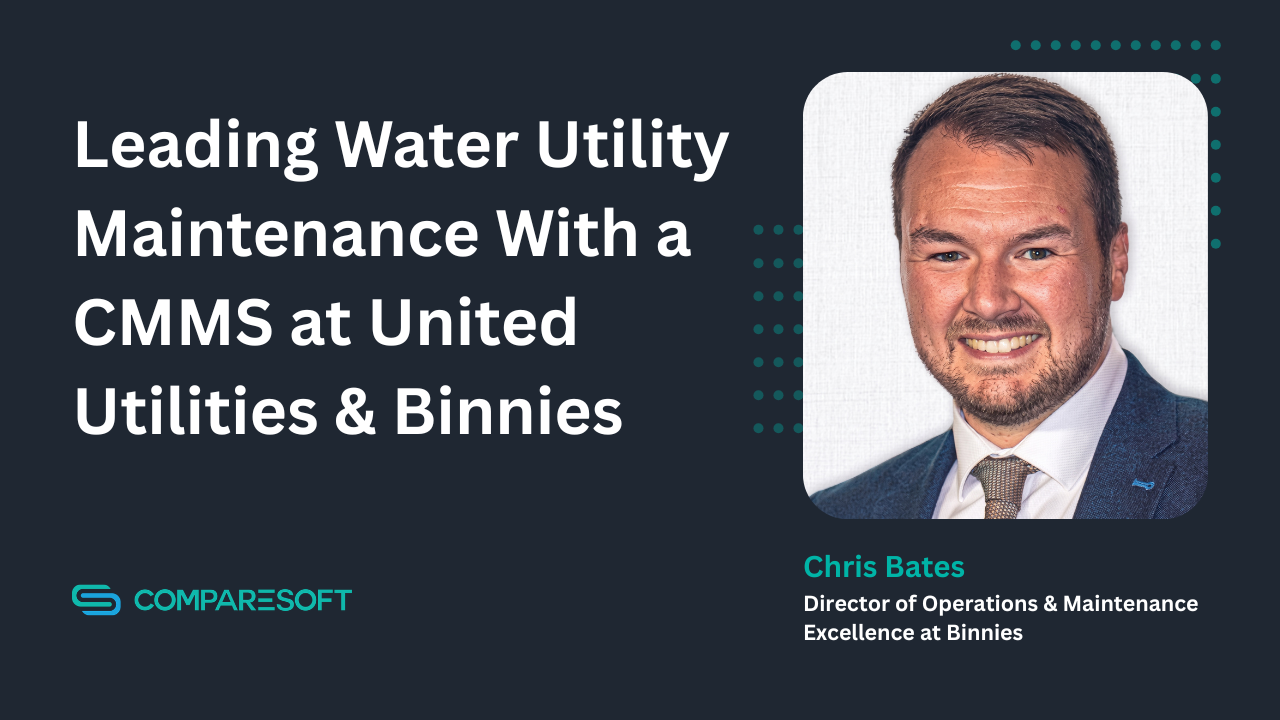
Leading Water Utility Maintenance With a CMMS at United Utilities & Binnies
Chris Bates, Director of Operations and Maintenance Excellence at Binnies, explains what water utility maintenance management really takes, discussing the CMMS requirements matter more than the system, how to select and implement a CMMS in a regulated environment, how to win technicians over & where AI fits in the water sector.
Listen and Watch the Podcast →
From Jet Engines to Runways: Airport Maintenance Management at MAG
James Ayre, Asset Management Director at Manchester Airports Group (MAG), explains what airport maintenance management takes at the UK’s largest dedicated cargo hub. After 20 years at Rolls-Royce, James oversees more than 220,000 assets across Manchester, London Stansted and East Midlands.
Listen and Watch the Podcast →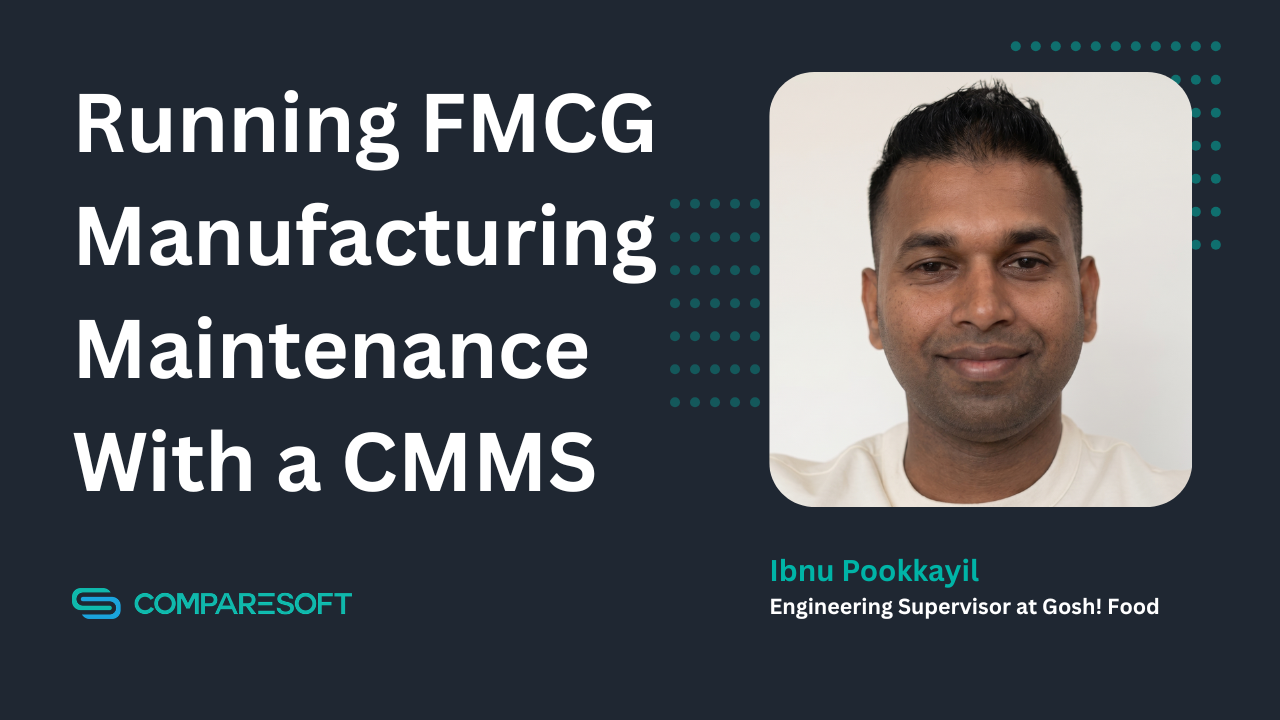
Running Maintenance in FMCG Manufacturing With a CMMS
Ibnu Pookkayil, Engineering Supervisor at Gosh! Food shows what running maintenance in FMCG manufacturing actually involves, explaining how his team cut reactive work below 20 per cent, why perishable products raise the cost of downtime, and how a CMMS underpins planned maintenance.
Listen and Watch the Podcast →Find the Right CMMS Software for MTO Maintenance Management
Quickly find the CMMS software that matches your asset mix, your critical-asset and condition-based maintenance strategy, and the uptime standards a 24/7 custom operation is held to.