
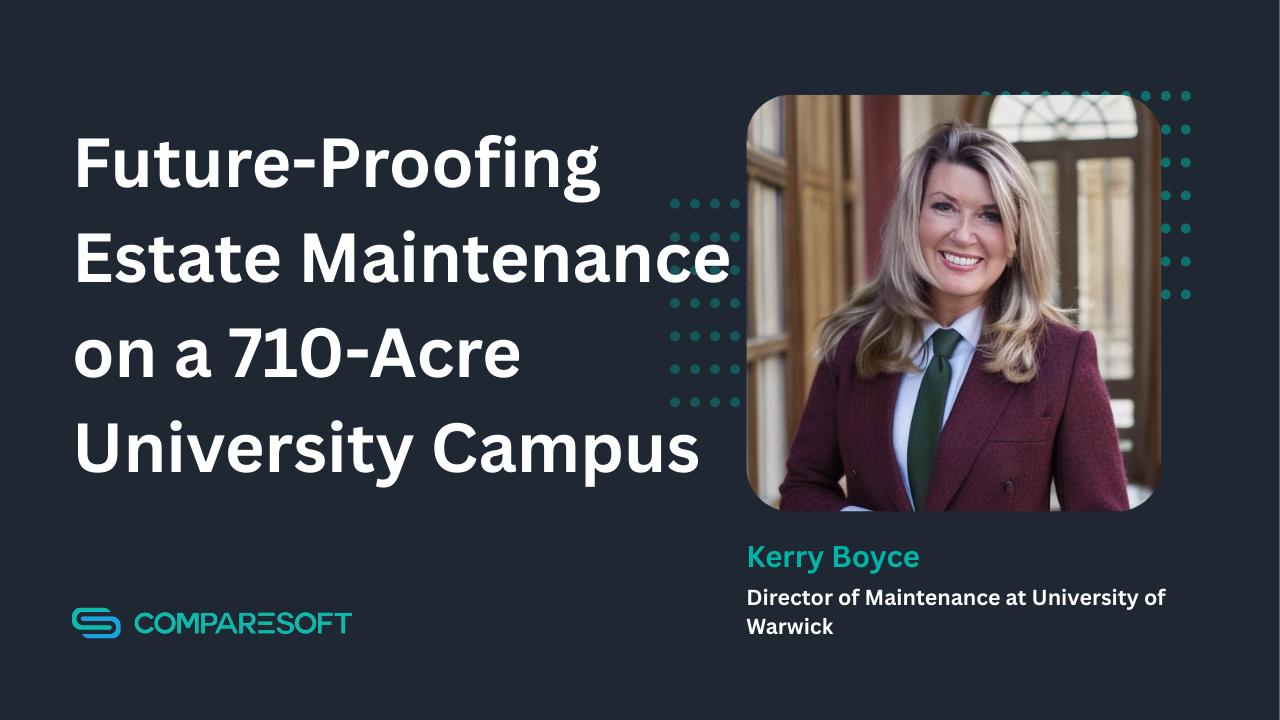
Future-Proofing Estate Maintenance on a 710-Acre University Campus
Kerry Boyce, Director of Maintenance at the University of Warwick, draws on a career spanning utilities, Transport for London, and the Royal Opera House to share what it takes to maintain a 710-acre university campus with over 500 buildings and a million-plus education assets.
In this episode
- Why University Campus Maintenance Is Unlike Any Other Sector
- Building Asset Visibility Across a 710-Acre Estate
- Maintaining a Major Campus on a Constrained Budget
- Asset Lifecycle Management: Repair, Refurbish, or Replace?
- Building a Culture Around Lifecycle Thinking
- Designing PPM That Supports Lifecycle Strategy
- Recognising When Maintenance Is Becoming Unsustainable
- Three Actions for Moving From Reactive to Lifecycle-Led Maintenance
- Future-Proofing the Estate as a Strategic Asset
- Full Transcript
Why University Campus Maintenance Is Unlike Any Other Sector
Unlike a transport network or a performance venue, a university is a 24-hour living environment. Students call it home for three years. Research laboratories demand precise environmental controls. Teaching spaces must be safe and accessible around the clock. And all of these systems must operate simultaneously, reliably, and without disruption to academic life.
Kerry’s perspective is clear: the only way to manage a campus of this scale is to treat it as a small city. Academic buildings, student residences, laboratories, sports facilities, theatres, and infrastructure networks are all interdependent. The complexity lies not just in the number of assets, but in how they interact, and in the consequences when they don’t.
Higher education also presents challenges that transport and venue environments do not. Kerry had not managed residential accommodation before joining Warwick. The responsibility of making students feel safe and at home added a dimension that required a genuine shift in perspective.
Building Asset Visibility Across a 710-Acre Estate
When Kerry joined the University of Warwick, her first priority was understanding what the estate actually owned, its condition, its criticality, and how its assets interacted with each other.
She approached this through three parallel activities: achieving asset visibility, assuring statutory compliance, and engaging directly with her maintenance team. No desktop review alone was sufficient. Getting out across the estate, walking through buildings with faculty members, and understanding the research happening inside each facility was essential. An asset that might appear low-priority on a spreadsheet could turn out to be critical infrastructure supporting externally funded research.
Her maintenance team, with deep institutional knowledge of how buildings behave, where faults recur, and where risks lie, was treated as a primary source of intelligence from day one. The goal in those first months was not to change everything immediately, but to build a clear and honest picture of the estate and create confidence in a direction of travel.
Maintaining a Major Campus on a Constrained Budget
Like every university in the sector, the University of Warwick operates under real financial constraints. Kerry’s approach to budget prioritisation is built on three lenses, applied in sequence: safety and compliance first, operational resilience second, and student and academic experience third.
Within those parameters, strong asset lifecycle management becomes the mechanism for stretching investment further. The goal is not to spend as much as possible, but to spend intellectually, identifying which assets can be sweated further and which represent unacceptable risk if left without intervention. As Kerry puts it, good maintenance is not about spending money; it is about spending it in the right places.
Asset Lifecycle Management: Repair, Refurbish, or Replace?
One of Kerry’s core areas of focus at Warwick is shifting the maintenance team’s thinking from task completion to asset lifecycle strategy. Rather than defaulting to replacement, the question she asks is always: can this asset be repaired, refurbished, or repurposed sustainably?
The decision-making framework she applies draws on asset history, maintenance records, failure trends, and criticality ratings. High value does not automatically mean high priority for replacement. What matters is whether an asset, at its current condition, is impeding research, impairing teaching, or creating compliance risk. Without that data, decisions become reactive, and the operation becomes less efficient.
Data quality underpins everything. If an engineer replaces a component but does not update the system record, a gap is created that compounds over time. Kerry is direct about this: capturing asset data accurately and consistently is a professional engineering discipline, not an administrative burden.
Building a Culture Around Lifecycle Thinking
Changing how engineers think takes time, but Kerry has seen the results. Rather than issuing directives, she has focused on helping the team understand why data capture, failure trending, and lifecycle analysis matter. When engineers see the full journey of an asset decision, and understand the cost and risk implications, they start to take ownership.
That cultural shift is already producing results. Engineers are proactively conducting trending analysis, building cost cases, and presenting options for asset lifecycle replacement. On a state of this scale, that distributed ownership is not a nice-to-have; it is essential.
Designing PPM That Supports Lifecycle Strategy
Kerry’s approach to planned preventative maintenance is anchored in asset criticality and lifecycle strategy. Critical systems require structured, disciplined maintenance regimes. Lower-risk assets may be maintained reactively, with their lifecycles sweated appropriately. The key is building a balanced regime that concentrates resources where the impact on teaching, research, and compliance is greatest.
Simplicity and discipline are central to making PPM work at scale. Over time, well-intentioned complexity can undermine consistency. Keeping processes standard and straightforward makes it easier for teams to follow them accurately, and easier for data to drive the decisions that follow.
Recognising When Maintenance Is Becoming Unsustainable
The earliest warning sign, in Kerry’s view, is a reactive-to-PPM ratio that is trending in the wrong direction. When reactive maintenance starts to dominate the workload, it signals that something in the system is not working, whether that is ageing assets, staffing pressures, or a lifecycle strategy that needs attention.
Other indicators include a growing maintenance backlog, rising asset failure rates, and compliance risks beginning to emerge. When those trends appear together, the asset lifecycle strategy needs to be examined, and the causes, whether operational, structural, or resource-related, need to be identified and addressed.
Three Actions for Moving From Reactive to Lifecycle-Led Maintenance
For maintenance leaders in higher education looking to make the transition from reactive firefighting to a lifecycle-led approach, Kerry recommends three starting points:
- Understand your assets: Build your asset condition registers and critical asset lists. Do not be afraid of what the data reveals; knowing the true condition of your estate is the foundation for everything that follows.
- Prioritise compliance and safety: Demonstrating that safety and statutory obligations are being met builds institutional trust and creates the credibility to advocate for longer-term investment.
- Shift the conversation from tasks to lifecycle strategy: Stop talking about maintenance as a series of reactive jobs and start communicating in terms of cost, risk, and long-term asset value. That shift in language signals a shift in thinking, and it builds confidence at every level of the institution.
Future-Proofing the Estate as a Strategic Asset
The mindset shift required to future-proof an estate, rather than simply maintain it, starts with recognising that the campus is a strategic asset for the institution. Universities compete globally for students, academics, and research investment. The estate is not a cost to be managed, it is an environment where innovation, learning, and community must be able to thrive.
For Kerry, that means thinking beyond keeping systems running. It means creating conditions in which the university can do its best work, now and in the years ahead.
Full Transcript
Ryan (00:01): Kerry, it’s great to have you on the podcast. How are you?
Kerry Boyce (00:03): I’m really well, thanks. It’s great to be here, Ryan thank you for inviting me.
Ryan (00:07): So Kerry, you started in electrical engineering where you were designing substations and transmission infrastructure. How did that early exposure to high-risk, high-reliability systems shape the way you approach maintenance today?
Kerry Boyce (00:22): That’s a really good question, because it has really shaped how I think about things. Those systems operate in a high-risk, high-reliability environment, and that experience fundamentally shaped how I think about maintenance today. It taught me three things early on that I’ve lived by ever since.
The first is that safety and compliance are non-negotiable. When you’re dealing with critical infrastructure in the transmission and electricity world, you quickly understand that processes, standards, discipline, and maintenance are what protect people.
The second is that design and maintenance must be connected. Without those two being connected, reliability really suffers over time.
And the third is that data is king data matters. Good engineering decisions come from understanding how assets behave over their lifecycle. Even though the environment at the university is very different, I approach the estate with the same mindset: critical assets, disciplined maintenance, and a relentless focus on safety and reliability. For me, that’s the most important thing.
Ryan (01:36): It’s great that you can switch between completely different sectors but still carry the same fundamentals.
Kerry Boyce (01:40): Exactly that. The high-risk environment really did shape how I think about things today. My colleagues will tell you I’m always putting safety first safety comes above everything. I’m really quite thankful for how that shaped my career, because it gave me some very good fundamentals.
Ryan (02:07): You’ve had key roles across multiple utility projects and complex maintenance settings. How did those environments shape your approach to risk, maintenance discipline, and asset resilience? What lessons have stayed with you?
Kerry Boyce (02:21): Utilities taught me system reliability at scale a really big scale, early on. Transport taught me operational discipline and public safety, which was a critical role in understanding the protection of the public. And the Royal Opera House taught me something different again how a building becomes part of the performance, so every system must work seamlessly to make the audience experience truly flawless.
On the Underground, you’re maintaining infrastructure that millions of people depend on every day, so the tolerance for failure is extremely low. Maintenance planning has to be incredibly structured.
How all of that translates to the university is this: a modern campus is like a small city. It has residential, teaching, research, and cultural spaces, all operating seamlessly and simultaneously. The challenge becomes ensuring that infrastructure enables excellence.
Ryan (03:48): And you’ve touched on it there it’s like a small city. As Director of Maintenance at the University of Warwick, you’re responsible for a 710-acre estate, 500 buildings, thousands of student residents. When people hear ‘university maintenance’, they might often imagine classrooms and lecture halls. Can you describe the real scale and diversity of assets you’re responsible for?
Kerry Boyce (03:49): Approaching it as a small city has really worked for me. The Warwick estate has so many diverse buildings academic buildings, student residences, laboratories, sports facilities, infrastructure networks, theatres, and event spaces. It’s all in the public realm and it’s all critical. The complexity lies not just in the number of assets, but in their criticality to how the university functions and how they interact with each other.
Research labs, for example, require very different environmental controls compared to residential accommodation or teaching spaces. But all of them and I’ll always come back to this must be safe, reliable, compliant, and adaptable, while supporting a world-class academic environment. The only way to run a campus like this is to treat it as a small city, where all the infrastructure is important and everything relies on everything else.
Ryan (05:40): What did your first 90 days look like in this role? It’s such a big undertaking. What data were you collecting, and what maintenance decisions were you prioritising?
Kerry Boyce (05:49): The first 90 days is critical in any role, but especially when jumping from sector to sector. This was my first venture into higher education. My first priority was understanding the estate through data and people, and that meant three parallel activities.
The first was achieving asset visibility understanding what we actually own, its condition, and its criticality. That was crucial. The second was compliance assurance understanding statutory maintenance regimes and safety standards, and making sure they were robust and transparent. The third was engaging with my maintenance team. I have a really good team whose technical ability is second to none, and they hold an enormous amount of knowledge about how the buildings behave, where the failures are, and where the risks lie.
My aim in those first few months was not to change everything immediately, but to build a clear picture of the estate and create confidence in our direction.
Ryan (07:10): How did you undertake the asset visibility process? With so many assets across that campus, what was the process to really get them under control?
Kerry Boyce (07:16): I spent the first couple of weeks getting a desktop understanding of the campus. But then it was really about getting out and about on the estate going out with the teams, visiting different faculty members. I might have a perception of what a faculty does, but visiting them and understanding their specific challenges beats any desktop study.
Visiting faculties and understanding their research requirements helped me understand what our critical assets were, what the critical asset lists looked like, and how those assets interacted with each other. Something I might not initially rate as critical could turn out to be essential infrastructure supporting funded research and therefore absolutely deserving of a critical asset rating.
It was definitely about boots on the ground. I love getting out amongst the team and the estate. Seeing our students using the facilities is really important to me too seeing how they interact with the spaces.
Ryan (08:38): You get a real understanding of how each facility and each asset is actually being used.
Kerry Boyce (08:43): Exactly what it’s actually used for and how that’s changed over time. How our students today use our spaces is quite different from when I was at university. It’s good to watch that in action.
Ryan (09:05): And as this was your first time in higher education, what would you say are the biggest operational challenges unique to this sector compared to your previous roles in transport and venues?
Kerry Boyce (09:22): It’s interesting, because we operate 24 hours a day across very different environments. The London Underground did shut down for engineering hours, but the university never really does because students are living here. It’s their home for several years. We’ve got campus events, theatre spaces, and residential accommodation all running around the clock. Understanding that 24-hour reality was one of the biggest early challenges.
We also have cutting-edge laboratories here, with world-class research happening that places very specific demands on our infrastructure. Coming from an engineering background, I find that amazing but it also means we need to continuously adapt our infrastructure to meet those research requirements.
And I had never had residential accommodation under my remit before. That was a significant change. These are people’s homes for three years. They’ve come here to study, and we need to make that environment welcoming, safe, and suited to their needs.
Ryan (11:23): Universities don’t have unlimited capital, so budget constraints are always going to be a challenge. How does a constrained budget change the way you prioritise maintenance?
Kerry Boyce (11:40): Prioritisation is essential, and it comes back to the three lenses I work with: safety and compliance first, operational resilience second, and student and academic experience third. Safety will always come first, but within that I need to prioritise the assets that support critical teaching and research activities.
When budgets are constrained, strong asset lifecycle management becomes really important. You need to extend asset life while maintaining reliability. Good maintenance is not about spending money it’s about spending intellectually. That’s where we have to really hone in on where every pound goes.
Ryan (12:52): Staying with asset lifecycle management something you’re really passionate about you’ve spoken about the importance of reuse, refurbishment, and repurposing rather than defaulting to replacement. What practical framework do you use when deciding whether to repair, refurbish, or replace an asset?
Kerry Boyce (13:04): It’s something I’m really passionate about, and the team is increasingly doing a lot more refurbishment work now. The decision really has to come from looking at the asset history, the maintenance history, the failure trends, and the criticality rating all of those things feed into the matrix that guides how you prioritise the funds you have. What assets can you sweat, and what assets can you not?
It might be high-value to replace an asset, but if it’s at end of its lifecycle or it’s impeding research or teaching, that information is critical to making the right call. Without it, you’re just being reactive and less efficient than you should be.
Data quality is fundamental here. When I’m looking at failure reporting and failure trending, the quality of that data has to be top-notch. Technology supports the culture and my engineers are starting to see that the asset data they capture today drives the decisions of tomorrow. When you take the time to explain that and demonstrate the full lifecycle journey, they really buy into it. It becomes part of what it means to be a professional engineer.
Ryan (14:43): And that’s you building a new culture getting your engineers to think in terms of asset life rather than just completing tasks.
Kerry Boyce (15:03): Yes, and that’s really starting to come to fruition. Just today, someone called me with an idea for an asset lifecycle replacement. They’d gone out, done all the trending analysis themselves, and came to me with a cost and a couple of different options. That’s exactly what I want to see.
On an estate this size, I can’t know everything. My team are my right hands. Having that engagement with them is vital I’m giving them a voice, giving them support, and they do know this stuff. They can make these decisions. And I am seeing that they are really joining in. I’ve got great aspirations for what we’re going to achieve with the refurbishment of the estate.
Ryan (15:48): That must feel like a really proud moment.
Kerry Boyce (16:02): It really does. We’re going to be doing some really good work.
Ryan (16:14): You mentioned how important it is to have the right data. How do you ensure that the data in your system is reliable enough to drive decisions?
Kerry Boyce (16:27): A lot of it comes from knowledge and experience. Data has evolved enormously over my career, and having that base knowing what we can do with good data has really shaped me. But for me, the practical side is about seeing the trends, the patterns, the recurring faults, and tracking ageing components and performance degradation.
Those insights are what allow us to move from reactive to predictive. Instead of responding to failure, we start to anticipate it. That shift dramatically improves reliability and reduces long-term costs. A lot of it comes from knowledge, but also from thinking outside the box and not being afraid to try different approaches or look at data differently. Everyone has different ideas, and that’s valuable.
Ryan (17:40): We’ve touched on how you’re working to shift the culture towards reuse and prevention. What practical steps are you taking to design PPM that matches your lifecycle management goals?
Kerry Boyce (17:54): Asset criticality is central to PPM design. As long as your PPMs align with asset criticality and lifecycle strategy, you’re on the right track. Critical systems require structured, disciplined maintenance. Lower-risk assets may be maintained reactively you can sweat those assets where the criticality is low, and that’s okay.
You can’t change everything all at once. It’s about creating a balanced regime that concentrates resources where the impact is greatest on teaching and research spaces, on the areas where any failure really hurts the university.
The right data comes from discipline. Every engineer has to go out, capture the same data consistently, correct it, and load it into the system. If you change a part and don’t asset-tag it and update the system, you’re just creating gaps. And keep it simple over time, things can get overly complicated with the best of intentions. If you keep it disciplined, standard, and as simple as possible, teams can understand the data and use it to drive better decisions.
Ryan (19:58): As well as asset criticality, how do you decide which assets sit under PPM and which can remain reactive? Can it come down to time and budget as well?
Kerry Boyce (20:09): It really comes down to risk and criticality. Statutory compliance is non-negotiable that’s always your number one. You’re never going to move away from statutory compliance for safety-critical assets. Beyond that, it depends on the mean time to repair, the lifecycle strategy, and what the knock-on effect would be for the university if you were to sweat a particular asset. All of that plays into whether you invest in replacement or continue with reactive maintenance.
Ryan (20:59): Are there any early warning signs that tell you maintenance is becoming unsustainable?
Kerry Boyce (21:03): The clearest early warning sign is reactive maintenance starting to dominate your workload your reactive-to-PPM ratio. When that tips the wrong way, it’s not going to be sustainable. Other signs include increasing asset failures, a growing maintenance backlog, and rising safety and compliance risk. When anything starts to drift out of compliance, something isn’t working.
When those trends appear together, the asset lifecycle strategy needs attention. Something isn’t quite right maybe it’s staffing, maybe the use of the estate has changed. That’s what you have to examine.
Ryan (21:52): And once you recognise that it’s not sustainable, what steps do you take?
Kerry Boyce (21:58): The first thing I always do is keep a running track of my reactive-to-PPM percentage. That ratio week in, month in is my first indicator of where things are heading.
The second is monitoring critical asset failures. Once you have your critical asset list and condition data, you’re keeping a close eye on those assets. If they start failing more frequently, something is at risk.
And I always look at SLA performance. If the team is not meeting SLAs, you have to ask why. Is it a staffing or recruitment issue? Or are we fully staffed but the backlog is growing regardless? That tells you the problem isn’t resource it’s the maintenance regime itself. The reactive-to-PPM percentage is always my first port of call.
Ryan (23:25): Excellent. Kerry, we like to save the last few questions for your insights and advice for maintenance leaders. If a maintenance leader in higher education wants to move from reactive firefighting to a lifecycle-led strategy, what three actions should they take first?
Kerry Boyce (23:45): The first is to understand your assets. Achieve visibility and gather condition data build your asset condition registers and your critical asset list. Don’t be afraid of what that data reveals. That’s the starting point.
The second is to prioritise compliance and safety. That builds trust across your institution. As long as you’re demonstrating that safety and compliance are being managed well, you’ll start to build the confidence that allows you to think longer term.
The third is to shift the conversation from maintenance tasks to asset lifecycle strategy. Stop firefighting and let your institution know you’re thinking about the long-term cost and risk picture. That shift builds confidence at every level. It demonstrates that you’re not just there to react you’re thinking about the future of the estate.
Ryan (25:15): And what mindset shift is required to future-proof an estate, rather than simply maintain it?
Kerry Boyce (25:23): The estate has to be seen as a strategic asset for the institution. Universities compete globally for students, academics, and research investment, and the estate plays a major part in that. Our responsibility isn’t just to maintain buildings it’s to create environments where innovation, learning, and community can truly thrive. That’s what’s really important for a university estate.
Ryan (25:57): Kerry, you’ve been a brilliant guest. Thank you so much for sharing such practical insight and real-world experience of maintaining higher education facilities. I’m sure it will give maintenance leaders a much clearer view of what it takes to manage large estates or small cities, as you put it.
Kerry Boyce (26:13): Small cities yes, we’re changing it to small cities! Thanks, Ryan. That was really good. Thank you very much.
Ryan (26:18): Kerry, thanks so much again. And thank you all for listening we’ll see you on the next episode.
What Type of Maintenance Do You Perform?
Meet the Speakers
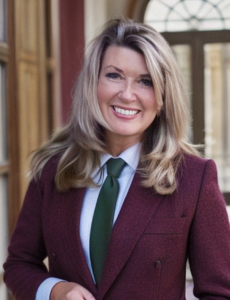
Kerry Boyce
Director of Maintenance at University of Warwick
Strategic estates and facilities leader with over 25 years’ experience across the UK and Canada. Currently Director of Maintenance at the University of Warwick, accountable for a £15m budget and 160+ staff.
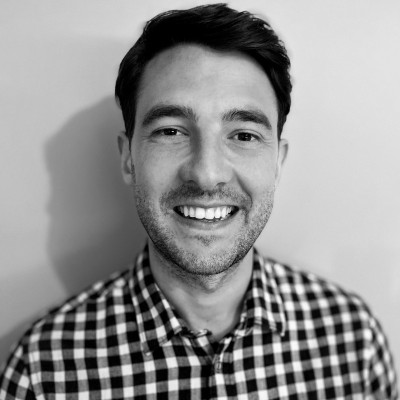
Ryan Condon
Head of Content
Content architect and strategist at Comparesoft, helping software buyers make confident decisions through purposeful, well-structured content. Podcast Host and Head of Content since joining the team in 2019.

Latest Maintenance Podcast Episodes
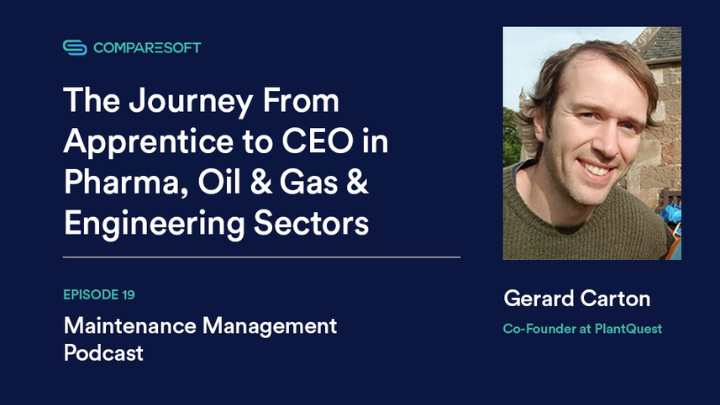
The Journey from Apprentice to CEO Via Pharma, Oil & Gas & Engineering Sectors
The CEO of PlantQuest, Gerard Carton, discusses the challenges faced in high-compliance environments in the Pharma, Oil & Gas, and Engineering Sectors and his journey from apprentice to CEO.
Listen and Watch the Podcast →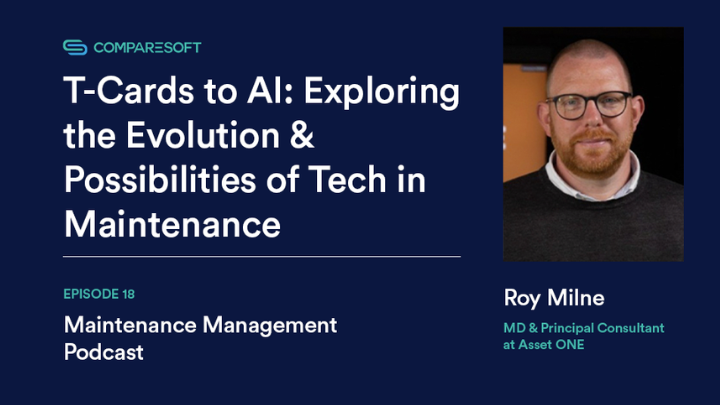
T-Cards to AI: Exploring the Evolution & Possibilities of Tech in Maintenance
Roy Milne, MD & Principal Consultant at newly-formed company Asset ONE, talks extensively about the progress and limitless capabilities of maintenance techniques and predictive maintenance strategies through the use of advanced technologies such as artificial intelligence.
Listen and Watch the Podcast →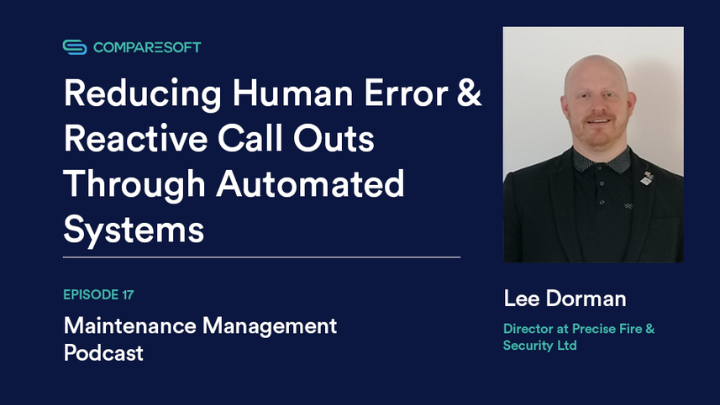
Reducing Human Error & Reactive Call Outs Through Automated Systems
Lee Dorman, Director at Precise Fire & Security Ltd, details the success of switching from pen and paper and spreadsheets to introducing an automated CRM system that has helped to eliminate human error and reduce reactive maintenance call outs.
Listen and Watch the Podcast →Find the Right CMMS for Your School or Campus
From K-12 schools to university campuses, no two facilities teams work the same way. Quickly find the maintenance management software that matches your team's size, workflows, and compliance needs — in just 40 seconds.