
Maintenance in Food and Beverage Manufacturing at Arla Foods
Josh Clarke, Senior Maintenance and Engineering Manager at Arla Foods' Aylesbury site, details the ins and outs of food and beverage manufacturing of a 24/7 dairy that produces 1.5 million bottles of milk a day and handles 500 to 700 work orders a week.

In this episode
- A Day in the Life of a Dairy Plant Maintenance Manager at Arla Foods UK
- How Arla Aylesbury Site Manages 500 to 700 Food and Beverage Work Orders a Week
- Why Run-to-Failure Has No Place in Food and Beverage Maintenance
- Running Food and Beverage Maintenance With No Shutdown Window
- What the Food and Beverage Sector Gets Wrong on Maintenance
- Building a Preventive Maintenance Culture in a Food and Beverage Plant
- Why Food and Beverage Plants Use to Spreadsheets Alongside a CMMS
- Maintaining Custom-Built Equipment in Food and Beverage Manufacturing
- Inside the 90% Downtime Reduction at Délifrance
- 3 Things That Separate Well-Run Food and Beverage Plants From the Rest
Unplanned downtime in food and beverage manufacturing is expensive, common, and largely avoidable. Industry studies put around 74% of food manufacturing downtime in the preventable category, with most plants still operating with OEE scores between 40 and 65%, well below the 85% world-class benchmark.
Josh Clarke, Senior Maintenance and Engineering Manager at Arla Foods’ Aylesbury site, has spent his career inside that gap. He runs maintenance at one of the world’s biggest dairy factories, a 24/7, 365 operation producing 1.5 million bottles of milk a day, and has previously delivered a 90% downtime reduction at Délifrance. In this episode of the Comparesoft CMMS Podcast, Josh sets out what daily maintenance actually looks like at that scale, why so many sites stay stuck in reactive mode, and what separates the well-run plants from the rest.
A Day in the Life of a Dairy Plant Maintenance Manager at Arla Foods UK
Aylesbury produces 1.5 million litres and 1.5 million bottles of milk a day, supported by around 100 robots, including 90 robotic forklifts in cold storage. With milk’s short shelf life, every decision Josh makes is tied to throughput.
“The most important part of my day is to deliver goods to our customers,” Josh says. “Milk being a short shelf life, it’s critical that we get it into site and out of site as quickly as possible, because our customers want the best shelf life. So all my day starts around that.”
After reviewing the last 24 hours and locking in today’s plan, his team steps onto the shop floor for what they call the golden hour. For Josh, this is non-negotiable.
“It’s the most important part of my day,” he explains. “Something will tweak my interest in the morning and I’ll be like, I want to dig a little bit more into this. You get to feel the shop floor and be with my own team as well as some of the operational teams. Being around people and being seen is a massive part of building a good cohesive team.”
It is a deliberate counterweight to the pull of the inbox. “We can get stuck in: I’m clearing emails, I’m in meetings, I’m too busy,” Josh adds. “The work’s done on the shop floor. I’m there to support them, not the other way around. Servant leadership, whatever you want to call it.”
How Arla Aylesbury Site Manages 500 to 700 Food and Beverage Work Orders a Week
Aylesbury manages between 500 and 700 work orders a week across the three departments Josh runs. The split between reactive, planned, and improvement work is something he is actively trying to shift.
“We have our reactives, and we’re really trying to drive the preventative and planned aspects of our roles now, as well as trying to build in some of the asset optimisation tasks,” he says. “We’re over-planning at the moment because, for me, we need to be always doing that little bit more planned work, that little bit more preventative, so our reactive does go down.”
That ambition is hard to deliver in practice. Josh argues that reactive work, by its nature, eats into the very capacity that would otherwise reduce it.
“The reactivity in your day-to-day work is almost a takeaway from what you should be doing, which is concentrating on the reliability, improving the systems, improving the site, and actually becoming more production resilient,” he explains.
Prioritisation runs through a dedicated engineering planning team built from inside the operation. “We’ve pulled from our operational departments to fill this role,” Josh says. “They understand it from their point of view, so they’re able to balance that operational requirement and what we’ve got. And they’re fantastic at finding what I would call opportunistic maintenance all around the site.”
Why Run-to-Failure Has No Place in Food and Beverage Maintenance
Run-to-failure has no place in Josh’s food and beverage maintenance strategy, even for the lowest-criticality assets. Not every asset gets the same treatment, but none gets ignored. Josh categorises assets as A, B, or C, with the level of intervention shifting accordingly. The discipline ties closely to how mature teams design their preventive maintenance programmes.
“I personally don’t think it’s okay to run something to the point of failure,” he says. “There’s assets that are more important than others, depending on what product lines they might be running. For me, there’s A’s, B’s and C’s. Our C category is not a run-to-fail category. It’s our lowest category, but for me they still have a very base level of maintenance. They might have inspections and checks rather than overhauls or part changes.”
The picture is dynamic. “As the market changes and industry changes, we might review that every now and again,” Josh adds. “Cs become Bs, or they might become As, depending on where our profits are coming from as a business. On any given day, any given week, it can change.”
Running Food and Beverage Maintenance With No Shutdown Window
Food and beverage maintenance at Aylesbury runs without the long annual shutdown that many plants rely on, because dairy production does not stop. Cows produce, customers expect, and shelf life is short.
“There’s multiple ways to do this,” Josh says. “In our energy centre, we run an N+1. So we’re able to shut down, overhaul and put back on, because utilities are all about 100% uptime. We have time-based shutdown within our processing department, where we shut down particular pasteurising lines or production lines for a day a week, depending on what it is.”
In production, the team uses what they call the maintenance rhythm, taking out a rotating line on the same day each week. Anything beyond that is opportunistic.
“We might have a quiet night, the sun’s out, not many people are drinking milk right now, so it’s a little bit quieter at site,” Josh explains. “We might have unplanned downtime on a line for demand reasons, and we’ll jump on that.”
The deeper principle is to size the work to the window. “We take that 10 hours of work and we chunk it up into five two-hour chunks, or it might even be 20 half-hour chunks,” he says. “That for me is just a different approach. We do it based on our demand and achieving our business goals.”
What the Food and Beverage Sector Gets Wrong on Maintenance
The food and beverage sector gets maintenance wrong by chasing production at the expense of the maintenance that protects production. With 74% of downtime classed as preventable and most plants sitting at 40 to 65% OEE, the gap to world-class is well documented. Josh’s view of why is direct, and it is not about technology.
“It becomes all about the production, and we need to get it out, we need to get it out,” he says. “Sometimes we need to do the maintenance to actually have a more beneficial effect on our production. You’re robbing Peter to pay Paul, so we get more production time, but actually we spend more time fixing things during that production time.”
The second mistake, in his view, is the appetite for glory projects: condition monitoring rollouts, vibration sensors, big-bang programmes pitched as cures. Worth doing, Josh says, but not first.
“My sole focus and my approach to being an engineering manager is just get the basics right,” he explains. “Have the maintenance, do the maintenance, and trust the maintenance. That’s how I see it.”
The proof, for Josh, comes from sites that started where most of the sector currently sits. “When I first moved to some of my sites I’ve worked on previously, we’ve been in that 40 to 60% situation, with downtime numbers of 50 to 60%. We’re spending over half of our time down for breakdowns.”
His way out was unfashionably small. “My approach has been: we just need to do one maintenance work order per day, one thing that’s preventative, which is going to stop a breakdown going forward. Then eventually that one becomes two, becomes three. We start to fight that fight.”
“I walked out of that site on my last day where we had less than 2% downtime and our OEE was well into the 90s,” Josh adds. “For me, that is the proof in the pudding. I didn’t do anything groundbreaking.”
Building a Preventive Maintenance Culture in a Food and Beverage Plant
Building a preventive maintenance culture in a food and beverage plant means moving the team from reactive habits to a planned rhythm, and that shift is rarely smooth. Josh is candid about how he started at one site where the maintenance schedule was, quite literally, a stack of paper on a desk.
“My first thing I did was throw it out in the bin,” he says. “There was literally a bin right next door. I swept it off the desk and I was like, I’m going to tell you what you’re going to be doing now. I ruffled a few feathers. Some people didn’t make the journey. They didn’t like the approach, didn’t like what I was doing. That’s fine.”
The people who stayed are now leading their own departments. The pattern, in his telling, is patience plus direction. “Being resilient, knowing what you want, having the patience: this is where I am and it’s hard, this is where I want to go, it’s going to take a while. Keeping your true north.”
He has little time for shortcuts. “Most businesses get it wrong. They want silver bullets to solve these problems. It’s just that slow methodical improvement. It might sound cliché, but it’s the continuous improvement methodology.”
Why Food and Beverage Plants Use to Spreadsheets Alongside a CMMS
Food and beverage plants revert to spreadsheets even with a CMMS in place because the software doesn’t fit the workflow they actually run. Around 70% of plants now run a CMMS or EAM, yet nearly half still report tracking maintenance partly on in-house spreadsheets. Aylesbury sits on SAP PM and Power BI, with citizen development layered on top, but Josh has seen the pattern repeatedly.
“People revert to those old ways on the Excel because that fits their process,” he says. “The tools we tend to implement from software companies, I’m not saying they’re not good, but they don’t fit the process that you’re trying to achieve.”
The implication for anyone choosing a system is to start with workflow, not features. The steps that protect a CMMS implementation start at exactly the same place. “If you’re going to introduce anything, it needs to be in order to make your process faster, quicker and more efficient,” Josh explains. “Sometimes we forget the purpose we’re serving when something’s fancy or has got a nice UI. That for me is where we fall down.”
Asked which capability he could not do without, his answer is unambiguous.
“Planning and scheduling for me is what it boils down to,” Josh says. “We’ve got a big pool of work. We’ve got a production plan. Now make him fit, particularly with a 24/7, 365 site. We need to make use of all the opportunities we have. It’s the little bit extra we’re doing: the half-hour downtime here, the quick fix there. That’s what’s helping us drive some of this performance.”
Maintaining Custom-Built Equipment in Food and Beverage Manufacturing
Maintaining custom-built equipment in food and beverage manufacturing requires a different sourcing and skills mix from off-the-shelf machinery. Aylesbury’s asset base includes equipment unique to the UK, built by manufacturers that no longer exist.
“Particularly in the dairy industry, there are some things that are unique to the UK and they don’t have them anywhere else in the world, particularly around our packaging,” Josh says. “My approach is to maintain our relationships with external partners. Some of my custom-built machinery, the manufacturers don’t exist anymore or have changed. So now, my approach is build in-house experts, but then also bring in the best from the outside.”
He calls them reliability projects, and they hinge on giving his own engineers room to investigate. “It’s using my own team, who are experts. Sometimes we’re the experts on the custom-built machines. We use them, we develop them, we maintain them. Get those guys and girls in my team, put them in place and say, look, you’ve got free rein. Go and figure this out for me.”
Inside the 90% Downtime Reduction at Délifrance
Before Arla, Josh ran engineering at Délifrance, where he inherited a site he describes as one of the worst-performing in the group, with a recently commissioned line already struggling. The headline result, a 90% reduction in downtime, did not come from a transformation programme. It started with a simpler instruction.
“It was more like stabilise,” Josh says. “I was getting calls in the middle of the night, things going wrong, customers getting shorted. That was my sole focus to begin with: stabilise, stabilise, stabilise. It took a while. I’m not going to lie, it took a while. It was tough, it was hard. I was learning, I was a baby engineering manager back then.”
Energy savings followed maintenance discipline, not the other way round. “I didn’t go into engineering thinking there was a sustainability approach to it. The sustainability approach came from doing good maintenance,” he explains. “If we change this, that would reduce our power consumption, and that reduction is going to make it more efficient and increase its service life. Particularly around the refrigeration side. Refrigeration is like 90% of our costs, particularly in the food industry, in terms of energy costs.”
The numbers eventually caught the attention of the finance team. “I’ve had accountants come rushing up to me before going, I think we’re being undercharged for electricity, what’s going on? And it’s like, let’s look at it and deep dive it. Well, this is when we did this project, and we see it drop down. You could start to correlate it. The correlation becomes cash, and the business is becoming more profitable.”
3 Things That Separate Well-Run Food and Beverage Plants From the Rest
Three things separate well-run food and beverage plants from struggling ones, in Josh’s experience.
The first is alignment. “One vision, one team,” he says. “Sometimes it can be so segregated into factions or silos that we forget what we’re all working for. When I’ve been on good teams and bad teams, that’s the thing that’s missing.”
The second is the maintenance principle he returns to throughout the conversation. “From a maintenance point of view, it’s have the maintenance, do the maintenance, and trust it. That for me is probably second.”
The third is throughput. “The priority of any business is to make money. That’s what we need to focus ourselves on: increasing throughput, knowing we need to be working towards that goal.”
Underpinning all three, Josh argues, is a refusal to stand still.
“It’s just that continuous improvement mindset,” he says. “You can be in any department or any discipline across the site, and if you’re not trying to get better or improve what you’re doing, if you’re just trying to survive, I don’t think that’s the right mindset. Good businesses die because they fail to change, or they fail to try something different or learn. That’s it for me. If that was one thing people want to take away.”
What Type of Maintenance Do You Perform?
Meet the Speakers

Josh Clarke
Senior Maintenance and Engineering Manager at Arla Foods
An experienced Engineering Leader, driving operational and financial improvements in challenging environments.

Ryan Condon
Head of Content
Podcast Host and Head of Content of Comparesoft, joining the team in 2019.

Latest Maintenance Podcast Episodes
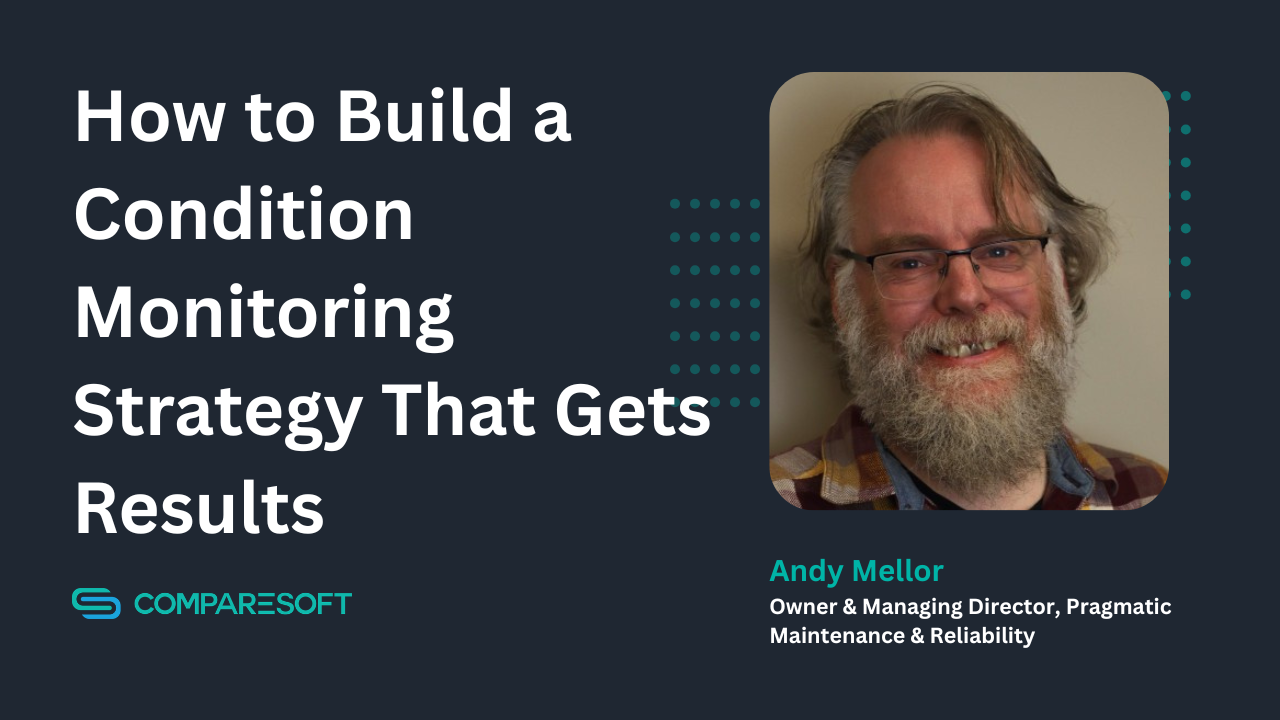
How to Build a Condition Monitoring Strategy That Gets Results
Andy Mellor explains what separates a condition monitoring programme that delivers measurable ROI from one that drifts into irrelevance. Former Plant Performance Engineer at British Steel, Andy, walks through the real reasons predictive maintenance fails and how engineers should present findings to plant managers.
Listen and Watch the Podcast →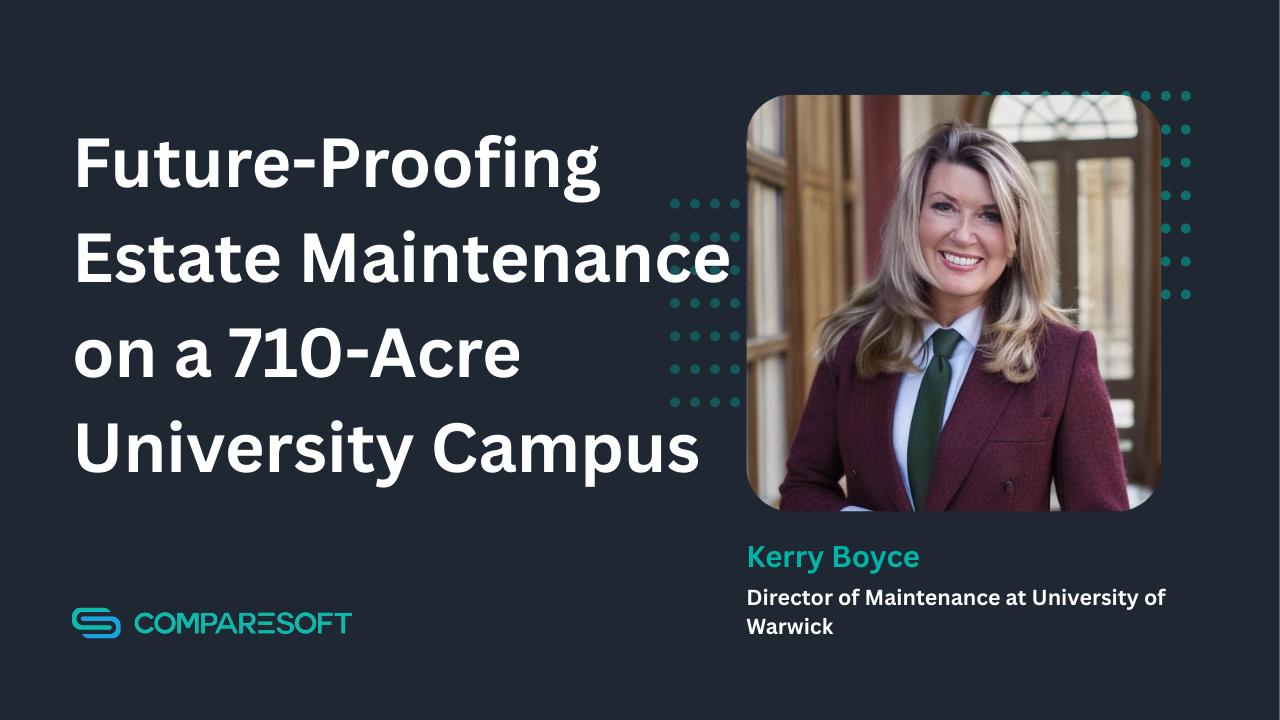
Future-Proofing Estate Maintenance on a 710-Acre University Campus
Kerry Boyce, Director of Maintenance at the University of Warwick, draws on a career spanning utilities, Transport for London, and the Royal Opera House to share what it takes to maintain a 710-acre university campus with over 500 buildings and a million-plus education assets.
Listen and Watch the Podcast →
The Journey from Apprentice to CEO Via Pharma, Oil & Gas & Engineering Sectors
The CEO of PlantQuest, Gerard Carton, discusses the challenges faced in high-compliance environments in the Pharma, Oil & Gas, and Engineering Sectors and his journey from apprentice to CEO.
Listen and Watch the Podcast →Find the Right CMMS Software for Your Food and Beverage Plant
From single-line dairies to multi-site processing operations, every food and beverage manufacturer runs maintenance differently. Quickly find the CMMS software that matches your production rhythm, compliance requirements, and planning workflows.