
GPS Asset Tracking Systems: What They Do, What They Cost & Which Ones Are Worth It
GPS asset tracking is straightforward in principle. You fix a GPS tracker to something valuable — a van, an excavator, a shipping container — and it tells you where that asset is, whenever you want to know. Most trackers run on their own battery, so there’s no wiring to worry about, and the location data lands in an app you can check from a phone or a desk.
Behind the app, a GPS asset tracking system does three jobs well: it shows you where things are in real time, lets you draw virtual boundaries and get alerted when assets cross them, and ties into your wider Asset Tracking Software so location isn’t a separate silo. For equipment managers, that solves three problems at once:
- Knowing where things are: Indoors and out, especially when trackers combine Wi-Fi and GNSS positioning.
- Keeping them safe: High-value kit is a theft target, and a tracker turns a total loss into a quick recovery.
- Seeing the whole picture: Every vehicle and piece of equipment on one map, in one app.
Because the hardware is cheap and the alerts are fast, this kind of tracking earns its keep in any industry with a lot of expensive kit on the move — construction, healthcare, transport, and logistics.
Easily shortlist GPS Asset Tracking Systems for the live, real-time tracking of vehicles and mobile equipment, preventing theft and improving visibility.
What Type of Assets Do You Want to Track?
How GPS Asset Tracking Actually Works
There are three key components to a GPS asset tracking system:
- First, the satellites — a constellation of roughly 24 to 32 GPS satellites circling the Earth about 20,200 km up.
- Second, the tracker itself, which is really just an antenna and a receiver that pull in signals from several satellites at once.
- Third, the software, which takes that transmitted data and plots it on a live map.
The clever bit is how a tracker works out where it is. It doesn’t ask one satellite; it listens to at least three or four at the same time and uses the tiny timing differences between their signals — a technique called trilateration — to pin down its latitude, longitude, elevation and the exact time. Fix a tracker to a piece of equipment, and that position gets sent straight to your tracking system.
The UK’s Best GPS Asset Tracking Systems
Itemit

A cloud-based tracker built for individuals, teams and departments who want to be up and running without a project plan. It’s genuinely self-serve (you can set it up yourself and start from £21 a month) and Itemit supplies its own GPS trackers for high-value assets, which you can assign across separate workspaces in a few minutes.
Industries: Construction, Healthcare, Trades, Domestic services, and Entertainment
Deployment: Cloud-based, Mobile App, Desktop
Visilion by Sony
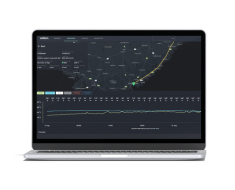
Sony’s Visilion is aimed squarely at supply chains. If you’re moving cargo that’s high-value, time-critical or sensitive to conditions, this is where it shines. You get precise location plus condition monitoring along the way. Pricing is a flat £20 per tracker per month, so costs scale cleanly with the number of things you’re tracking.
Industries: Logistics and distribution, Packaging, Construction, Automotive, and Consumer products
Deployment: Desktop, Tablet, Mobile
Timly

GPS tracking sits inside Timly’s professional plan, which starts at £445 a month. For that you get real-time tracking across multiple sites and teams, which makes it a fit for organisations with valuable assets that move around a lot and get reallocated quickly.
Industries: Government, Education, Engineering, Construction, Manufacturing, and Recreation
Deployment: Cloud-based, Mobile app, Desktop
Lime
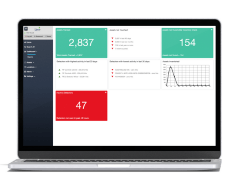
Lime is the option for complicated operations — lots of mobile assets, layered workflows, the works. Its auto-scanned tracking zones keep location data accurate at scale. Worth noting: it’s pitched at organisations with a first-year budget of at least £25,000, so it’s not a starter system.
Deployment: Cloud-based, Mobile app, On-premise, Desktop
Assettrac
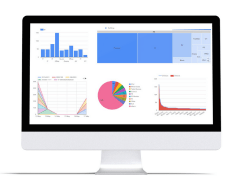
Assettrac leans on GPS to drive location- and status-based reporting, and it comes as a full package: hardware (the GPS trackers) and software together, implemented for you. Pricing starts from £2,500 a year.
Industries: Healthcare, IT, Education, Government, and Domestic services
Deployment: Cloud-based, web-based (desktop)
Shortlist the UK’s best GPS Asset Tracking Software products
What Type of Assets Do You Want to Track?
What Does a GPS Asset Tracking System Cost?
There’s no single price tag for a GPS asset tracking system, because the total depends on four things:
- Type of hardware needed
- How many assets you’re covering
- How much software functionality you want
- How much implementation help is involved
On hardware, individual trackers run from about £50 to £200. What pushes a tracker up that range is durability, battery life and features like real-time reporting, geofencing and motion alerts. Rugged, weatherproof and solar-powered units sit at the top end; plain battery-powered ones are the cheap seats.
The software is almost always a subscription. Expect roughly £5 to £15 per tracker or user each month, though some providers price differently. Visilion by Sony, for instance, charges a flat rate per device. That subscription usually bundles the platform and the app together, and onboarding tends to be quick.
For small businesses, self-service systems like Itemit or EZOfficeInventory start around £21 a month and give you the core tracking, the mobile app and support without a complicated setup. Mid-sized operations usually pay a bit more for extras like usage reporting, maintenance scheduling, geofencing. Larger enterprises go the other way, negotiating volume discounts alongside custom integrations, API access and multi-user setups.
The sticker price can look steep at first, but it’s worth weighing against the payback. Among GPS tracking users, 31% reported a positive ROI within the first six months, and that’s before you factor in avoided theft losses.
Four Features That Make GPS Asset Tracking Worth It
1. A Mobile App That Shows You Everything, Live
Because these systems are cloud-based, you can check assets from the office, a job site or a train. Log in on a phone or tablet and you’ll see location, running time, idle hours and how heavily each asset is being used.
That last bit matters more than it sounds. Ppotting kit that’s barely used tells you what to redeploy or retire, and knowing run-time tells you when to service something before it fails.
2. Geofencing
Draw a virtual boundary around a site or zone, and the system pings you the moment an asset crosses it when it shouldn’t. It’s one of the more useful features for theft prevention and for keeping tabs on multi-site work. You find out something’s left before anyone notices it’s gone.
3. Movement and Usage Alerts
Beyond boundaries, you can get notified about the things that usually signal a problem: an engine starting outside working hours, a machine that’s been idling far too long, unexpected movement overnight. Catching those early is the difference between a quick phone call and a written-off asset.
4. Hardware Built to Last
Trackers are made for rough lives. They’re sealed, shock-resistant casings that keep transmitting through rain, dust, vibration and temperature swings. On a construction site or in the back of a lorry, that reliability is the whole point.
How Hard Is GPS Asset Tracking To Set Up?
Not very, honestly. The barriers are low: pricing scales with what you need, the software is third-party and ready to go, and the trackers themselves are designed to be fitted in minutes. You stick them on with industrial adhesive, clamp them with a magnetic base, or bolt them down. Since most run on internal batteries, there’s usually no wiring at all.
How long the battery lasts comes down to the model and how often it reports. A basic tracker will do 2 to 3 years; a more advanced one with motion sensing or a solar panel can stretch to 5 to 7. If you’d rather not think about batteries, some units hardwire into a vehicle or machine for continuous power.
On price, you’re back to that £50–£200 per tracker range, depending on whether you need real-time reporting, tamper alerts or extra ruggedisation. Nearly every provider ships a mobile and desktop app with guided setup and rollout support, so getting a fleet live is a fast job rather than a project.
Types of GPS Trackers and When to Use Each
GPS trackers come in several types, each suited to different asset tracking needs. They include:
- Battery-Powered Trackers
- Hardwired Trackers
- OBD Trackers
- Solar-Powered Trackers
- Portable Trackers
- Bluetooth Asset Tags
Each has its own unique capabilities that are used for different processes, as displayed in the comparison table below:
Tracker Type | Power Source | Typical Use Case | Installation | Battery Life / Power |
|---|---|---|---|---|
| Battery-Powered | Internal battery | Trailers, containers, mobile equipment | Adhesive, magnetic, or bolted on | 6 months to 7 years (depending on use) |
| Hardwired | Vehicle or machine power | Vehicles, heavy equipment | Wired into ignition or battery | Continuous (vehicle-powered) |
| OBD Trackers | OBD-II port power | Light commercial vehicles | Plug-and-play into OBD port | Continuous while vehicle is on |
| Solar-Powered | Solar panel + internal battery | Remote or infrequently used assets | Mounted on asset surface | Long-term with sufficient sunlight |
| Portable Trackers | Rechargeable battery | Temporary tracking, valuables in transit | Carried or attached with clip | A few days to weeks |
| Bluetooth Asset Tags | Coin cell battery | Indoor or short-range tracking | Attached via adhesive or strap | 6–24 months |
The short version: battery and solar trackers for things without their own power, hardwired and OBD for vehicles, portable units for one-off jobs, and Bluetooth tags when you only need to find something indoors.
Three Cases Where GPS Tracking Earned It’s Keep
1. World Trade Center Cleanup Project
GPS tracking technology played a vital role in the debris removal project at the World Trade Center site.
GPS systems were used to track thousands of truckloads of debris leaving Ground Zero, ensuring accurate documentation, security, and efficiency. This included 200 vehicles, responsible for removing 1.8 million tonnes of material.
By equipping trucks with GPS and integrating tracking data, the team prevented unauthorised dumping, validated haul routes, and enhanced coordination.
2. British Gas Trimming It’s Fleet
British Gas achieved a strong return on investment (ROI) by implementing a GPS fleet tracking system. It cut its fleet size by 10% and saved £14 million over five years. These savings were driven by improved vehicle utilisation and route optimisation.
The system also enabled more accurate ETAs for customers, increasing customer satisfaction.
3. Eastern Distribution Recovering Stolen vehicles
Eastern Distribution significantly reduced vehicle theft by implementing GPS tracking across its fleet. The system enabled real-time location monitoring, allowing stolen vehicles to be recovered within hours.
Over time, the presence of GPS acted as a theft deterrent, lowering the frequency of incidents. As a result, the company benefitted from reduced insurance premiums.
GPS vs. RFID vs. Barcode
GPS isn’t always the answer. Sometimes RFID or a plain barcode does the job for a fraction of the cost. It comes down to how far you need to track, how tough the tag has to be, and what you’re willing to spend.
Technology | Hardware Cost | Durability | Range | Battery Life |
|---|---|---|---|---|
| GPS Trackers | £50 to £200 per device | High: Often weatherproof and rugged | Unlimited (via satellite/cellular) | 6 months to 7 years (or continuous if hardwired) |
| RFID Tags | £0.10 to £10 per tag | Medium to high: Some rugged options | Up to 100 metres (active RFID), few cm (passive) | Passive: none required; Active: 6 months to 2 years |
| Barcodes | £0.01 to £0.10 per label | Low: Susceptible to wear and damage | Line-of-sight only, typically <1 metre | No battery required |
If you need to know where something is anywhere in the world, GPS is the only one of the three that can tell you. If you just need to scan items in and out of a warehouse, barcodes or RFID will save you a lot of money. Most real operations end up using a mix.